
New Labour Law in India: What the 4 Labour Codes Mean for Employees and Employers
India’s labour laws are going through the biggest transformation in decades. With the introduction of four consolidated labour codes, the country has moved away from a complex web of outdated regulations toward a simpler and more unified framework. These
changes directly affect employees, employers, startups, and large organisations across sectors.
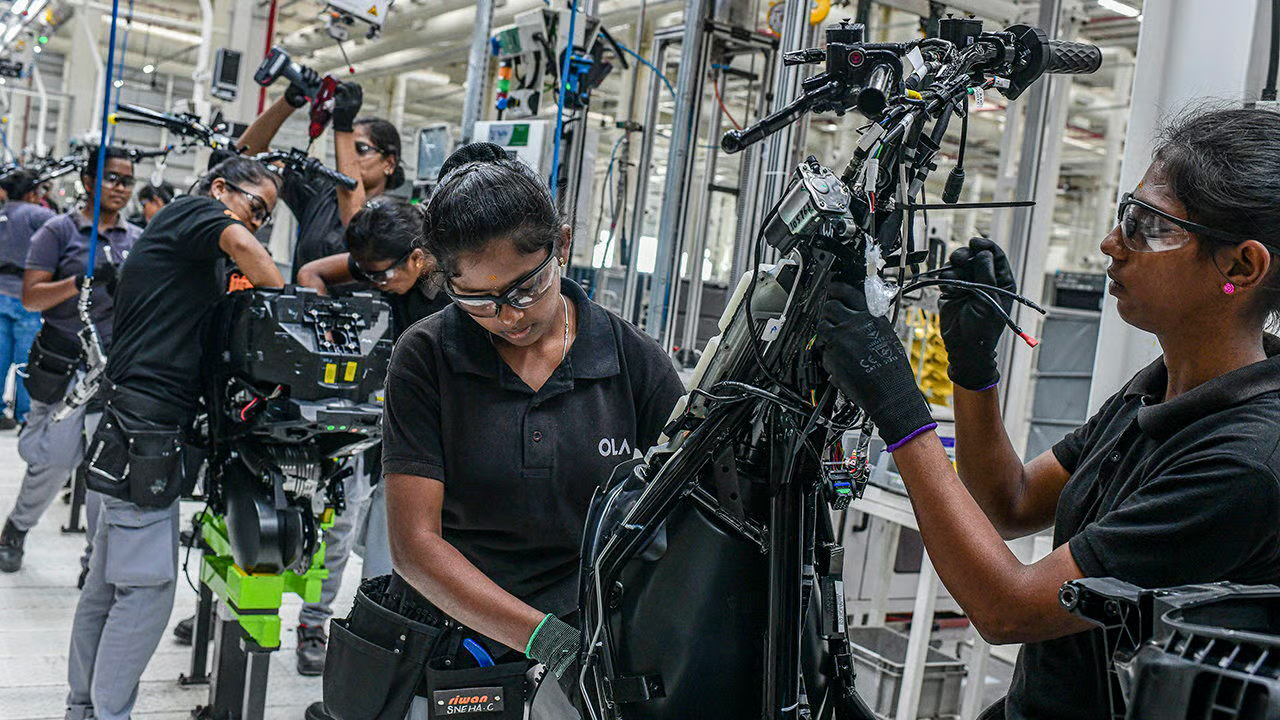
The new labour law framework, introduced by the Government of India, aims to protect worker rights while improving ease of doing business. It also reflects how India’s workforce is changing with the rise of gig work, technology-driven jobs, and formalisation
of employment.
Why India Introduced the New Labour Law
Earlier, India had nearly 29 central labour laws, many of which overlapped or contradicted each other. This made compliance difficult for employers and created confusion for workers about wages, benefits, and safety standards. Enforcement was inconsistent,
and a large section of the workforce remained outside formal protection.
The new labour law reforms consolidate these laws into four clear codes. The goal is to simplify compliance, improve transparency, and extend social security benefits to more workers, including those in the unorganised and gig economy.
The Four Labour Codes Explained
1. Code on Wages
The Code on Wages standardises wage-related rules across industries. It introduces a uniform definition of wages and ensures timely payment to workers. The concept of a national floor wage has also been introduced, setting a minimum benchmark that states
must follow.
For employees, this means greater clarity and fairness in salary structures. For employers, it reduces ambiguity in payroll calculations and compliance requirements.
2. Industrial Relations Code
This code deals with trade unions, dispute resolution, and rules around hiring, retrenchment, and closures. It simplifies industrial dispute mechanisms and defines clearer thresholds for layoffs in large establishments.
While the code is expected to improve industrial efficiency, trade unions have expressed concerns about job security and easier retrenchment norms.
3. Social Security Code
One of the most important reforms is the expansion of social security coverage. The Social Security Code brings gig workers, platform workers, and unorganised sector employees under the formal social security system for the first time.
Benefits related to provident fund, insurance, pension schemes, and maternity support are expected to reach a much wider workforce, helping formalise employment in India.
4. Occupational Safety, Health and Working Conditions Code
This code merges laws related to workplace safety, health, and working conditions across factories, mines, construction sites, and other establishments. It sets uniform safety standards and strengthens employer responsibility for worker well-being.
Employees benefit from stronger legal protection, while employers must ensure safer and healthier work environments.
Impact of the New Labour Law on Employees
For workers, the new labour law brings several advantages, including clearer wage rules, expanded social security, and improved workplace safety. Gig and contract workers gain formal recognition and access to benefits that were previously unavailable.
However, some employees remain concerned about job stability, especially in sectors where hiring and retrenchment rules have become more flexible.
What Employers Need to Prepare For
Employers benefit from simplified compliance through digital registration, unified returns, and reduced paperwork. At the same time, businesses must review salary structures, HR policies, and compliance systems to align with the new definitions under
the labour codes.
Proper implementation is essential, as penalties for non-compliance still apply under the new framework.
Concerns and Ongoing Debate
Trade unions and labour organisations have raised concerns that the new labour law favours employers, particularly in matters related to layoffs and contract labour. Protests and discussions continue as states work on framing detailed rules.
Since labour is a concurrent subject, implementation may vary across states, especially in the initial stages.
Conclusion
The new labour law in India marks a major shift in how employment is regulated. By consolidating laws into four comprehensive codes, the government has laid the foundation for a modern, transparent, and adaptable labour system.
For employees and employers alike, understanding these changes is crucial. How effectively the labour codes improve worker welfare and business efficiency will depend on balanced enforcement and awareness in the years ahead.