[india_weather]

Delhi Sultanate History: Dynasties, Rulers and Administration
In 1206, a Turkish general who had begun life as a purchased slave became the ruler of Delhi. Qutb-ud-din Aibak’s accession is the usual starting point of Delhi Sultanate history, a period of 320 years in which five dynasties ruled from Delhi until Babur’s victory at Panipat in 1526. Their coins, buildings, taxes and court language shaped North India long after the last sultan died.
Quick Facts
| Period | 1206 to 1526 |
|---|---|
| Founded by | Qutb ud-din Aibak |
| Capital | Delhi |
| Five dynasties | Mamluk (Slave), Khalji, Tughlaq, Sayyid and Lodi |
| Ended | 1526, when Babur defeated Ibrahim Lodi at the First Battle of Panipat |
| Followed by | The Mughal Empire |
For students, the Sultanate is the bridge between the early kingdoms that followed the Gupta Empire and the Mughals. Most exam questions on it come down to a few things: who founded it, the order of the dynasties, the reforms of Alauddin Khalji and Muhammad bin Tughlaq, and how it ended.
Who established the Delhi Sultanate?
Qutb-ud-din Aibak established the Delhi Sultanate. He was a Turkish slave (mamluk) who rose to become one of the most trusted commanders of Muhammad Ghori, the ruler from Ghor in present-day Afghanistan.
Ghori’s victory over Prithviraj Chauhan at the Second Battle of Tarain in 1192 opened the Ganga plains to his armies. He did not stay in India to rule. Instead he left his conquests in the hands of slave commanders, with Aibak in charge of the Indian territories. Aibak began the Quwwat-ul-Islam mosque in Delhi, which an inscription says was built with material from 27 demolished Hindu and Jain temples, and began the Qutb Minar beside it.
When was the Delhi Sultanate established?
The Delhi Sultanate is dated from 1206. That year Muhammad Ghori was assassinated, and with no strong heir in Ghor, Aibak became an independent ruler of the Indian conquests. He ruled mostly from Lahore, but Delhi soon became the permanent capital, which is why the state is named after it.
Aibak’s reign was short. He died in 1210 after a fall from his horse while playing chaugan, a form of polo. The real work of building a stable state was left to his successor.
The five dynasties of the Delhi Sultanate
Five dynasties ruled in turn. The dates below are the ones used in most Indian textbooks.
- Mamluk or Slave dynasty: 1206-1290
- Khalji dynasty: 1290-1320
- Tughlaq dynasty: 1320-1414
- Sayyid dynasty: 1414-1451
- Lodi dynasty: 1451-1526
The first four were of Turkish origin; the Lodis were Afghans. The Tughlaqs ruled the longest and, under Muhammad bin Tughlaq, controlled the largest area.
Mamluk dynasty (1206-1290): Iltutmish, Razia and Balban
Iltutmish (1211-1236), Aibak’s son-in-law and another former slave, is often called the real founder of the Sultanate. He defeated rivals such as Yildiz of Ghazni and Qubacha of Multan and Sindh, and in 1229 received a letter of investiture from the Abbasid Caliph, which gave his rule religious legitimacy. He introduced the silver tanka and the copper jital, the two basic coins of the Sultanate, and completed the Qutb Minar.
Iltutmish also had to deal with the Mongols. In 1221 Chinggis Khan reached the Indus in pursuit of Jalal-ud-din Mangbarni, the prince of Khwarazm. Iltutmish refused Jalal-ud-din shelter, and the Mongols turned back without entering the Sultanate.
He named his daughter Razia as heir. She ruled from 1236 to 1240, the only woman ever to sit on the throne of Delhi, but the Turkish nobles known as the Chahalgani (“the Forty”) turned against her and she was killed. After a period of weak sultans, including Nasir-ud-din Mahmud (1246-1266), real power passed to his deputy.
Ghiyas-ud-din Balban (1266-1287) broke the power of the Chahalgani, built up a spy network, and fought the Mongols and the Meos with what chroniclers called a policy of “blood and iron”. He presented the sultan as zil-i-ilahi, the shadow of God on earth, and introduced Persian court customs such as sijda (prostration before the ruler).
Khalji dynasty (1290-1320): Alauddin’s conquests and reforms
Jalal-ud-din Khalji took the throne in 1290 from the last weak successors of Balban. In 1296 his nephew Alauddin Khalji had him murdered and became sultan. Alauddin ruled until 1316 and is the Sultanate ruler students most need to know.
His armies took Gujarat (1299), Ranthambore (1301) and Chittor (1303), and then Malwa. His general Malik Kafur led campaigns deep into the south, against Devagiri, Warangal, the Hoysalas and the Pandyas, collecting tribute and treasure rather than annexing territory.
To pay a large army without raising salaries, Alauddin controlled prices in Delhi. There were separate markets for grain, for cloth and other costly goods, and for horses, slaves and cattle, each with fixed prices, government officials and spies to prevent hoarding and short weights. Soldiers were paid in cash, horses were branded (dagh) and soldiers’ descriptions recorded (huliya) to stop fraud at musters. Later chroniclers put his standing army at 475,000 cavalry, a figure historians treat with caution.
Alauddin also faced the heaviest Mongol attacks. His forces defeated them at Jaran-Manjur in 1298 and at Kili in 1299, and he strengthened the frontier and built Siri, a new fortified city in Delhi.
Tughlaq dynasty (1320-1414): ambition and collapse
Ghiyas-ud-din Tughlaq (1320-1325) founded the dynasty and built the fortress city of Tughlaqabad, whose sloping stone walls you can still walk along in south Delhi.
His son Muhammad bin Tughlaq (1325-1351) is remembered for bold plans that went wrong. In 1327 he moved the capital from Delhi to Daulatabad in the Deccan, forcing much of Delhi’s population to make the long march south, with heavy loss of life; within a few years the court returned. He issued bronze and copper token coins to be used at the value of silver, but they were easily forged and had to be withdrawn. A planned campaign towards Khurasan was abandoned, and an expedition into the Karachil (Kumaon-Garhwal) hills ended in disaster. By the end of his reign, rebellions had broken out across the empire.
Firoz Shah Tughlaq (1351-1388) took a different approach. He dug canals from the Yamuna and the Sutlej, and chroniclers credit him with founding towns such as Firozabad, Hisar and Jaunpur and laying out some 1,200 gardens. He also ran a hospital (dar-ul-shifa) and an office to help the poor arrange marriages. At the same time he extended the jizya to Brahmins, kept a huge establishment of slaves, and made iqtas hereditary, which weakened the centre.
In 1398 Timur invaded and sacked Delhi. Chroniclers say he had about 100,000 prisoners killed before the battle outside the city. The Tughlaqs never recovered.
Sayyid dynasty (1414-1451)
Khizr Khan, who had been Timur’s governor in Multan, took Delhi in 1414 and founded the Sayyid dynasty. The Sayyids ruled a much reduced state, often controlling little beyond Delhi and its surrounding districts, while Bengal, Gujarat, Malwa and Jaunpur had already become independent sultanates.
Lodi dynasty (1451-1526)
Bahlul Lodi (1451-1489) brought the Afghans to power and ruled with the support of Afghan clan chiefs. His son Sikandar Lodi (1489-1517) founded the city of Agra in 1504 and shifted his capital there.
Ibrahim Lodi (1517-1526) tried to make the Afghan nobles submit to the throne, and many turned against him. Daulat Khan Lodi, governor of Punjab, and Ibrahim’s uncle Alam Khan invited Babur, the Timurid ruler of Kabul, to invade.
How the Delhi Sultanate ended at Panipat in 1526
On 21 April 1526, Babur met Ibrahim Lodi at Panipat, north of Delhi. By Babur’s own account he had about 12,000 men against an army of about 100,000, though the numbers come from the winner’s memoirs. He used field guns and matchlocks, arranged behind a line of carts, and the tulughma tactic of sending cavalry around the flanks to attack the enemy from behind. Ibrahim Lodi was killed on the field, the only Delhi sultan to die in battle.
The First Battle of Panipat ended the Delhi Sultanate. The full story of the battle and the two that followed on the same ground is in our guide to the Battle of Panipat, and what Babur built afterwards is covered in our history of the Mughal Empire.
How the Sultanate was governed
The key institution was the iqta. The sultan assigned a territory to a noble or officer, the muqti, who collected its revenue, paid his own expenses and maintained troops for the sultan. Iqtas were meant to be transferable. When they became hereditary, as under Firoz Shah, the muqtis became local powers in their own right.
The main taxes were kharaj (land revenue), jizya (a tax on non-Muslims), zakat (a religious tax on Muslims) and khams (a share of war booty). Alauddin fixed land revenue at half the produce, assessed by measuring the land, which was a very heavy demand. Qazis administered Islamic law, but sultans also issued their own regulations, called zawabit, and did not always follow the advice of the ulama.
Religion, language and culture
Sufi orders spread widely in this period. The Chishti saints, such as Qutb-ud-din Bakhtiyar Kaki and Nizamuddin Auliya in Delhi, kept away from the court and drew large followings of Hindus and Muslims through their khanqahs and their use of music (sama).
Persian was the language of the court and administration. In the markets and army camps, Persian mixed with the spoken language of the Delhi region, the base from which Hindavi and later Urdu grew. Amir Khusrau, poet at the courts of several sultans and a disciple of Nizamuddin Auliya, wrote in both Persian and Hindavi; tradition also credits him with inventing the sitar and tabla, though most music historians doubt this.
Bhakti saints such as Namdev, Ramananda and Kabir taught devotion to a personal god and questioned caste and ritual. In the south, the collapse of Tughlaq control over the Deccan saw the rise of the Bahmani Sultanate and the Vijayanagara Empire, both founded in the 1330s and 1340s.
Where to see Delhi Sultanate history in Delhi today
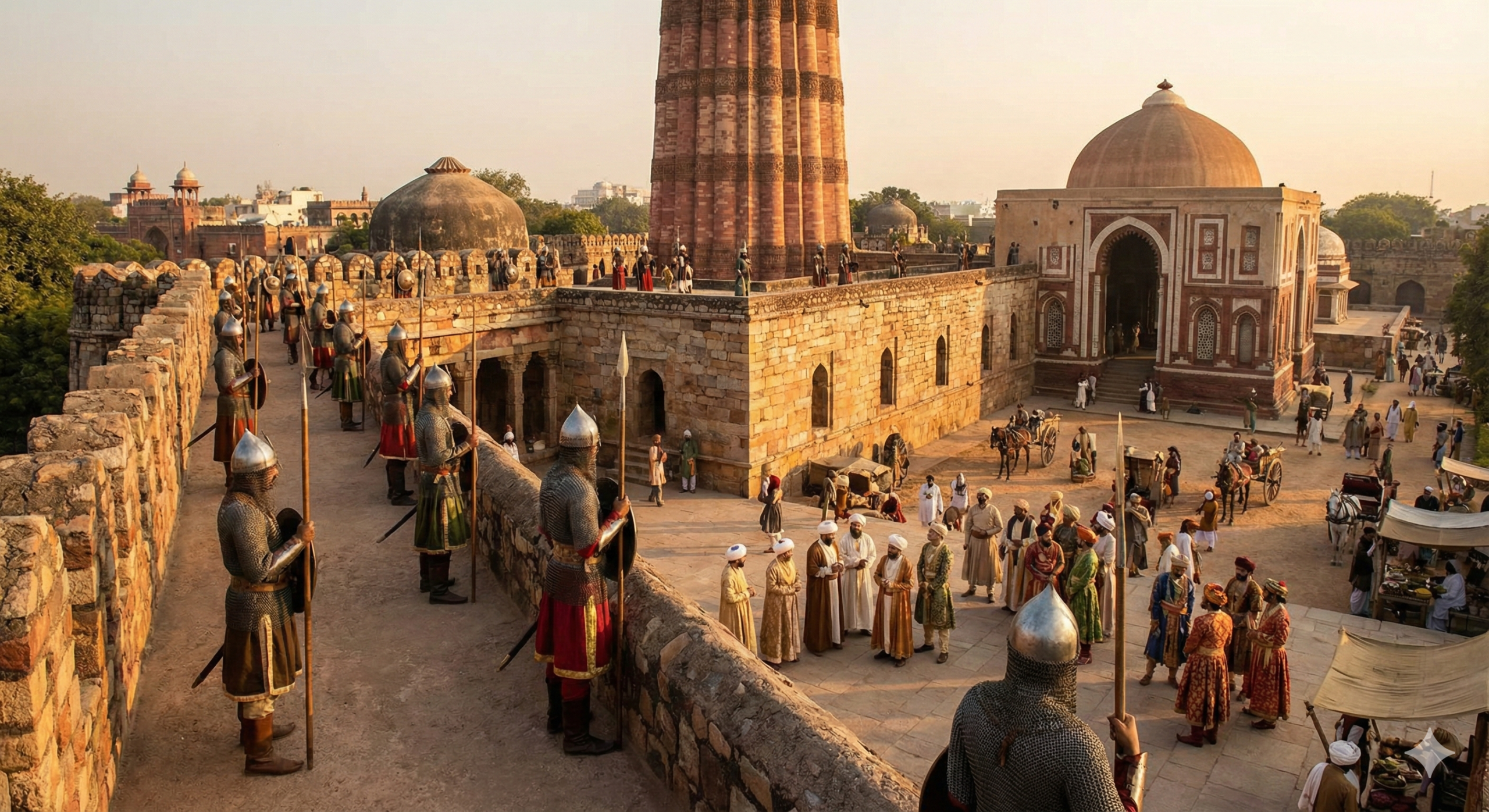
Delhi is unusual in that you can follow the Sultanate on foot. Start at the Qutb complex in Mehrauli: the Qutb Minar, about 73 metres tall; the Quwwat-ul-Islam mosque, with its reused temple pillars; and the Alai Darwaza, built by Alauddin in 1311, which has the first true dome in India. Nearby is the tomb of Balban, where the first true arch in India appears.
From there you can visit the walls of Tughlaqabad, the ruins of Siri, Firoz Shah Kotla with its Ashokan pillar brought from Topra, and the Hauz Khas tank and madrasa. Finish at the Lodi Gardens, where the tombs of Muhammad Shah Sayyid and Sikandar Lodi stand among the lawns. The question of which buildings belong to which of Delhi’s “seven cities” is still argued over by historians, which makes it a good walk to do with a map.
Read Next
- Mughal Empire History: Rulers, Administration and Legacy
- Battle of Panipat History: Causes, Battles and Impact on India
- Vijayanagara Empire History: Rise, Rulers and Cultural Legacy
Frequently Asked Questions
Why is the first dynasty called the Slave dynasty?
Because Aibak, Iltutmish and Balban had all begun as military slaves (mamluks). Many historians prefer “Mamluk” or “Early Turkish Sultans”, since these rulers were freed men and actually belonged to three separate family lines.
Which Delhi Sultanate dynasty ruled the longest?
The Tughlaq dynasty, which ruled for 94 years from 1320 to 1414.
How was the Delhi Sultanate different from the Mughal Empire?
The Sultanate was a series of separate dynasties, often short-lived, with frequent succession fights, while the Mughals were a single dynasty. The Mughals also built a more systematic revenue and rank system (mansabdari) on top of Sultanate foundations.