The Festival Where India Prays to the Setting Sun
Most religions of the world pray to the sun when it rises. On the third day of Chhath Puja, in a tradition that goes back thousands of years, the people of Bihar, Jharkhand, and eastern Uttar Pradesh stand waist deep in cold river water at sunset and offer their prayers to the sun as it is going down. Only the next morning, at sunrise, do they salute the sun coming back up.
In that small choice, of thanking the sun for what it has already given before asking for anything new, lies the whole spirit of Chhath. Chhath Puja 2026 will be observed from 14 to 17 November. The main day, when families gather at rivers and ponds for the sunset arghya, is Sunday, 15 November.
This is the story of one of the oldest, most demanding, and most beautiful festivals in India.
What Chhath Puja Actually Is
Chhath is a four day festival dedicated to Surya, the sun god, and to Chhathi Maiya, the goddess who is believed to be the sister of Surya and the protector of children. Devotees, called vratis, fast for around thirty six hours without food or water. They pray for the health and long life of their families, especially their children.
The festival is celebrated most intensely in Bihar, Jharkhand, and the eastern half of Uttar Pradesh. But it has now travelled far beyond. Mumbai, Delhi, Kolkata, and even London and New York have their own Chhath ghats where the eastern diaspora gathers every November.
The Four Days of Chhath
Day 1, Nahay Khay (14 November 2026): The vrati takes a bath in the Ganga or a nearby river or at home, then eats one meal of simple sattvic food, usually rice, dal made from chana, and lauki sabzi cooked without onion or garlic. This is the day of preparation.
Day 2, Kharna (15 November 2026): The vrati fasts all day and eats one meal after sunset, usually kheer made from jaggery and rice, roti made from wheat, and a fruit. After this evening meal, the thirty six hour fast begins.
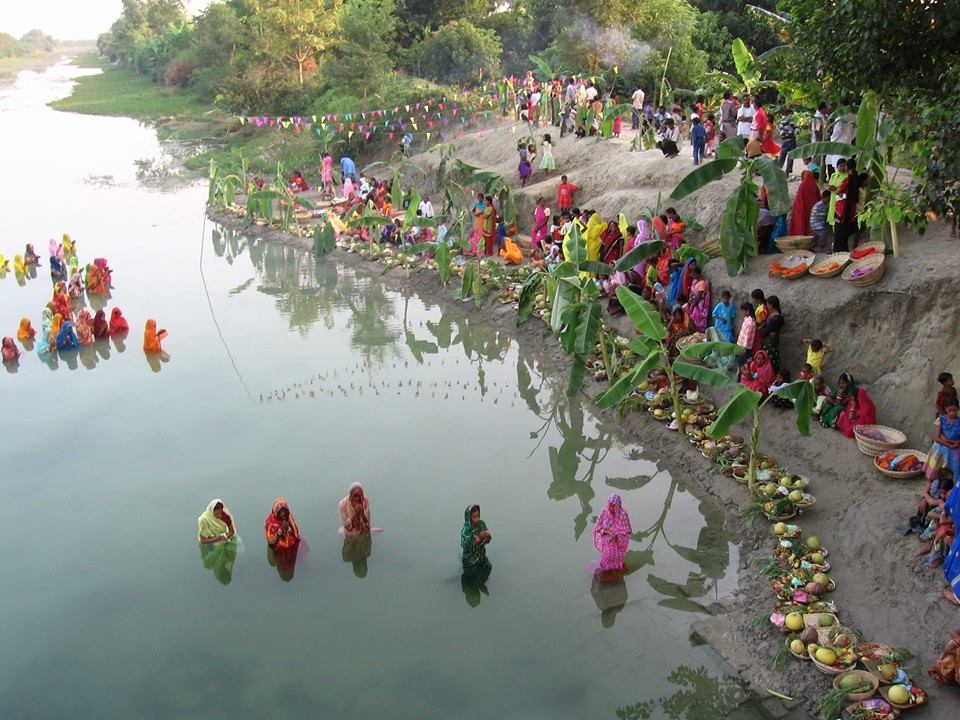
Day 3, Sandhya Arghya (15 November 2026 evening): The main day of Chhath. The whole family walks to the riverbank in the evening, carrying bamboo baskets called soop full of fruits, sugarcane, thekua sweets, and rice laddus. The vrati stands in the water and offers arghya, or prayers, to the setting sun. This is the image most people carry of Chhath.
Day 4, Usha Arghya (16 November 2026 morning): Before dawn, the family walks back to the riverbank in the cold. The vrati stands in the water again and offers arghya to the rising sun. After this, the fast is broken. Prasad is shared. The festival ends.
What Chhath Actually Requires
No other Indian festival asks as much of its devotees as Chhath. The fast is not one day. It is thirty six hours without food or water. It is broken only after the rising sun has been honoured on the fourth morning. In the days before and after, only sattvic food is eaten. Onion, garlic, and any processed food are avoided.
The prasad, called thekua, is prepared in a kitchen that has been cleaned to a level most modern homes never see. Some families do not allow anyone to enter this kitchen without a bath. The thekua is made from wheat flour, jaggery, and ghee. It is deep fried in small round patterns and offered in the soop along with sugarcane, coconut, banana, lemon, and other fruits.
The whole community participates. Neighbours help each other carry the soops to the ghat. Men build small stages in the river with bamboo for the vratis to stand on. Children walk ahead with lamps. The community around a Chhath vrati is not decorative. It is essential.
The Story Behind Chhath
Chhath is one of the oldest known festivals in India. References to sun worship on the sixth day of the lunar fortnight appear in the Rigveda, giving Chhath a lineage of at least three thousand years. The festival is far older than most temple worship traditions in Hinduism.
One legend traces Chhath to Karna, the son of Surya in the Mahabharata. Karna is said to have prayed to his father the sun every day, standing in the river. His devotion is the model that vratis are asked to follow.
Another story credits Draupadi. When the Pandavas lost their kingdom in the dice game, Draupadi is said to have observed Chhath at the advice of the sage Dhaumya and regained her family’s fortunes.
Why the Setting Sun Comes First
The idea that Chhath begins with the setting sun and only then honours the rising sun is deeply Indian. It says something about how this culture understands gratitude. You do not thank someone for what they might give you. You thank them for what they have already given. Then, having thanked them, you can ask for more.
The sunset offering is a farewell to the sun that has already warmed the fields, ripened the crops, and helped the family through another year. The sunrise offering is the beginning of a new cycle. Both matter. Neither is more important than the other.
Chhath Beyond Bihar
Every November, workers from Bihar and eastern UP who live and work in Delhi, Mumbai, Ahmedabad, Bengaluru, and Kolkata carry the festival with them. Chhath ghats now exist along the Yamuna in Delhi, the Mithi in Mumbai, Powai Lake, and even along small artificial ponds in city parks.
The Delhi Chhath, held along the Yamuna in Kalindi Kunj, draws hundreds of thousands of devotees every year. The Mumbai Chhath at Juhu Beach turns the Arabian Sea into a temporary river for one weekend. In Ahmedabad, workers who cannot travel home to Bihar for the festival build makeshift ghats in the Sabarmati.
What all of these have in common is the same simple pattern. A woman standing waist deep in cold water at sunset. A family carrying the soop through the crowd. The steady singing of Chhath geet, a musical tradition centuries old. The absolute silence when the arghya is offered.
Why Chhath Endures
In a country where festivals are increasingly about shopping and party planning, Chhath is different. It is hard. It is quiet. It is done for children, not for the vrati herself. It is celebrated by families who often have little money and simple homes. It has no expensive rituals, no expensive idols, no expensive priests.
It requires only a river, a soop, a fast, and the faith of one family. Because of that, Chhath has stayed close to what religion used to feel like before it became a business. That is why, three thousand years later, it is still growing rather than shrinking.
Frequently Asked Questions
When is Chhath Puja in 2026?
Chhath Puja 2026 will be observed from Saturday, 14 November to Tuesday, 17 November. The main day of sunset arghya is Sunday, 15 November. Sunrise arghya follows on Monday, 16 November.
Why is Chhath dedicated to the sun?
The sun is the source of all life, warmth, and light on earth. Chhath honours Surya as the giver of health and vitality. Chhathi Maiya, the goddess honoured alongside the sun, is believed to protect children and grant them long lives.
How long is the Chhath fast?
The vrati fasts for approximately thirty six hours without food or water. The fast begins after the evening meal on Kharna (day two) and ends after the sunrise arghya on the fourth morning.
What is thekua?
Thekua is a traditional sweet prepared for Chhath prasad. It is made from wheat flour, jaggery, and ghee, and deep fried in small patterned rounds. It is offered to the sun along with sugarcane, coconut, and fresh fruits in the bamboo soop.
Can men observe Chhath?
Yes. While Chhath is most often observed by women, men also fast and offer arghya. In many families, both husband and wife observe the vrat together for the wellbeing of their children.
Sources and Further Reading
- Ministry of Culture, Government of India, Festivals of India archive
- Sahapedia, Chhath Puja: A Living Tradition
- Kunal Nayyar, Rituals and Faith in North India, Sage Publications