[india_weather]

Rani Lakshmibai of Jhansi: The Queen Who Refused to Kneel
On 18 June 1858, near Kotah ki Serai on the edge of Gwalior, a cavalry force of the 1857 uprising rode out against a British column. At its head, dressed as a cavalry soldier, was Rani Lakshmibai of Jhansi. By the end of the day she was dead, aged twenty-nine, and the last major rebel army in central India was close to defeat. The British commander she had fought for months, Sir Hugh Rose, is widely quoted as calling her “the bravest and best military leader of the rebels”.
How a queen of a small Bundelkhand state ended up leading troops against the East India Company is a story of a disputed inheritance, a ten-month rule, and two sieges.
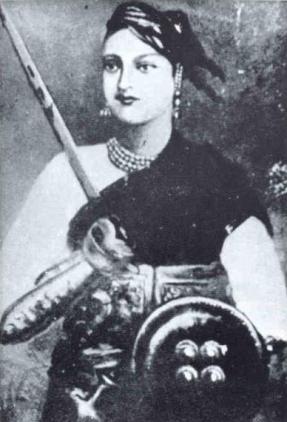
Early life: the girl called Manikarnika
Rani Lakshmibai was born on 19 November 1828 in Varanasi and named Manikarnika. Her father, Moropant Tambe, served in the household of Peshwa Baji Rao II, the last Peshwa of the Maratha Empire, who was living in exile at Bithoor near Kanpur. Her mother, Bhagirathi Bai, died when Manikarnika was about four.
Growing up around the Peshwa’s court gave her an unusual childhood for a girl of her time. She was brought up alongside the Peshwa’s adopted son, Nana Sahib, who would later become another leader of 1857. She learned to read and write, and she rode, fenced and practised with weapons that girls of her class rarely touched.
In May 1842, at about fourteen, she married Maharaja Gangadhar Rao Newalkar, ruler of the princely state of Jhansi in Bundelkhand. After the wedding she was given the name Lakshmi Bai.
Why Jhansi was annexed: the Doctrine of Lapse
Gangadhar Rao was much older than his wife. In 1851 the couple had a son, who died in infancy. In 1853, with the Maharaja’s health failing, they adopted a boy from his family and named him Damodar Rao. Gangadhar Rao died later that year.
Under Hindu custom, an adopted son was a full heir. Under the Doctrine of Lapse, applied vigorously by Governor-General Lord Dalhousie, the Company refused to recognise adopted heirs to states it considered dependent on it, and took those states over. Satara had gone this way in 1848, and Nagpur followed in 1854, the same year Dalhousie applied the doctrine to Jhansi. To the princes of central India, Jhansi looked like one more case in a pattern.
The Rani was told to leave the fort and accept a pension. She refused to give up her son’s claim. She sent petitions to the Company and to London, and engaged a lawyer to argue her case. All of it failed. Jhansi was placed under British administration, and she lived on in the town palace without any power for the next three years.
What Rani Lakshmibai did in 1857
In May 1857, sepoys of the Company’s army at Meerut rose against their British officers, and the revolt spread across northern and central India. In June the garrison at Jhansi rebelled, and British officers and their families were killed. The Rani’s role in those killings has been argued over ever since. British accounts at the time blamed her, while many later historians think she had little control over the sepoys.
After the garrison left, she took charge of Jhansi. At first she wrote to the British saying she was holding the state on their behalf. At the same time she rebuilt her army, had cannon cast, repaired the fort walls and trained women of her household to fight. Whether she was hedging, preparing for the worst, or already committed to rebellion is still debated. By early 1858 the British had recaptured most of the north, and in March a force under Sir Hugh Rose reached Jhansi. She was asked to surrender and refused.
The siege of Jhansi, March-April 1858
Between 21 March and 3 April 1858, Rose’s troops besieged Jhansi Fort. The Rani directed the defence herself, and was seen on the ramparts organising the artillery. A relief army under Tantia Tope tried to break the siege and was beaten off. By 3 April it was clear the fort would fall.
Local tradition in Bundelkhand also remembers Jhalkari Bai, a woman in the Rani’s service who is said to have dressed as the queen and gone out to the British camp to draw attention away from her. The story was passed down mainly through folk songs and local memory rather than British records, so historians treat the details with care, but Jhalkari Bai is now honoured in her own right.
That night she escaped with a small guard of loyal soldiers. The best-known version has her lowering herself from the walls and riding out with Damodar Rao tied to her back. She rode through the night to Kalpi, where Tantia Tope’s forces were regrouping.
The last battle at Gwalior
After defeat at Kalpi, the rebel leaders made a bold move. In late May and early June 1858, Lakshmibai, Tantia Tope and Rao Sahib took Gwalior, one of the strongest forts in central India. The Maharaja of Gwalior, Jayajirao Scindia, who had stayed loyal to the British, fled to Agra.
The British counter-attack began on 17 June. The Rani led a cavalry action outside the city near Kotah ki Serai, and was killed on 18 June. Accounts differ on how: some say a bullet, others a sabre cut. Her attendants carried her away and cremated her nearby, so that her body would not fall into British hands. Gwalior was retaken within days.
Rani Lakshmibai’s legacy
For Indian nationalists in the decades that followed, the Rani of Jhansi became the best-known face of 1857. Subhadra Kumari Chauhan’s Hindi poem Jhansi ki Rani, with its refrain “khoob ladi mardani, woh to Jhansi wali rani thi”, made her a household name across North India. Generations of schoolchildren have learned it by heart.
In 1943 the Indian National Army named its women’s unit, led by Captain Lakshmi Sahgal, the Rani of Jhansi Regiment. Her statues stand in Jhansi, Gwalior and many other cities, and her samadhi at Gwalior marks the place associated with her death.
Damodar Rao survived the war. He lived quietly in Indore under British watch, petitioned for years for his family’s rights with little success, and died there in 1906. If you are in Gwalior, visit her samadhi along with the fort: between them they cover the last weeks of her life, from the capture of the city to the battle outside it.
Read Next
- British Rule in India: Causes, Policies and Impact
- Indian Freedom Struggle: Timeline, Movements and Leaders
- Chhatrapati Shivaji Maharaj: The Warrior King Who Built the Maratha Empire
Frequently Asked Questions
Was Rani Lakshmibai’s birth year 1828 or 1835?
Most sources give 19 November 1828, but some older accounts give 1835. The 1828 date is now the one most widely used, and it fits her age of about fourteen at her marriage in 1842.
Who was Damodar Rao?
He was the boy Lakshmibai and Gangadhar Rao adopted in 1853. The Company’s refusal to accept him as heir is what led to the annexation of Jhansi in 1854.
Where did Rani Lakshmibai die?
Near Kotah ki Serai, outside Gwalior, on 18 June 1858. Her samadhi is in Gwalior.
Sources and Further Reading
- Subhadra Kumari Chauhan, Jhansi ki Rani (poem, 1930)
- Joyce Lebra, The Rani of Jhansi
- Rainer Jerosch, The Rani of Jhansi, Rebel Against Will (Aakar Books)
- National Archives of India, records of the 1857 uprising