[india_weather]

Chhatrapati Shivaji Maharaj: The Warrior King Who Built the Maratha Empire
In 1646 a sixteen-year-old named Shivaji Bhosale took Torna, a hill fort in the Sahyadris south-west of Pune, from the Adil Shahi sultanate of Bijapur. Twenty-eight years later he was crowned Chhatrapati at Raigad. Between those two events, Chhatrapati Shivaji Maharaj built a kingdom in the hills of the western Deccan that the Mughals, then the strongest power in India, never managed to destroy. Here is how his life unfolded, from Shivneri to Raigad.
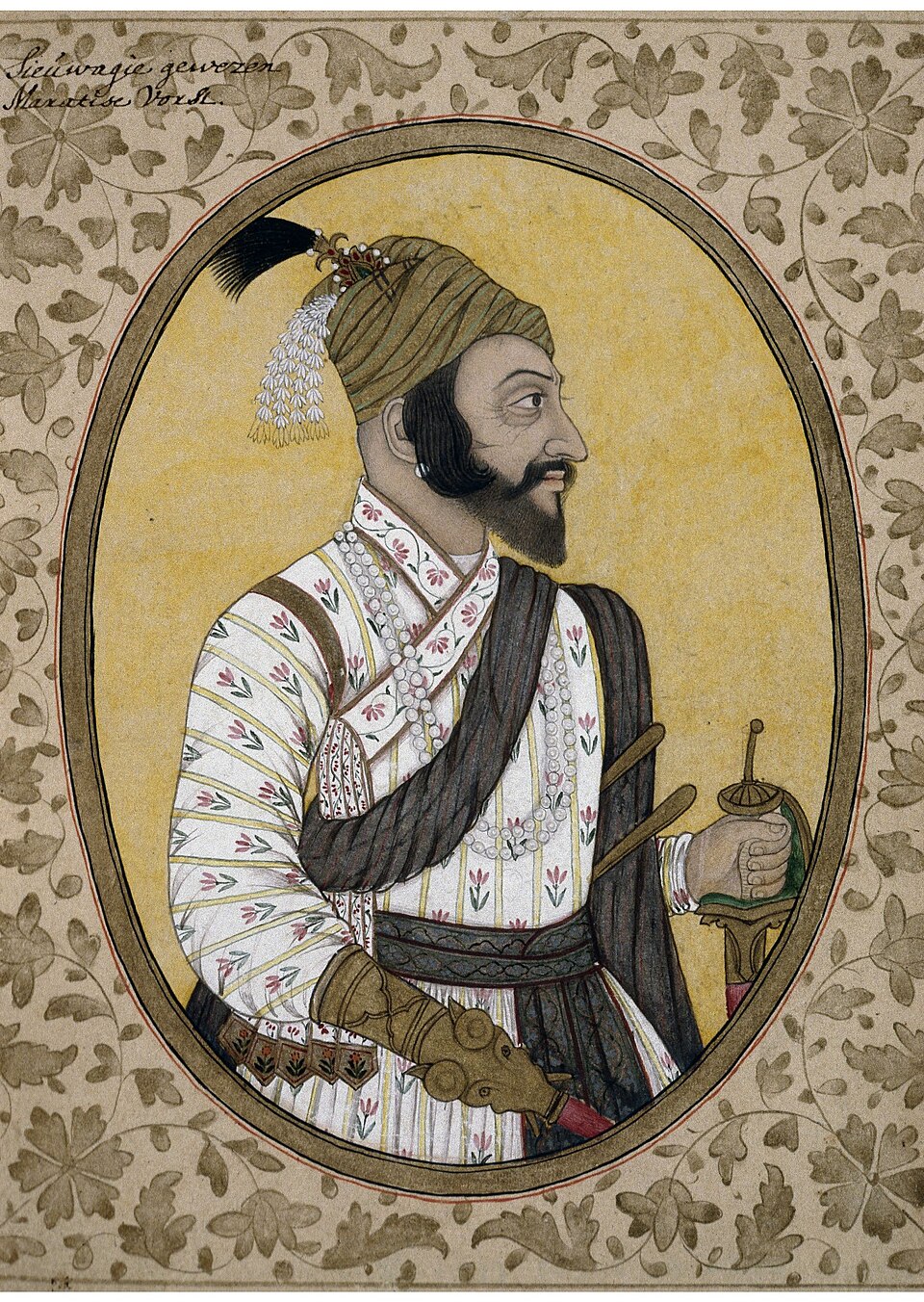
Early life of Chhatrapati Shivaji Maharaj at Shivneri
Shivaji was born at Shivneri Fort near Junnar, in today’s Pune district. The Maharashtra government observes 19 February 1630 as his birth date, though some historians have argued for 1627. His father, Shahaji Bhosale, was a senior general who had served the Nizam Shahi kingdom of Ahmadnagar and then the Adil Shahi sultanate of Bijapur, which also gave him the jagir of Pune.
His mother, Jijabai, came from the powerful Jadhav family of Sindkhed. Shahaji was usually away on campaign, so Shivaji grew up with Jijabai and the administrator Dadaji Kondadev, first at Shivneri and later at Pune. Jijabai brought him up on the Ramayana and the Mahabharata, and most accounts give her a large part in shaping his ambition to rule in his own right rather than serve a sultan.
Tradition says that in 1645 Shivaji and a group of young companions took an oath at the Raireshwar temple to found a self-ruled kingdom, which Marathi sources call Hindavi Swarajya. At the time, the Mughal Empire controlled most of North India and was pushing steadily into the Deccan.
The first forts and ganimi kava
Torna, taken in 1646, became the first fort of the future Maratha state. Over the following decades Shivaji captured, built or repaired a large network of forts across the western Deccan; traditional counts put the total at around three hundred. Rajgad served as his early capital.
His method suited the terrain. Instead of meeting Mughal or Bijapuri armies in open battle on the plains, he used the steep Sahyadri ranges. Small, fast units struck outposts and supply lines and pulled back into the hills before reinforcements could arrive. Marathi calls this ganimi kava, usually translated as guerrilla warfare. Shivaji did not invent it, but he used it more systematically than anyone before him against armies built for set-piece battles.
Afzal Khan at Pratapgad, 1659
In 1659 Bijapur sent its general Afzal Khan, a large and experienced commander, to finish Shivaji off. Shivaji withdrew to Pratapgad, a fort in thick forest where a big army could not manoeuvre, and Afzal Khan agreed to meet him below the fort for talks, each side with only a few attendants.
Shivaji expected treachery and wore chainmail under his clothes, with a set of steel claws, the bagh nakh, hidden in his hand. At the meeting on 10 November 1659, Afzal Khan pulled him into an embrace and struck with a dagger. The armour held, and Shivaji tore into Afzal Khan with the claws. Maratha troops hidden in the forest then attacked the Bijapuri camp and routed it. After Pratapgad, Shivaji was a power the Deccan sultanates and the Mughals had to deal with seriously.
Shaista Khan, Surat and the Treaty of Purandar
The Mughals sent Aurangzeb’s uncle Shaista Khan, who occupied Pune. In April 1663 Shivaji and a small party slipped into his quarters at night; Shaista Khan escaped but lost fingers in the attack, and was recalled in disgrace. In 1664 Shivaji raided Surat, the Mughals’ richest port, and carried off a large treasure.
Aurangzeb then sent Raja Jai Singh of Amber with a much larger force. Jai Singh besieged Purandar, and in 1665 Shivaji accepted the Treaty of Purandar, handing over 23 forts and agreeing to visit the Mughal court.
The escape from Agra, 1666
Shivaji reached Agra in May 1666. At court, Aurangzeb placed him among nobles of lower rank, and Shivaji protested openly. He was put under house arrest and held for about three months.
His escape is one of the best-known episodes in Indian history. He let it be known that he was ill and began sending large baskets of sweets and fruit out to holy men and nobles. Once the guards stopped checking them closely, Shivaji and his young son Sambhaji were carried out hidden in baskets in August 1666. They left Agra in disguise and made their way back to Maharashtra by a long, roundabout route. Aurangzeb never had Shivaji in his power again.
The coronation at Raigad, 1674
Back in the Deccan, Shivaji recovered most of the forts he had given up. One of the most famous recaptures was Kondhana in 1670, where his commander Tanaji Malusare was killed; the fort was later renamed Sinhagad.
On 6 June 1674 Shivaji was crowned Chhatrapati at Raigad, in a ceremony led by the Varanasi scholar Gaga Bhatt. Chhatrapati means “lord of the umbrella”, the parasol being an old Indian mark of sovereignty. The coronation announced that he was an independent king, not a rebel jagirdar, and it gave him standing in dealings with the Mughals, the Deccan sultanates and the European trading companies. In 1677 he led a major campaign into the south, taking Jinji and Vellore.
How Shivaji governed
Shivaji ran his kingdom through a council of eight ministers, the Ashta Pradhan, each with a defined department. He tried to collect revenue directly from cultivators instead of through hereditary middlemen, and he is remembered for protecting farmers from extortion.
He also built a navy, rare for an Indian ruler of the time, with sea forts such as Sindhudurg, to hold the Konkan coast against the Siddis of Janjira and the European powers. Muslims served as officers in his army and administration, and Christian missions were allowed to function. He promoted Marathi in administration and had a dictionary, the Rajyavyavahara Kosha, compiled to replace Persian official terms with Sanskrit and Marathi ones.
Death and what came after
Shivaji died at Raigad on 3 April 1680, aged about fifty. Most accounts say he died of an illness; some suggest poisoning by rivals at court, but there is no firm evidence for it. The kingdom he left was still small next to the Mughal Empire.
His son Sambhaji fought Aurangzeb for nine years before he was captured and executed in 1689. Under Sambhaji’s son Shahu and the Peshwas who served him, Maratha power spread across much of India in the eighteenth century, at its widest reaching from Attock in today’s Pakistan to Thanjavur in the south. The Maratha confederacy remained a major force until its defeat by the British in 1818.
In Maharashtra, Shivaji’s memory is part of daily life. His portrait hangs in schools, police stations and taxis, and Shiv Jayanti is marked with processions every year. If you want to see his world for yourself, start at Raigad: the ropeway gets you up in minutes, but the steps show you why a fort like this was so hard to take.
Read Next
- Maharana Pratap History: Life, Battles and Legacy
- Mughal Empire History: Rulers, Administration and Legacy
- Battle of Panipat History: Causes, Battles and Impact on India
Frequently Asked Questions
When is Shiv Jayanti celebrated?
The Maharashtra government observes it on 19 February. Many people also celebrate it by the Hindu calendar, on Phalgun Vadya Tritiya, so the date varies from year to year.
Where is Shivaji Maharaj’s samadhi?
His samadhi is at Raigad Fort in Raigad district, Maharashtra, where he was crowned and where he died.
Did Shivaji’s kingdom charge a separate tax on non-Hindus?
No. Non-Hindu subjects paid the same taxes as Hindus, and Muslims served in his army and administration. He also respected mosques and Sufi shrines during his campaigns.
Sources and Further Reading
- M.G. Ranade, Rise of the Maratha Power, Punalekar
- Jadunath Sarkar, Shivaji and His Times, Orient Longman
- Stewart Gordon, The Marathas 1600-1818, Cambridge University Press
- Krishnaji Anant Sabhasad, Sabhasad Bakhar, an early Marathi chronicle written within about two decades of Shivaji’s death