[india_weather]
Diwali: Festival of Lights, Legends, Rituals, and Modern Celebrations
On the darkest night of the autumn lunar month, the new moon of Kartik, families across India set out rows of small clay lamps along their doorsteps, balconies and boundary walls. That row of lamps gives the Diwali festival of lights its name: Deepavali comes from the Sanskrit deepa (lamp) and avali (row). Diwali is mainly a Hindu festival, but Jains, Sikhs and some Buddhists also mark it, each for their own reasons, and it runs over five days rather than one.
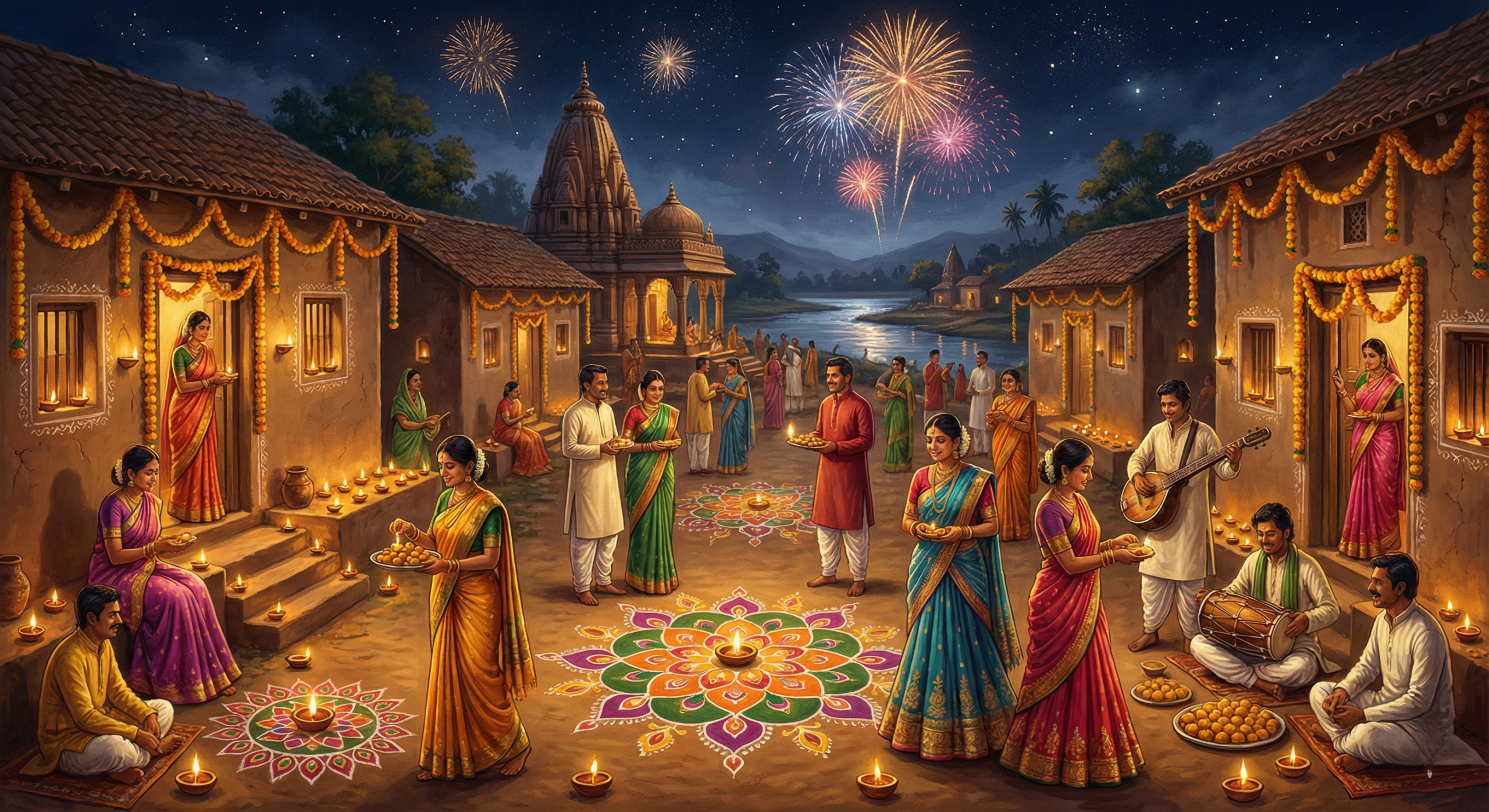
This guide goes through the five days in order, the main legends attached to the festival, how the celebration changes from Bengal to Tamil Nadu to Gujarat, what people cook, and what Diwali looks like in Indian cities and abroad today.
When is Diwali celebrated?
Diwali falls in October or November. The exact date moves every year because it follows the Hindu lunar calendar, and the main night is Amavasya, the new moon. In the purnimanta calendar used across most of North India, this is the new moon of Kartik. In the amanta calendar used in Gujarat, Maharashtra and much of the South, the same night is counted as the new moon at the end of Ashvin. The night is the same; only the month’s name differs.
Because the date is set by the moon, check a panchang or your state’s holiday list each year rather than relying on a fixed date. The main day is a public holiday across India, and the festivities usually start two days before it and end two days after.
How old is Diwali?
Lighting lamps in autumn is an old Indian practice, and the festival as we know it took shape slowly. Later Sanskrit texts, especially the Puranas, describe lamp-lighting and the worship of Lakshmi around this time of year; the Padma Purana and Skanda Purana are the ones usually cited. Many scholars connect the festival’s early form with the end of the kharif harvest, when granaries were full and the rains were over.
It is often said that Diwali was celebrated with great display at royal courts, from the period of the Gupta Empire (320-550 CE) through the medieval kingdoms. The broad point holds: rulers patronised the festival and their public celebrations shaped popular custom. But the evidence for any one court is uneven, so treat confident claims about “Gupta-era Diwali” with some care. What is clear is that different regions attached their own legends to the same new-moon night, which is why Diwali means slightly different things in different parts of India.
The five days of the Diwali festival of lights
Most families follow a five-day sequence, though not every region gives each day the same weight. Here is what happens on each day.
Day 1: Dhanteras
Dhanteras falls two days before the main Diwali night, on the thirteenth lunar day (trayodashi) of the waning fortnight. The name joins dhan (wealth) and teras (thirteenth). It is the day for buying gold, silver or new steel and brass utensils, and jewellery shops and utensil markets are at their busiest. Today the shopping list often includes electronics and vehicles too.
Dhanteras is also linked to Dhanvantari, the physician of the gods, who is said to have risen from the churning of the ocean (Samudra Manthan) carrying a pot of amrit. So the day is about health as well as money, and many families worship Dhanvantari along with Lakshmi in the evening. Homes are cleaned, the doorway is decorated with rangoli, and the first diyas of the festival are lit.
Day 2: Naraka Chaturdashi (Choti Diwali)
The second day is called Naraka Chaturdashi, Choti Diwali (“small Diwali”) or, in Gujarat, Kali Chaudas. It remembers Krishna’s victory over the demon Narakasura. The best-known custom is the abhyanga snan, an oil bath before sunrise, often with ubtan (a paste of gram flour, turmeric and herbs), after which people put on new or freshly washed clothes.
In some regions this is a day for worshipping Kali or other fierce forms of the goddess for protection. More lamps are lit than on Dhanteras, sweets and snacks are prepared, and in parts of the South this morning, not the main night, is the high point of the whole festival.
Day 3: Diwali and Lakshmi Puja
The main day falls on Amavasya. In the evening, families perform Lakshmi Puja, usually together with Ganesha, at a time the panchang marks as auspicious. Every part of the house is lit, doors and windows are often left open so that Lakshmi can enter, and the rangoli at the entrance is at its most elaborate. Marigold garlands and torans of mango leaves hang over the doors.
After the puja come sweets, visits to neighbours and, in many places, firecrackers. Playing cards on Diwali night is a popular custom in North and West India and is considered lucky. For traders, this is the night of Chopda Pujan or Bahi Khata Puja, when the old account books are closed and new ledgers are worshipped before use.
Day 4: Govardhan Puja, Annakut and Padwa
The fourth day recalls Krishna lifting Govardhan hill on his little finger to shelter the people of Braj from storms sent by an angry Indra. Families shape a small Govardhan from cow dung and worship it, and cattle are bathed and decorated. In temples, especially in the Braj region around Mathura and Vrindavan, cooks prepare Annakut (“mountain of food”): a large heap of vegetarian dishes, often 56 items (chhappan bhog) or even 108, which is offered to Krishna and then shared as prasad.
In Maharashtra the same day is Diwali Padwa, also called Bali Pratipada, when husbands and wives exchange gifts. In Gujarat it is Bestu Varas, the Gujarati New Year, which begins the Vikram Samvat year in that state. People greet each other with “Saal Mubarak” and visit relatives.
Day 5: Bhai Dooj
The last day, Bhai Dooj, is about brothers and sisters. It falls on the second lunar day (dwitiya) of the new bright fortnight, which is where “dooj” comes from. It is also called Yama Dwitiya, Bhau Beej in Maharashtra and Bhai Phonta in Bengal.
The story behind it is that Yamuna invited her brother Yama, the god of death, to her home, put a tilak on his forehead and performed aarti for him. Pleased, Yama declared that any brother who received a tilak from his sister on this day would not fear death. Today sisters apply tilak, perform aarti and feed their brothers, and brothers give gifts in return. It is similar in spirit to Raksha Bandhan, but there is no rakhi.
The legends behind Diwali
There is no single Diwali story. Each region and each religious community leans on a different legend, though all of them link the lamps to light winning over darkness.
Rama’s return to Ayodhya
The best-known story, especially in North India, comes from the Ramayana. After fourteen years of exile and the defeat of Ravana, Rama returned to Ayodhya with Sita and Lakshmana, and the people lit rows of lamps to welcome them home on a moonless night. In North India the Ramlila performances that end with Dussehra lead naturally into Diwali about twenty days later, which is treated as Rama’s homecoming.
Lakshmi and the churning of the ocean
In another account, Lakshmi emerged from the ocean during the Samudra Manthan, when the devas and asuras churned it for amrit, and chose Vishnu as her consort. Accounts differ on the exact day, but popular tradition ties her appearance to this season. The belief that Lakshmi visits clean, well-lit homes on Diwali night explains two of the festival’s central customs: the big pre-Diwali clean (Diwali ki safai) and the evening Lakshmi Puja. This story is especially important to merchant communities in western India.
Krishna and Narakasura
In South India, particularly Tamil Nadu, Karnataka and Andhra Pradesh, the main Deepavali story is Krishna’s victory over Narakasura, a demon king who had attacked the heavens and held thousands of women captive. Krishna killed him with the help of his wife Satyabhama and freed the prisoners. In one version, Narakasura asked as he died that his death be remembered with lights. This is why the pre-dawn oil bath on Naraka Chaturdashi matters so much in the South.
Mahavira’s nirvana (Jain Diwali)
For Jains, Diwali marks the nirvana (moksha) of Mahavira, the twenty-fourth and last Tirthankara, at Pavapuri in Bihar. The traditional Jain date is 527 BCE, though many historians place his death later, in the fifth century BCE. His followers lit lamps to mark the passing of the light of knowledge. Jain observance is quieter than the Hindu one, with fasting, prayer and the reading of scripture, and the Jain new year begins the next day.
Bandi Chhor Divas (Sikh Diwali)
Sikhs celebrate the day as Bandi Chhor Divas, the “day of liberation”. It marks the release of Guru Hargobind, the sixth Sikh Guru, from Gwalior Fort, where he had been held on the orders of the Mughal emperor Jahangir; the release is usually dated to 1619, though accounts differ. The Guru is said to have insisted that 52 imprisoned Hindu kings be freed with him. When he reached Amritsar, the Harmandir Sahib (Golden Temple) was lit up, and the Golden Temple’s illumination and fireworks are still among the best-known sights of the festival.
How Diwali is celebrated in different regions of India
The lamps are everywhere, but the focus shifts as you move across the country.
North India
In Uttar Pradesh, Madhya Pradesh, Rajasthan, Punjab, Delhi and Haryana, Diwali is mainly Rama’s homecoming. The Lakshmi-Ganesha puja on the main night is the centre of the festival, with heavy lighting, firecrackers, card games and boxes of ladoo, barfi and gulab jamun carried from house to house. Ayodhya itself now holds a large public lamp-lighting along the ghats of the Saryu. Govardhan Puja is especially important in the Braj region.
South India
In Tamil Nadu, Karnataka and Andhra Pradesh, Deepavali is about Krishna and Narakasura, and the big moment is early on Naraka Chaturdashi rather than the new-moon night. Families wake before dawn for the oil bath, put on new clothes, burst crackers in the early morning and eat sweets for breakfast. Kolam made of rice flour decorates the threshold, and brass or bronze lamps (vilakku) are lit alongside clay diyas. In Karnataka, Bali Padyami remembers the asura king Bali. Kerala celebrates Deepavali on a much smaller scale than its neighbours.
West India
Gujarat and Maharashtra have old trading communities, so Diwali here is closely tied to business and the new year. Gujarati traders perform Chopda Pujan on Diwali night, and the next day, Bestu Varas, is the Gujarati New Year. In Maharashtra the festival starts with Vasubaras, when cows and calves are worshipped, just before Dhanteras, and continues through Padwa and Bhau Beej. Families make a faral, a tray of homemade snacks and sweets, to share with visitors. Children in Maharashtra traditionally build small mud forts (killa) in courtyards during Diwali, a nod to the forts of Shivaji.
East India
In West Bengal, Odisha and Assam, the new-moon night is Kali Puja. Clay images of Kali are installed in community pandals and homes and worshipped through the night, and people go pandal hopping much as they do during Durga Puja, though on a smaller scale. Lamps and candles line the rooftops. Bhai Phonta, the Bengali Bhai Dooj, follows two days later.
Diwali rituals at home: diyas, rangoli and Lakshmi Puja
Cleaning and decorating
Preparations start weeks ahead with Diwali ki safai, a thorough clean of the whole house, including the lofts and cupboards that are ignored the rest of the year. Many families also whitewash or paint at this time, and old, broken things are thrown out. The practical reason is obvious after the monsoon; the religious reason is that Lakshmi is believed to enter only a clean home.
Rangoli
Rangoli is drawn at the entrance with coloured powder, rice flour, flower petals or coloured sand. The designs range from simple dot-and-line kolam to large freehand patterns with lotuses, diyas, swastikas and footprints of Lakshmi pointing into the house. Because rangoli is swept away and redrawn, many households make a new one each day of the festival.
Diyas
The diya is a small clay lamp filled with mustard oil or ghee, with a cotton wick. Families place them at the door, on window sills, on the roof edge and around the courtyard, and many keep at least one lamp burning through Diwali night. In some places diyas are floated on rivers and ponds. Electric string lights are now common, but most homes still light clay diyas for the puja itself.
Lakshmi Puja step by step
Customs vary by family, but the evening puja usually follows this order:
- A clean cloth is spread on a low platform, and images of Lakshmi and Ganesha are placed on it with coins, flowers, sweets and lamps.
- Ganesha is worshipped first, as the remover of obstacles.
- Lakshmi is invoked with mantras, and flowers, incense, lamps and food are offered.
- The family sings aarti with a camphor or ghee lamp.
- Prasad is shared, and the lamps are carried out to the rest of the house.
Many families also buy new clothes for the occasion: silk saris are common in the South, kurtas and lehengas in the North, and chaniya choli in Gujarat. Gold bought on Dhanteras is often worn for the first time on Diwali night.
Diwali food: sweets and snacks by region
Sweets are the most-exchanged gift of the festival, and in many homes the kitchen is busy for days before the main night. Some sweets are found almost everywhere:
- Ladoo: balls of besan, rava or coconut bound with ghee and sugar.
- Barfi and kaju katli: milk or cashew fudge, often covered in silver leaf (vark).
- Gulab jamun and jalebi: fried and soaked in sugar syrup.
- Kheer and halwa: rice pudding, and halwa made from carrots, semolina or moong dal.
Savoury snacks are just as important, partly because they keep for weeks: chakli or murukku (spirals of rice and lentil flour), mathri, namak pare, sev, chivda and pakoras.
Regional specialities are where it gets interesting. Gujarat makes mohanthal (a gram-flour fudge) and ghughra (fried pastries filled with dry fruit and khoya). The Maharashtrian faral includes anarsa, karanji, chakli, shankarpali and besan ladoo. Tamil homes make adhirasam (a jaggery and rice-flour sweet), murukku and Mysore pak. In Bengal, Kali Puja and Bhai Phonta mean sandesh, rosogolla and mishti doi. In the Braj region, the Annakut offering on Govardhan Puja is perhaps the biggest single Diwali meal anywhere.
How Diwali is celebrated today
Firecrackers, pollution and green crackers
Firecrackers became a large part of Diwali only in modern times, and they are now the most argued-over part of the festival. Air quality in North Indian cities, already poor in late autumn because of stubble burning and still winter air, often gets much worse on and after Diwali night. Courts and state governments have responded with time limits, bans on some types of crackers and, in the worst-hit cities, full bans in some years.
“Green crackers”, designed to give off fewer emissions, are now promoted as an alternative, and many urban families have cut down on crackers or stopped altogether. Burns and eye injuries are also common every Diwali, so if you do light crackers, keep a bucket of water nearby, wear cotton clothes and keep children at arm’s length from anything that is lit.
Shopping and gifting
Diwali is India’s biggest shopping season, often compared with Christmas in Western countries. Gold, cars, two-wheelers, phones and household appliances all see peak sales around Dhanteras, and online shopping platforms now run sales for weeks before the festival. Many employers pay a Diwali bonus, and corporate gift hampers of dry fruit and sweets have become an industry in their own right. Some people worry that this commercial side crowds out the religious one; others point out that buying new things has always been part of Dhanteras.
Smaller families, new habits
With more people living in nuclear families or in cities far from home, Diwali is often the one time of year they travel back, and trains and flights fill up weeks ahead. Busy households now buy ready-made sweets and snacks instead of cooking them, or hire help to decorate. LED string lights have largely replaced older bulbs, video calls let relatives abroad join the puja, and greetings arrive on WhatsApp instead of by post. Even so, most families keep a few things the same every year, usually the puja, the clay diyas and at least one homemade sweet.
Diwali outside India
The Indian diaspora has taken Diwali around the world. In Nepal the festival is called Tihar and lasts five days. Deepavali is a public holiday in Sri Lanka, Malaysia, Singapore, Mauritius, Fiji, Trinidad and Tobago, Guyana and Suriname, countries with large populations of Indian origin, many descended from workers taken there in the nineteenth century.
Where Diwali is not a holiday, it is still marked publicly. Leicester in the UK holds one of the largest Diwali celebrations outside India, London lights up Trafalgar Square, and Canadian and Australian politicians send official greetings. In the United States, the White House first hosted a Diwali event in 2003, and several US states and cities now issue proclamations or hold public lamp-lightings.
Read Next
- Dussehra: The Victory of Good Over Evil
- Navratri: The Nine Nights of the Divine Feminine
- Karva Chauth: The Story, Rituals, and Meaning
Frequently Asked Questions
What is the difference between Choti Diwali and Diwali?
Choti Diwali is the day before the main festival, Naraka Chaturdashi, and is associated with Krishna’s victory over Narakasura and the pre-dawn oil bath. Diwali itself is the new-moon night of Lakshmi Puja.
Is Tihar in Nepal the same as Diwali?
Tihar falls at the same time and also lasts five days, with lamps and Lakshmi Puja, but it has its own customs, such as days for honouring crows, dogs and cows, and Bhai Tika for brothers on the last day.
What is the auspicious time for Lakshmi Puja?
The puja is usually done in the evening during the period called pradosh kaal, within a muhurat calculated for that year. Check a local panchang or temple calendar, because the timing changes every year and from city to city.
What should a guest bring to a Diwali visit?
A box of sweets or dry fruit is the usual gift, and a pack of diyas or a small plant is always welcome. If you are visiting on the main evening, go after the family has finished its puja.