[india_weather]

Indian Classical Dance: A Guide to the Eight Recognised Forms
A single Bharatanatyam varnam can last twenty minutes, and in that time one dancer, using only her hands, eyes and feet, may play a devotee waiting through the night for her god to arrive. That is the kind of storytelling Indian classical dance is built for. The Sangeet Natak Akademi recognises eight classical forms, each from a different region, with its own music, costume, movement and repertoire of stories. Here is what they are, where they come from and how to tell them apart.
Where Indian classical dance comes from: the Natya Shastra
All eight forms trace their theory to one text, the Natya Shastra, attributed to Bharata Muni and composed sometime between 200 BCE and 200 CE. It is the oldest surviving treatise on the performing arts anywhere. It covers theatre, dance and music in detail: kinds of movement, the emotions a performer must be able to show, body postures, hand positions, even how the stage should be laid out.
The Natya Shastra splits performance into three parts, and you will hear these terms in any dance class. Nritta is pure movement and rhythm with no story. Nritya is expressive movement that tells a story through gesture and face. Natya is drama, with characters and plot. Every classical form mixes these three in its own proportions.
Two more words come up constantly. A mudra is a hand gesture, and each one has a set meaning: a lotus, a deer, a bow, a particular god. Abhinaya is the art of expression, carried mainly by the face and eyes.
The eight classical dance forms of India
Bharatanatyam (Tamil Nadu)
Bharatanatyam grew out of the temple dance of Tamil Nadu, performed for centuries by devadasis, women dedicated to temple service. In the early twentieth century, colonial officials and Indian reformers campaigned against the devadasi system, and temple performance was eventually banned. The dance survived because scholars and performers took it to the concert stage. The best known of them was Rukmini Devi Arundale, who reworked the repertoire for a new generation of students. Kalakshetra, the institution she founded in Chennai in 1936, is still the most influential Bharatanatyam school in the world.
You can recognise Bharatanatyam by its sharp, geometric lines. The dancer holds a half-sitting posture called ardhamandali for long stretches, and her feet strike the floor in precise rhythmic patterns. The eyes and eyebrows matter as much as the hands. It is usually performed solo, to Carnatic music.
Kathak (Uttar Pradesh)
Kathak takes its name from katha, story. Its earliest performers were storytellers who acted out tales in temple courtyards. Later, in the courts of Lucknow, Jaipur and Banaras under Mughal-era patronage, it became a refined court art, and these three cities gave their names to the main Kathak gharanas. Today it is the leading classical form of North India.
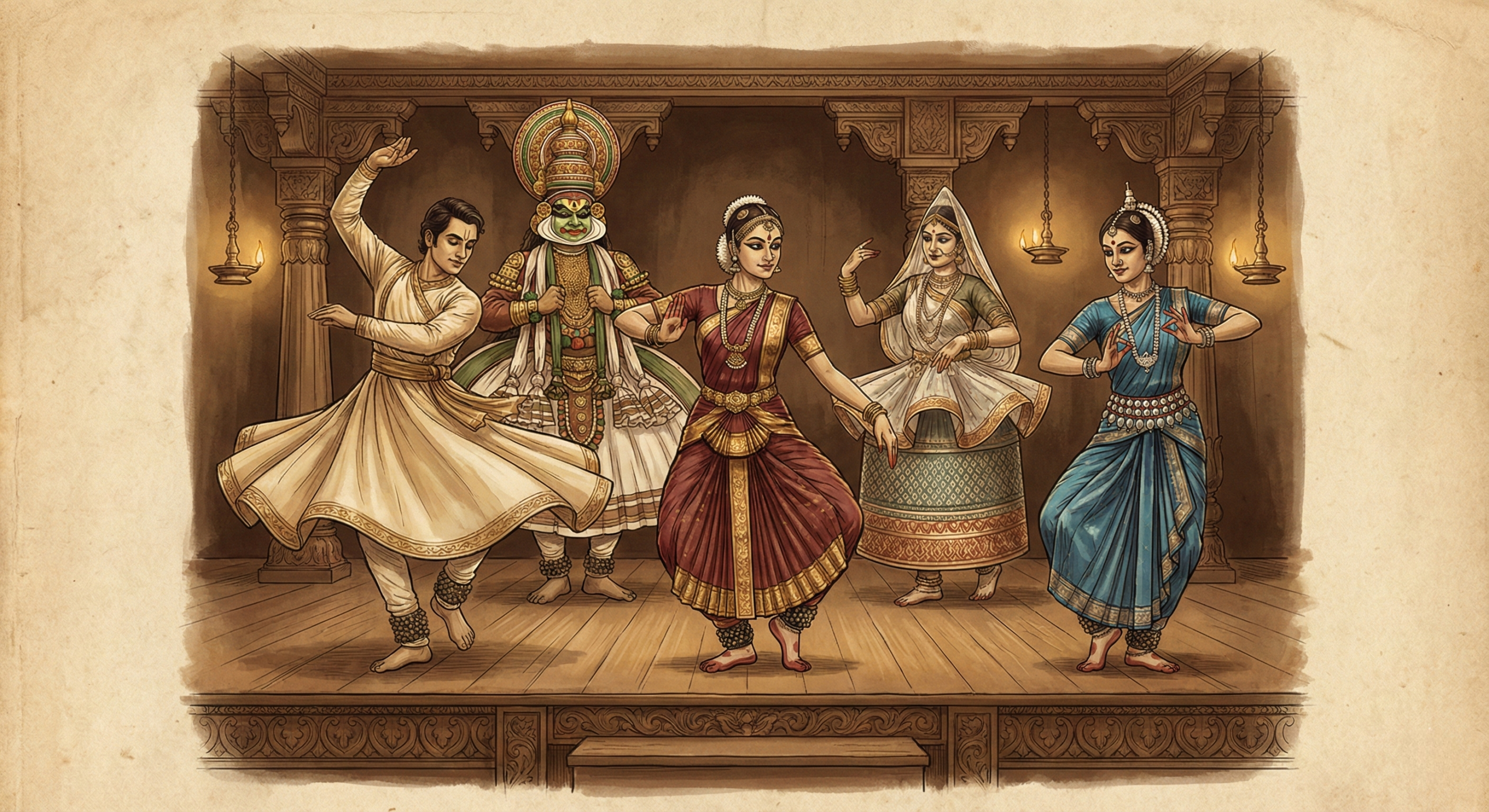
The signature move is the chakkar, a fast spin repeated dozens of times in one sequence until the dancer’s skirt flares out like a bell. Kathak dancers also wear ankle bells and match complex footwork to the tabla, often reciting the rhythmic syllables (bols) aloud before dancing them. The expressive sections usually interpret poetry, especially verses about Radha and Krishna. The music is Hindustani.
Kathakali (Kerala)
Kathakali is dance drama on a grand scale. Bharatanatyam and Kathak are usually solo forms; a Kathakali performance has a full cast, heavy costumes and long stories from the Mahabharata and Ramayana. Traditionally it ran through the whole night, from evening until dawn.
The makeup is its most famous feature, and it works as a code. Green faces mark noble heroes, red beards mark evil kings, black marks fierce or forest characters, and white is for divine or feminine roles. Applying it takes hours, and huge crowns sit on top. In older productions every role, including the female ones, was played by men trained from childhood.
Kuchipudi (Andhra Pradesh)
Kuchipudi is named after a village in Andhra Pradesh. It began as a dance drama performed by Brahmin men, based on compositions by Siddhendra Yogi, who is usually dated to the sixteenth or seventeenth century. Today it is performed by both men and women.
Its best known item is the tarangam, in which the dancer performs fast footwork while standing on the rim of a brass plate, sometimes with a small pot of water balanced on the head. Kuchipudi uses Carnatic music like Bharatanatyam, but its movement is more fluid and dramatic.
Odissi (Odisha)
Odissi looks like the sculptures on the medieval temples of Bhubaneswar, Konark and Puri come to life. Its key posture is the tribhanga, the “three bends”, in which the head, torso and hips curve in different directions.
The temple tradition collapsed during the colonial period, and Odissi nearly disappeared. It was rebuilt in the 1950s and 1960s by gurus including Kelucharan Mohapatra, Pankaj Charan Das and Deba Prasad Das. They worked from temple sculpture, old texts and the memories of the last mahari (temple dancers) and gotipua (boys who danced dressed as girls).
Sattriya (Assam)
Sattriya was created by the saint-reformer Sankardev in the fifteenth century as part of his Vaishnava devotional movement. For centuries it was performed only by monks inside the sattras, the Vaishnava monasteries of the Brahmaputra valley. The Sangeet Natak Akademi recognised it as a classical form only in 2000, which makes it the most recent of the eight to be recognised, though the tradition itself is over five hundred years old.
Manipuri (Manipur)
Manipuri is best known for the raas leela, the enactment of Krishna’s dance with the gopis of Vrindavan. Its movements are the softest of all the classical forms. Dancers rarely strike the floor hard; they glide. The female costume is easy to spot: a stiff, embroidered cylindrical skirt that flares out at the bottom.
Mohiniyattam (Kerala)
Mohiniyattam means “dance of the enchantress”, after Mohini, the female form Vishnu took to trick the asuras. It is traditionally performed by women, with gentle, swaying movements often compared to palm trees moving in the Kerala breeze. The costume is a plain white or off-white sari with a gold border, the same style as the traditional Kerala mundu.
How to tell the forms apart when you watch
If you are new to watching, a few clues help. Look at the legs first. A deep, wide half-sit with sharp angles usually means Bharatanatyam; a curving S-shaped body means Odissi; fast spins mean Kathak.
Then look at the costume. Painted green faces and huge skirts are Kathakali. A white and gold sari with the hair in a side bun is Mohiniyattam. A stiff, flared cylindrical skirt is Manipuri.
Finally, listen. Carnatic music points south (Bharatanatyam, Kuchipudi, Mohiniyattam). Tabla and Hindustani music point to Kathak. Odissi has its own Odissi music tradition, and Kathakali is accompanied by loud drums such as the chenda.
Learning Indian classical dance
Learning any of these forms takes years. Serious students usually begin between the ages of five and eight and train for around ten years before their solo debut, which in Bharatanatyam is called the arangetram. Teaching follows the guru-shishya model, where a student works closely with one teacher for a long time.
Institutions have opened up training to many more people. Kalakshetra in Chennai, Nrityagram outside Bengaluru, and the Kathak kendras in Delhi and Lucknow are among the best known. If you want to see good performances rather than train, the December music and dance season in Chennai is the easiest place to watch several forms in a single week.
Read Next
- Indian Folk Art: A Guide to Madhubani, Warli, Pattachitra, Kalamkari and Gond Traditions
- Konark Sun Temple: The Stone Chariot of Surya in Odisha
- Brihadeeswarar Temple Thanjavur: The Great Chola Masterpiece
Frequently Asked Questions
What is the oldest Indian classical dance?
The tradition, based on the Natya Shastra, goes back more than two thousand years. Among the present forms, Bharatanatyam has the longest continuous documented lineage, traceable through Chola temple sculpture and the devadasi tradition.
What is the difference between Kathak and Bharatanatyam?
Kathak is from North India, developed partly in royal courts, and is known for fast spins and footwork set to the tabla. Bharatanatyam is from Tamil Nadu, grew out of temple dance, and is more geometric and angular, set to Carnatic music.
Can men and women perform all the classical dances?
Yes. All forms are performed by both men and women today, though Kathakali is still mostly male and Mohiniyattam mostly female. Bharatanatyam, Odissi and Kathak have well-known performers of both sexes.
Sources and Further Reading
- Bharata Muni, Natya Shastra, translated by Manomohan Ghosh
- Kapila Vatsyayan, Classical Indian Dance in Literature and the Arts, Sangeet Natak Akademi