Battle of Panipat History: Causes, Battles and Impact on India
The small town of Panipat, located in present-day Haryana, India, occupies a unique place in world history. This unremarkable settlement, situated along the ancient Grand Trunk Road approximately 90 kilometers north of Delhi, became the stage for three of the most decisive battles ever fought on the Indian subcontinent. The Battles of Panipat in 1526, 1556, and 1761 were not merely military engagements but pivotal moments that determined the political trajectory, cultural evolution, and demographic composition of India for centuries to come.
The political landscape of India before these battles was shaped by several ancient Indian empires, including the cultural and administrative legacy of the Gupta Empire.
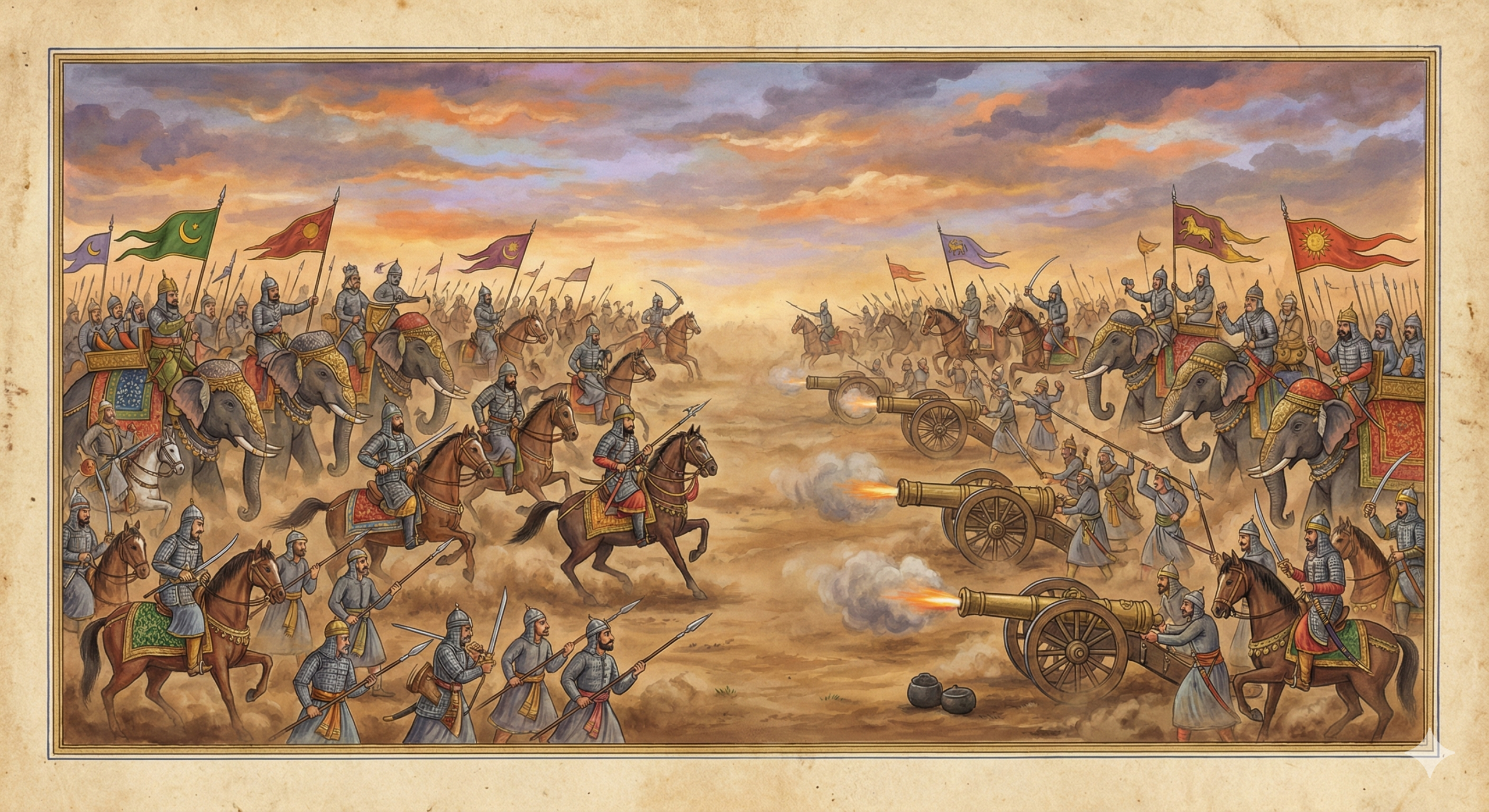
What makes Panipat extraordinary is not just that three major battles were fought there, but that each conflict fundamentally altered the balance of power in India. The first established the Mughal Empire, the second consolidated it against internal challenges, and the third shattered the dreams of Maratha supremacy while opening the door for British colonial expansion. Together, these battles span 235 years of Indian history and illustrate how military prowess, strategic innovation, and decisive leadership shaped the destiny of millions.
Understanding the Battles of Panipat requires examining not only the military tactics and individual heroism displayed on the battlefield but also the broader political, economic, and social forces that brought armies to this strategic location. Each battle tells a story of ambition and consequence, of empires rising and falling, and of how the course of history can pivot on decisions made in the chaos of combat.
Why Panipat Became the Battleground of Major Indian Wars
Panipat became the site of several decisive battles in Indian history due to its strategic geographic location. Situated close to Delhi, Panipat lay on the main invasion route from Central Asia into northern India. Any ruler who controlled Panipat could directly threaten Delhi, the political center of power for centuries.
The region also had open plains, making it suitable for large cavalry movements and artillery warfare. This made Panipat an ideal battlefield for armies relying on horses, cannons, and infantry formations. Additionally, its proximity to supply routes ensured easy access to food, water, and reinforcements.
Because of these advantages, Panipat repeatedly became the stage where empires rose and fell, shaping the political future of India.
Why Panipat? The Strategic Significance
Before delving into the individual battles, it is essential to understand why Panipat became the preferred battlefield for decisive conflicts in northern India. Geography, infrastructure, and strategic logic all contributed to making this location the natural meeting point for armies competing for control of Hindustan.
Geographic and Strategic Advantages
Panipat’s location along the Grand Trunk Road, one of Asia’s oldest and longest major roads, made it a critical junction for armies moving between Afghanistan, Central Asia, and the Indian heartland. Any force seeking to control Delhi and the fertile Indo-Gangetic plain had to pass through or near Panipat. The town’s position allowed defending armies to intercept invaders before they could reach the capital, while invading forces could use it as a staging ground for their assault on Delhi.
The terrain around Panipat offered tactical advantages for organized warfare. The relatively flat plains allowed for the deployment of large cavalry forces and artillery, essential components of medieval and early modern warfare. Yet the area also featured enough natural and man-made obstacles like rivers, canals, and villages to enable defensive positioning and tactical maneuvering.
| Event Name | Battle of Panipat |
| Total Battles | Three major battles |
| Location | Panipat, present-day Haryana, India |
| Strategic Importance | Gateway to Delhi and North India |
| First Battle Year | 1526 CE |
| First Battle Parties | Babur vs Ibrahim Lodi |
| First Battle Outcome | Foundation of the Mughal Empire |
| Second Battle Year | 1556 CE |
| Second Battle Parties | Akbar (Bairam Khan) vs Hemu |
| Second Battle Outcome | Restoration of Mughal rule in India |
| Third Battle Year | 1761 CE |
| Third Battle Parties | Ahmad Shah Abdali vs Maratha Confederacy |
| Third Battle Outcome | Crushing defeat of the Marathas |
| Military Innovation | Early use of artillery and gunpowder warfare |
| Political Impact (1526) | End of the Delhi Sultanate |
| Political Impact (1556) | Strengthening of Mughal administration |
| Political Impact (1761) | Decline of Maratha power in North India |
| Human Cost | Hundreds of thousands killed across three battles |
| Role of Geography | Flat plains ideal for large-scale warfare |
| Historical Sources | Baburnama, Akbarnama, Persian chronicles |
| Long-term Significance | Repeatedly reshaped the political destiny of India |
| Modern Relevance | Symbol of decisive turning points in Indian history |
Historical Patterns of Invasion
India’s history of invasions from the northwest established Panipat as a recurring battleground. For centuries, waves of invaders from Central Asia, Persia, and Afghanistan entered India through mountain passes, following established routes that inevitably led through Punjab toward Delhi. Panipat represented the last major defensive position before the capital, making it the logical location for rulers to confront threats to their power.
The First Battle of Panipat: 1526
The First Battle of Panipat, fought on April 21, 1526, marked the beginning of Mughal rule in India and stands as one of history’s most consequential military engagements. This battle pitted the experienced Central Asian conqueror Babur against Ibrahim Lodi, the Sultan of Delhi, in a contest that would determine the future of northern India.
At the time of the First Battle of Panipat, northern India was largely governed under the Delhi Sultanate period, which was already facing internal weaknesses and succession conflicts.
The Contenders: Babur and Ibrahim Lodi
Zahir-ud-din Muhammad Babur was a descendant of both Timur (Tamerlane) on his father’s side and Genghis Khan on his mother’s side, combining the bloodlines of two of history’s greatest conquerors. Despite this illustrious ancestry, Babur had faced repeated setbacks in his attempts to establish a kingdom in Central Asia. After losing Samarkand multiple times, he turned his attention southward to India, viewing the wealthy and politically fragmented subcontinent as an opportunity to build the empire that had eluded him in his homeland.
By 1526, Babur had already conducted several raids into India and established a foothold in Punjab. He was an experienced military commander, well-versed in the latest warfare techniques from Central Asia and the Middle East, including the use of gunpowder weapons and field artillery. His memoir, the Baburnama, reveals a thoughtful, cultured leader with keen strategic insights and a gift for inspiring loyalty among his followers.
Ibrahim Lodi, by contrast, was the third and last ruler of the Lodi dynasty, which had governed the Delhi Sultanate since 1451. Ibrahim inherited a kingdom in decline, facing rebellions from Afghan nobles who resented his attempts to centralize power. His harsh treatment of the aristocracy alienated potential supporters, and several disaffected nobles, including Daulat Khan Lodi, the governor of Punjab, actually invited Babur to invade India as a means of deposing Ibrahim.
The Military Disparity
Forces Engaged:
- Babur’s Army: Approximately 12,000-15,000 troops including cavalry, infantry, and crucially, artillery units with cannons and matchlock guns
- Ibrahim Lodi’s Army: Approximately 100,000 soldiers including cavalry and war elephants, but lacking artillery and modern firearms
On paper, Ibrahim Lodi possessed an overwhelming numerical advantage, with his forces outnumbering Babur’s by a ratio of nearly ten to one. However, numbers alone do not determine victory, and Babur’s smaller army compensated for its size disadvantage with superior technology, discipline, and tactical innovation.
Revolutionary Tactics: The Tulughma and Araba
Babur introduced tactics that were revolutionary for the Indian battlefield. His primary innovation was the combination of two tactical systems: the Tulughma (a Central Asian flanking maneuver) and the Araba (a defensive formation using carts).
The Tulughma involved dividing his force into distinct divisions: a center, flanking units, and a reserve. This allowed for coordinated attacks from multiple directions and provided flexibility to respond to changing battlefield conditions. The Araba consisted of carts tied together with ropes and chains to create a mobile defensive barrier. Behind these carts, Babur positioned his artillery and matchlock men, creating a fortified position that could deliver devastating firepower while protecting his troops from cavalry charges.
Babur also employed field artillery, a technology that Ibrahim Lodi’s forces were unfamiliar with and unprepared to counter. The psychological impact of cannon fire, combined with its destructive power, proved decisive in breaking the morale of Lodi’s troops.
The Battle Unfolds
On the morning of April 21, 1526, the two armies faced each other on the plains of Panipat. Babur had chosen his position carefully, anchoring his flanks on the town of Panipat and a wooded area, which prevented Ibrahim from using his numerical superiority to envelope Babur’s smaller force. The carts of the Araba formation created a defensive line with gaps through which Babur’s cavalry could charge and retreat.
Ibrahim Lodi, confident in his numerical advantage, ordered a frontal assault. His massive army advanced toward Babur’s position, with war elephants at the fore intended to break through enemy lines. However, as they approached, Babur’s artillery opened fire, unleashing a barrage of cannon balls and matchlock fire that the Lodi forces had never experienced before.
The noise and destruction terrified Ibrahim’s elephants, causing many to panic and stampede back through their own ranks, creating chaos in the tightly packed formations. Babur’s cavalry units, using the Tulughma tactic, launched coordinated attacks on both flanks, encircling portions of the enemy army. The Lodi forces, hemmed in by their own numbers and unable to effectively deploy their strength, began to break.
After several hours of fighting, Ibrahim Lodi himself was killed in the battle, struck down as he fought in the front lines. His death demoralized his troops and effectively ended organized resistance. Babur’s victory was complete and decisive.
Immediate Consequences
The First Battle of Panipat had immediate and far-reaching consequences. Within days, Babur marched on Delhi and Agra, occupying both cities without significant resistance. The Delhi Sultanate, which had ruled northern India for over three centuries, ceased to exist. In its place, Babur established the Mughal Empire, which would dominate the Indian subcontinent for the next three centuries.
The battle demonstrated the decisive advantage of gunpowder weapons and modern military tactics over traditional methods relying on numerical superiority and individual valor. This realization would transform warfare throughout India as subsequent rulers adopted similar technologies and tactics.
Babur’s victory also opened India to greater Central Asian and Persian cultural influence. The Mughal court became a center of Persian literature, art, and architecture, synthesizing Indian traditions with influences from Iran, Central Asia, and Turkey to create a distinctive Indo-Islamic culture that profoundly shaped the subcontinent.
The Second Battle of Panipat: 1556
The Second Battle of Panipat, fought on November 5, 1556, was a contest to determine whether the Mughal Empire established by Babur would survive or be replaced by a resurgent Hindu kingdom. This battle pitted the forces of the young Mughal emperor Akbar, led by his regent Bairam Khan, against the Hindu king Hemu, who had briefly seized Delhi and Agra after the sudden death of Akbar’s father, Humayun.
The Crisis of Mughal Succession
Babur’s son and successor, Humayun, had faced a tumultuous reign. In 1540, he was defeated by Sher Shah Suri, an Afghan noble who briefly interrupted Mughal rule. Humayun spent fifteen years in exile, seeking refuge in Persia, before finally regaining his throne in 1555. However, just six months after recapturing Delhi, Humayun died in an accident, falling down the stairs of his library while carrying books.
This left the Mughal throne to Humayun’s thirteen-year-old son, Jalal-ud-din Muhammad Akbar. The young emperor’s inexperience and the recent instability of Mughal power created an opportunity for rivals to challenge the dynasty’s legitimacy.
The Rise of Hemu
Hemu, also known as Hemchandra Vikramaditya, was one of history’s most remarkable military leaders. Born into a humble family, he rose through the ranks to become the chief minister and general of Adil Shah Suri, one of the successors to Sher Shah Suri. A brilliant military tactician and administrator, Hemu won twenty-two consecutive battles, establishing himself as the most formidable commander in northern India.
When news of Humayun’s death and Akbar’s youth reached Hemu, he saw an opportunity to restore Hindu rule to Delhi for the first time in centuries. He marched on the capital, defeating Mughal forces in a series of engagements. On October 7, 1556, Hemu captured Delhi, and on October 24, he crowned himself Raja Vikramaditya, proclaiming the restoration of Hindu sovereignty over northern India.
The Mughal Response
Akbar’s regent, Bairam Khan, a seasoned military commander who had served under both Babur and Humayun, recognized the existential threat posed by Hemu’s victories. Despite the young emperor’s age and the demoralization of Mughal forces, Bairam Khan organized a army to confront Hemu. The stage was set for another decisive confrontation at Panipat.
Forces Engaged:
- Mughal Forces: Approximately 20,000 troops led by Bairam Khan, with the thirteen-year-old Akbar present but not commanding
- Hemu’s Forces: Approximately 30,000 troops including 1,500 war elephants, battle-hardened veterans from his previous victories
The Battle: Fortune Favors the Mughals
On November 5, 1556, the two armies met at Panipat. Unlike the first battle, there was no significant technological disparity; both sides employed artillery and cavalry in similar fashion. The battle was expected to be a hard-fought contest of skill and courage.
Hemu led from the front, mounted on his war elephant, Hawai, inspiring his troops with his presence. The battle began with an exchange of artillery fire, followed by cavalry charges on both flanks. Initially, Hemu’s forces gained the upper hand, with his war elephants breaking through Mughal lines and creating disorder in the enemy ranks.
The tide of battle was turning in Hemu’s favor when fate intervened. A random arrow struck Hemu in the eye, penetrating his skull and knocking him unconscious. His mahout, the elephant driver, attempted to turn the elephant and retreat from the battlefield to save his master, but the sight of their commander’s elephant fleeing demoralized Hemu’s troops.
The Mughal forces, sensing the shift in momentum, launched a coordinated counterattack. Without Hemu’s leadership, his army’s cohesion dissolved. Soldiers began to flee, and what had been a disciplined fighting force minutes earlier descended into chaos.
Hemu was captured while unconscious and brought before Akbar and Bairam Khan. According to some accounts, Bairam Khan executed Hemu himself, while others suggest he encouraged young Akbar to strike the first blow to earn the title of “ghazi” (victorious warrior). Regardless of the exact circumstances, Hemu was beheaded, and his head was sent to Kabul as proof of victory while his body was displayed in Delhi as a warning to potential rebels.
Consequences of the Second Battle
The Second Battle of Panipat secured Mughal rule in India and eliminated the last serious threat to Akbar’s throne during his minority. With Hemu defeated and killed, no other military leader possessed the capability or credibility to challenge Mughal supremacy in northern India.
The battle also ended the realistic possibility of a Hindu kingdom reestablishing control over Delhi. Hemu’s brief reign represented the last gasp of indigenous Hindu political power in northern India until the rise of the Marathas two centuries later. The subcontinent would remain under Muslim rule, either Mughal or regional sultanates, until the British colonial period.
For Akbar personally, the victory provided the stability necessary for him to mature into one of history’s greatest rulers. As he came of age and took direct control of governance from Bairam Khan, Akbar pursued policies of religious tolerance, administrative innovation, and cultural synthesis that made his reign a golden age of Mughal civilization.
The Interlude: Mughal Golden Age and Maratha Rise
The period between the Second and Third Battles of Panipat witnessed the Mughal Empire reaching its zenith under Akbar, Jahangir, Shah Jahan, and Aurangzeb, before entering a long decline that created opportunities for regional powers to assert their independence.
Mughal Achievements
The Mughal Empire in the sixteenth and seventeenth centuries represented one of the world’s great civilizations. Under Akbar’s rule, the empire expanded to encompass most of the Indian subcontinent, implementing an efficient administrative system that balanced centralized authority with local autonomy. Akbar’s policy of religious tolerance, exemplified by abolishing the discriminatory jizya tax on non-Muslims and marrying Rajput princesses, created unprecedented harmony between Muslim rulers and Hindu subjects.
The Mughal period produced extraordinary achievements in architecture, including the Taj Mahal, Red Fort, Fatehpur Sikri, and numerous gardens, mosques, and forts that still define India’s architectural heritage. Mughal miniature painting, Persian and Urdu literature, and classical music flourished under imperial patronage, creating a sophisticated courtly culture that influenced the entire subcontinent.
The Seeds of Decline
The empire’s decline began under Aurangzeb (r. 1658-1707), the last of the great Mughal emperors. His lengthy reign saw the empire reach its greatest territorial extent, but his religious conservatism and military overextension planted seeds of disintegration. Aurangzeb reimposed the jizya tax, destroyed some Hindu temples, and engaged in costly campaigns in the Deccan that drained the treasury and alienated Hindu nobles who had been loyal to previous Mughal emperors.
The Rise of the Marathas
The primary beneficiary of Mughal decline was the Maratha Confederacy, which emerged from the Deccan plateau under the brilliant leadership of Chhatrapati Shivaji Maharaj in the late seventeenth century. Shivaji created an efficient guerrilla warfare system that frustrated Mughal attempts at conquest, established an independent kingdom, and inspired Maratha pride and nationalism.
After Aurangzeb’s death in 1707, the Marathas rapidly expanded their power, taking advantage of weak Mughal successors and fragmented imperial authority. Under the Peshwa (prime minister) system, particularly during the leadership of Baji Rao I and Balaji Baji Rao, Maratha power extended across much of India. By the mid-eighteenth century, the Marathas had established their dominance over central India, extracted tribute from Mughal Delhi, and appeared poised to become the successor to Mughal supremacy.
The Third Battle of Panipat: 1761
The Third Battle of Panipat, fought on January 14, 1761, was the largest, bloodiest, and most consequential of the three Panipat battles. This massive confrontation pitted the Maratha Confederacy against the invading Afghan forces of Ahmad Shah Durrani, with the fate of India hanging in the balance.
The Afghan Threat: Ahmad Shah Durrani
Ahmad Shah Durrani, also known as Ahmad Shah Abdali, was the founder of the Durrani Empire in Afghanistan and one of history’s most successful military commanders. A former general under the Persian emperor Nader Shah, Ahmad Shah established an independent Afghan kingdom after Nader Shah’s assassination in 1747 and embarked on a series of invasions into India.
By 1760, Ahmad Shah had conducted seven invasions of India, primarily targeting Punjab and Sindh. His motivations combined economic opportunism with concerns about Maratha expansion toward Afghanistan’s borders. The immediate trigger for his eighth invasion was an appeal from various Indian Muslim rulers, including the nominal Mughal emperor Shah Alam II, who feared Maratha dominance and sought Afghan help to check their power.
Maratha Ambitions and Preparations
The Maratha Confederacy in 1760 represented the dominant military power in India. Under the leadership of Peshwa Balaji Baji Rao, the Marathas controlled or extracted tribute from territories stretching from the Deccan to Delhi, from Gujarat to Bengal. Their military forces, numbering in the hundreds of thousands across their various sardars (chieftains), combined traditional cavalry with modern artillery and infantry.
When Ahmad Shah invaded in 1760, the Marathas assembled a massive army under the command of Sadashiv Rao Bhau, the Peshwa’s cousin, to confront the Afghan threat. Unlike previous conflicts where Marathas employed hit-and-run tactics, Bhau decided to meet the Afghans in a conventional pitched battle, believing that Maratha strength was sufficient to crush the invaders decisively.
The Prelude: Strategic Maneuvering
The campaign leading to the Third Battle of Panipat involved months of strategic maneuvering. The Maratha army, accompanied by a massive non-combatant train of pilgrims, traders, and camp followers, marched north to confront Ahmad Shah. Contemporary estimates suggest the total Maratha column numbered anywhere from 300,000 to half a million people, making it one of the largest military expeditions in history.
Both armies converged on the Delhi region in 1760. After initial skirmishes, the armies established positions near Panipat in October 1760, but the actual battle did not occur until January 1761. During these months, both sides engaged in raids, negotiations, and attempts to secure supplies while preventing their opponents from doing the same.
The Marathas made a critical strategic error by establishing a fortified camp at Panipat and waiting for battle rather than maintaining their mobility. Ahmad Shah’s forces cut Maratha supply lines, and by January 1761, the Maratha army was suffering from severe food shortages and starvation. This weakened their fighting capability and forced them to either retreat or give battle under unfavorable conditions.
Forces and Technology
Forces Engaged:
- Maratha Forces: Approximately 45,000-60,000 combat troops with artillery, plus tens of thousands of non-combatants
- Afghan Coalition: Approximately 40,000-60,000 troops including Afghan cavalry, Rohilla Afghans, and forces from allied Indian Muslim rulers
Both armies possessed significant artillery, with the Marathas fielding over 200 cannons including large siege guns. However, the Afghan cavalry, particularly Ahmad Shah’s elite horsemen, represented the finest light cavalry in Asia, renowned for their mobility, archery skills, and shock tactics.
The Battle: January 14, 1761
The Third Battle of Panipat began at dawn on January 14, 1761, and lasted throughout the day, making it one of the longest single-day battles in history. The Marathas, desperate due to starvation and hoping to break the siege, launched an attack on Afghan positions.
The battle opened with a massive artillery exchange that favored the Marathas initially. Their superior gunnery inflicted heavy casualties on Afghan forces, and Maratha infantry advances made gains on the battlefield. For several hours, it appeared that Maratha numerical superiority and firepower might prevail despite their weakened condition.
However, Afghan cavalry, held in reserve, launched devastating charges against Maratha flanks. The mobility and skill of Afghan horsemen exploited gaps in Maratha formations, attacking artillery positions and creating chaos in enemy ranks. A critical moment came when Afghan cavalry managed to destroy or capture many Maratha cannons, eliminating their firepower advantage.
Sadashiv Rao Bhau, leading from the front on an elephant, dismounted to lead infantry personally when he saw his forces wavering. This brave gesture backfired when Bhau was killed in combat, possibly by a bullet. His death, combined with the death or capture of most other senior Maratha commanders, decapitated the army’s leadership structure.
Without coordinated command, the Maratha army disintegrated. Soldiers fled the battlefield, only to be cut down by pursuing Afghan cavalry. The carnage continued through the afternoon and into the night as Afghans pursued fleeing Marathas for miles around Panipat.
The Aftermath: Unprecedented Carnage
The Third Battle of Panipat resulted in catastrophic casualties that made it one of history’s bloodiest single-day battles. Contemporary estimates suggest that between 60,000 and 70,000 people were killed during the battle itself, with tens of thousands more dying in the pursuit and aftermath. The non-combatant camp followers suffered particularly horrific losses as they had no means of defense or escape.
Nearly every prominent Maratha noble present at the battle was either killed or captured. The flower of Maratha military leadership, including Sadashiv Rao Bhau, Vishwas Rao (the Peshwa’s son and heir), and numerous sardars perished. The few survivors who reached Maharashtra brought news of the disaster that plunged the Maratha homeland into mourning.
Strategic and Political Consequences
The immediate consequence of the battle was the complete collapse of Maratha power in northern India. Territories that had acknowledged Maratha supremacy rejected their authority, and the Maratha dream of succeeding the Mughals as rulers of all India died on the field of Panipat.
However, Ahmad Shah Durrani, despite his victory, did not establish permanent Afghan rule in India. His own army had suffered heavy losses, his supply lines back to Afghanistan were precarious, and news of troubles in his homeland forced him to withdraw from India within months of the battle. He conducted one more brief invasion in 1767 but never again attempted to hold Indian territory.
The power vacuum created by Maratha collapse and Afghan withdrawal fragmented northern India into numerous small kingdoms and principalities. The nominal Mughal emperor in Delhi held no real power, and no indigenous force possessed the strength to unite the subcontinent.
The British Opportunity
The Third Battle of Panipat’s most significant long-term consequence was creating conditions that facilitated British colonial expansion. The East India Company, which had been gradually expanding its territorial holdings in Bengal and southern India, faced no unified opposition after 1761.
The Road to Colonial Dominance
The Marathas recovered partially from their Panipat disaster, but they never regained their former power or unity. The confederacy became increasingly divided among rival factions, making them vulnerable to British divide-and-rule tactics. When the British fought three wars against the Marathas between 1775 and 1818, they faced a fragmented alliance rather than the unified force that had dominated India in the mid-eighteenth century.
Other regional powers like Mysore, the Sikhs, and various Afghan and Rajput kingdoms likewise proved unable to unite against British expansion. The memory of Panipat’s carnage discouraged many Indian rulers from risking large-scale confrontations, leading them to accept British subsidiary alliances that gradually subordinated them to colonial control.
By 1818, the British had established undisputed supremacy over India, a dominance that lasted until independence in 1947. While numerous factors contributed to British success, including superior naval power, industrial technology, and diplomatic skill, the fragmentation of Indian power following the Third Battle of Panipat created the political conditions that made colonial conquest possible.
Comparing the Three Battles
Each of the three Battles of Panipat occurred in a different political and technological context, yet certain patterns unite them and offer insights into military history and the dynamics of empire.
Technological Evolution
The three battles reflect the evolution of military technology across 235 years. The First Battle demonstrated the decisive advantage of gunpowder weapons and field artillery against traditional forces. The Second Battle showed both sides employing similar technologies, with victory determined by leadership, morale, and chance. The Third Battle featured the most advanced weapons of the mid-eighteenth century, with massive artillery barrages producing casualties on an unprecedented scale.
The Role of Leadership
Each battle turned significantly on the quality of leadership. Babur’s tactical genius overcame numerical inferiority in 1526. Bairam Khan’s steadiness preserved Mughal power in 1556, aided by Hemu’s unfortunate wounding. The Third Battle demonstrated both the importance of leadership, with the Maratha collapse following Sadashiv Rao Bhau’s death, and the limitations of individual brilliance against strategic errors and logistical disadvantages.
Strategic Location
All three battles confirmed Panipat’s strategic significance as the gateway to Delhi and northern India. The town’s location along invasion routes from the northwest, combined with terrain suitable for large-scale battles, made it the natural site for decisive confrontations. This geographic determinism shaped Indian history, as control of Panipat effectively meant control of the northern plains.
Military Innovations and Tactics
The Battles of Panipat showcase various military innovations that transformed warfare in India and provide case studies in tactical thinking that remain relevant for military historians.
Artillery and Firearms
The progressive importance of gunpowder weapons across the three battles illustrates the military revolution that transformed global warfare between the sixteenth and eighteenth centuries. Babur’s effective use of field artillery in 1526 introduced a technology that would dominate battlefields for the next four centuries. By 1761, both sides deployed hundreds of cannons, making artillery the dominant battlefield weapon that determined initial phases of combat.
Cavalry Tactics
Despite technological advances, cavalry remained crucial in all three battles. Babur’s combined use of cavalry with artillery, Hemu’s war elephants supporting cavalry charges, and the devastating effectiveness of Afghan horsemen at the Third Battle demonstrate that mobility and shock action retained their importance even as firepower increased.
Logistics and Supply
The Third Battle particularly highlighted the decisive importance of logistics. The Maratha army’s starvation, resulting from severed supply lines, weakened them physically and psychologically before battle began. This demonstrates the ancient military wisdom that armies march on their stomachs, and that logistical superiority can be as decisive as tactical brilliance.
Cultural and Social Impact
Beyond political and military consequences, the Battles of Panipat profoundly influenced Indian culture, society, and collective memory in ways that persist to the present day.
Demographic Changes
Each battle triggered significant demographic shifts. The First Battle encouraged migration of Central Asian and Persian nobility, scholars, artists, and merchants to India, enriching Mughal court culture. The massive casualties of the Third Battle depopulated parts of northern India and Maharashtra, with effects visible for generations.
Religious and Communal Impact
The battles shaped religious identities and communal relations in complex ways. The establishment of Mughal rule after the First Battle reinforced Islamic political authority while simultaneously creating conditions for Hindu-Muslim cultural synthesis under Akbar and his successors. The Second Battle’s defeat of Hemu ended hopes for Hindu political supremacy in the north. The Third Battle, framed by some as a conflict between Hindu Marathas and Muslim Afghans, though it was primarily a political and territorial dispute, influenced later communal narratives.
In Literature and Memory
The battles, particularly the Third Battle of Panipat, occupy prominent places in Indian literature and collective memory. Marathi literature contains numerous poems, ballads, and historical narratives commemorating those who fell at Panipat. The battle became a symbol of tragic heroism, of courage in the face of overwhelming odds, and of the fragility of power and ambition.
Archaeological and Historical Evidence
Modern archaeology and historical scholarship have worked to separate fact from legend regarding the Battles of Panipat, though significant debates remain.
Archaeological Discoveries
Archaeological excavations at Panipat and surrounding areas have uncovered evidence of military activity, including weapons, coins, and human remains that provide physical testimony to the battles. However, the transformation of the battlefield area into agricultural land and urban development has destroyed or obscured much potential evidence.
Primary Sources
Historical understanding of the battles relies on various primary sources of varying reliability. Babur’s own memoir, the Baburnama, provides a firsthand account of the First Battle. Contemporary Persian and Sanskrit chronicles document the Second Battle, though with evident biases. The Third Battle generated numerous accounts from participants and observers, including letters, official reports, and later historical compilations, though casualty figures and specific details remain disputed.
Historical Debates
Historians continue to debate aspects of all three battles. Questions include the exact size of armies involved, the precise casualty figures, the relative importance of various tactical factors, and the extent to which individual battles determined historical trajectories versus broader social, economic, and political forces. These debates reflect both gaps in historical evidence and differing methodological approaches to understanding the past.
Panipat in Modern India
Today, Panipat is a thriving industrial city known for textile manufacturing rather than battlefields. Yet the town’s historical significance remains evident in museums, monuments, and the collective memory of those who visit its sites.
Memorials and Museums
The Panipat Museum houses artifacts and displays related to all three battles, educating visitors about the town’s unique place in Indian history. Various monuments and markers indicate battlefield locations, though urban development has transformed the landscape beyond recognition from its appearance in 1526, 1556, or 1761.
Tourism and Education
Panipat attracts history enthusiasts, students, and tourists interested in exploring sites where Indian history pivoted. Educational programs use the battles as case studies in military history, strategic thinking, and the broader patterns of Indian historical development. The town serves as a tangible connection to events that shaped the subcontinent’s trajectory.
Lessons from Panipat
What lessons do the Battles of Panipat offer for understanding history, warfare, and human affairs more broadly?
The Importance of Adaptation
Babur’s victory in 1526 demonstrated that success belongs to those who adapt to changing circumstances and embrace innovation. His willingness to employ new technologies and tactics overcame seemingly insurmountable disadvantages. This lesson applies beyond military affairs to all areas of human endeavor where adaptation and innovation determine success or failure.
The Role of Chance
Hemu’s wounding by a random arrow at the Second Battle illustrates the role of chance in historical events. Even the most carefully laid plans can be upended by unpredictable events. This suggests humility when analyzing historical causation and caution against overly deterministic interpretations of why events unfolded as they did.
Strategic Thinking Versus Tactical Brilliance
The Third Battle shows that tactical brilliance cannot overcome fundamental strategic errors. The Marathas’ decision to establish a static camp and allow their supply lines to be cut doomed them regardless of their soldiers’ courage or their commanders’ skill. This reinforces the principle that strategy must precede and guide tactics, and that operational and logistical factors often determine outcomes more than battlefield performance.
The Fragility of Power
All three battles demonstrate how quickly power can shift and how fragile even seemingly dominant positions can be. The Delhi Sultanate appeared secure before Babur’s invasion. Hemu seemed on the verge of establishing a new dynasty before his defeat. The Marathas dominated India before Panipat destroyed their power. This reminds us that no position is permanently secure and that vigilance, adaptation, and wise leadership are necessary to maintain power and prosperity.
Unity and Division
The aftermath of the Third Battle particularly illustrates how internal divisions weaken collective strength. The Marathas’ failure to rebuild their confederacy’s unity after 1761 left them vulnerable to British expansion. This lesson about the importance of unity against external threats resonates throughout Indian history and remains relevant in contemporary contexts.
Counterfactual Scenarios
Historical speculation about “what if” scenarios can illuminate the significance of the Battles of Panipat by considering how Indian history might have developed differently had these battles produced different outcomes.
If Ibrahim Lodi Had Won
If Ibrahim Lodi had defeated Babur in 1526, the Delhi Sultanate might have continued, though its internal weaknesses would likely have produced eventual collapse or transformation. India might have avoided significant Central Asian influence, potentially developing different cultural and political patterns. However, other invaders would likely have eventually challenged a weakened sultanate, so permanent Delhi Sultanate rule seems improbable.
If Hemu Had Survived
Had Hemu not been wounded and had he won the Second Battle, a Hindu kingdom centered on Delhi might have been established. This would have represented a remarkable reversal of centuries of Islamic political dominance in northern India. However, Hemu would have faced challenges from remaining Mughal forces, regional powers, and potential Afghan invasions, making the sustainability of such a kingdom uncertain.
If the Marathas Had Won in 1761
A Maratha victory at the Third Battle would have established them as undisputed masters of India, potentially creating a Hindu-dominated empire succeeding the Mughals. This might have prevented or significantly delayed British colonial expansion, as a unified and powerful Maratha state could have resisted European encroachment more effectively than the fragmented polities that actually existed after 1761. Indian history might have followed a trajectory more similar to Japan, maintaining independence while selectively adopting Western technology.
The Battles in Popular Culture
The Battles of Panipat have inspired numerous creative works that bring these historical events to popular audiences through various media.
Films and Television
Bollywood and Indian television have produced several films and series depicting the battles, particularly the Third Battle with its dramatic narrative and tragic heroism. These productions, while often taking liberties with historical accuracy for dramatic effect, introduce these pivotal events to audiences who might not encounter them through formal history education.
Literature
Historical novels, poetry, and dramatic works have reimagined the battles from various perspectives. Marathi literature particularly has produced extensive work about the Third Battle, treating it as a defining moment in Maratha identity and history. These literary treatments explore the human dimensions of historical events, imagining the thoughts, emotions, and motivations of historical figures.
Video Games and Digital Media
Strategy video games and digital recreations allow users to “fight” the Battles of Panipat, making decisions about tactics, positioning, and resource allocation. While simplified, these interactive experiences engage people with historical events in novel ways and can stimulate interest in deeper historical learning.
Comparative Military History
The Battles of Panipat offer opportunities for comparative analysis with other decisive battles in world history, revealing universal patterns in military affairs.
Technological Advantages
The First Battle’s outcome, determined by Babur’s technological superiority, parallels other battles where new weapons or tactics proved decisive, such as the Spanish conquistadors’ gunpowder advantages in the Americas or the Prussian needle gun at Sadowa. These comparisons highlight how technological innovation can compensate for numerical inferiority and transform military balance.
Decisive Battles and Historical Change
All three Panipat battles qualify as “decisive battles” that significantly altered historical trajectories. They can be compared to other such battles like Hastings (1066), which established Norman rule in England; Waterloo (1815), which ended Napoleon’s empire; or Stalingrad (1942-43), which turned the tide of World War II. These comparisons reveal patterns in how military outcomes translate into broader political, social, and cultural changes.
Modern Military Analysis
Contemporary military professionals and strategists continue to study the Battles of Panipat for insights applicable to modern warfare, despite the vast technological changes that separate eighteenth-century battlefields from contemporary military operations.
Principles of War
The battles illustrate timeless principles of war such as the objective, offensive, mass, economy of force, maneuver, unity of command, security, surprise, and simplicity. Babur’s concentration of force at decisive points, the importance of maintaining supply lines demonstrated at the Third Battle, and the catastrophic effects of losing command cohesion all exemplify principles that remain valid in contemporary military doctrine.
Combined Arms Operations
Babur’s integration of artillery, cavalry, and infantry in 1526 represents an early example of combined arms warfare, where different military capabilities are synchronized to achieve effects greater than the sum of their parts. This concept remains fundamental to modern military thinking, whether coordinating air power, armor, and infantry in ground operations or integrating cyber, space, and conventional capabilities in contemporary conflicts.
Frequently Asked Questions About the Battle of Panipat
1. How many Battles of Panipat were there?
There were three major Battles of Panipat: the First Battle in 1526, the Second Battle in 1556, and the Third Battle in 1761. Each battle was a decisive engagement that significantly influenced the political landscape of India.
2. Where is Panipat located?
Panipat is a city in the Haryana state of northern India, located approximately 90 kilometers (56 miles) north of Delhi along the ancient Grand Trunk Road. Its strategic position made it the natural site for battles between forces competing for control of Delhi and northern India.
3. Who won the First Battle of Panipat?
Babur won the First Battle of Panipat in 1526, defeating Ibrahim Lodi, the Sultan of Delhi. This victory established the Mughal Empire in India, which would dominate the subcontinent for the next three centuries.
4. What military innovations did Babur use in 1526?
Babur employed several revolutionary tactics including the Tulughma (flanking maneuver), the Araba (defensive cart formation), and effective use of field artillery and matchlock guns. These innovations gave him decisive advantages over Ibrahim Lodi’s much larger but technologically inferior army.
5. Who was Hemu and why is he significant?
Hemu, also known as Hemchandra Vikramaditya, was a Hindu general and minister who won 22 consecutive battles and briefly crowned himself Raja after capturing Delhi in 1556. He represented the last serious attempt to establish Hindu rule over northern India before being defeated at the Second Battle of Panipat.
6. How did Hemu lose the Second Battle of Panipat?
Hemu was struck in the eye by a random arrow during the battle, knocking him unconscious. When his troops saw his war elephant retreating, they believed their commander had fled and their army lost cohesion, leading to defeat despite having been winning the battle up to that point.
7. Why was the Third Battle of Panipat fought?
The Third Battle of Panipat (1761) was fought between the Maratha Confederacy and Ahmad Shah Durrani’s Afghan forces. The Marathas sought to establish their supremacy over all of India, while Ahmad Shah invaded to check Maratha expansion and responded to appeals from Indian Muslim rulers who feared Maratha dominance.
8. How many casualties occurred in the Third Battle of Panipat?
The Third Battle of Panipat was one of history’s bloodiest single-day battles. Estimates suggest 60,000 to 70,000 people were killed during and immediately after the battle, with tens of thousands more dying from wounds, starvation, and exposure in the following days.
9. Who won the Third Battle of Panipat?
Ahmad Shah Durrani and his Afghan coalition won a decisive victory over the Marathas. However, despite winning, Ahmad Shah withdrew from India shortly after due to his own heavy losses and troubles in Afghanistan, failing to establish permanent Afghan rule.
10. What was the long-term impact of the Third Battle of Panipat?
The battle shattered Maratha power and ended their ambitions to succeed the Mughals as rulers of all India. The resulting power vacuum and fragmentation of Indian political authority created conditions that facilitated British colonial expansion in the late 18th and early 19th centuries.
11. Did the Mughal Empire benefit from any of these battles?
The First and Second Battles directly benefited the Mughals by establishing and then securing their rule. However, by the Third Battle in 1761, Mughal power had declined to the point where the emperor was merely a figurehead. The Afghan victory over the Marathas did not restore real Mughal authority.
12. What role did elephants play in these battles?
War elephants were important in the Second and Third Battles but proved vulnerable to artillery fire. In the First Battle, Babur’s cannon fire terrified Ibrahim Lodi’s elephants, causing them to stampede through their own ranks. By the Third Battle, while still used, elephants were less dominant due to improved firearms.
13. How did the Battles of Panipat influence British colonization of India?
The Third Battle’s destruction of Maratha power created a fragmented political landscape with no dominant indigenous power capable of unifying resistance against British expansion. This fragmentation allowed the British East India Company to employ divide-and-rule tactics and gradually establish colonial control.
14. What happened to Panipat after these battles?
Panipat continued as a town along major trade routes but its importance as a battlefield ended after 1761. Today it is a thriving industrial city known for textile manufacturing, particularly carpets and blankets, while museums and monuments commemorate its historical significance.
15. Were there other significant battles at Panipat?
While these three are the most famous, other smaller engagements occurred near Panipat throughout history. However, none matched the scale or historical significance of the major three battles that fundamentally altered India’s political landscape.
16. What sources provide information about these battles?
Primary sources include Babur’s memoir (Baburnama) for the First Battle, contemporary Persian and Sanskrit chronicles for the Second Battle, and numerous letters, reports, and historical accounts for the Third Battle. Archaeological evidence and later historical compilations supplement these primary sources.
17. How long did each battle last?
The First Battle lasted several hours on April 21, 1526. The Second Battle also lasted several hours on November 5, 1556. The Third Battle was the longest, lasting throughout the day on January 14, 1761, making it one of history’s longest single-day battles.
18. What was the Maratha Confederacy?
The Maratha Confederacy was a Hindu-dominated political and military alliance that emerged from the Deccan plateau in the 17th century. Under leaders like Shivaji and the Peshwas, it expanded to control or extract tribute from much of India by the mid-18th century before its defeat at the Third Battle of Panipat.
19. Can tourists visit the Panipat battlefield today?
Yes, tourists can visit Panipat, which has a museum dedicated to the battles and various monuments marking historical sites. However, urban development and agriculture have transformed the landscape, so the actual battlefield appearance differs greatly from historical times.
20. Why did three major battles occur at the same location?
Geography and strategy made Panipat the natural site for decisive battles. Its location along invasion routes from the northwest, position as the last major defensive point before Delhi, and terrain suitable for large-scale warfare made it the logical meeting point for armies competing for control of northern India.
Conclusion
The three Battles of Panipat stand as pivotal moments in Indian history, each representing a turning point that redirected the subcontinent’s political, cultural, and social trajectory. The First Battle in 1526 established Mughal rule and introduced new military technologies and cultural influences that would shape India for centuries. The Second Battle in 1556 consolidated Mughal power and ended the possibility of a Hindu restoration in northern India. The Third Battle in 1761 shattered Maratha dreams of pan-Indian empire and created conditions that facilitated British colonial expansion.
These battles demonstrate the complex interplay of individual leadership, technological innovation, strategic thinking, tactical execution, and pure chance in determining historical outcomes. They illustrate how military victories translate into broader political and social changes, how power can shift dramatically in brief periods, and how the consequences of decisions made in the chaos of battle can echo through generations.
The small town of Panipat, through an accident of geography that made it the natural meeting point for contending armies, became the stage for three of history’s most consequential conflicts. The blood spilled on its fields determined who would rule India, how cultures would blend and clash, and ultimately the path that led to modern India.
More than two and a half centuries after the last battle, Panipat’s significance endures in historical memory, scholarly analysis, and popular culture. The battles remind us that history is shaped not only by broad economic forces and social movements but also by specific events where courage, leadership, innovation, and fortune determine outcomes that affect millions. They teach lessons about the importance of adaptation, the role of technology, the fragility of power, and the human costs of ambition and conflict.
As we study these battles today, we see not just military history but windows into the societies that produced these conflicts, the leaders who directed them, the soldiers who fought them, and the countless ordinary people whose lives were transformed by their outcomes. The Battles of Panipat changed Indian history, and understanding them helps us understand how the past shapes the present and how moments of decision and conflict can alter the course of civilizations.
The repeated power struggles at Panipat eventually reshaped India’s political future, creating conditions that, centuries later, influenced the later freedom movement in India.