Lessons From India’s Oldest: Civilizations for Today’s Cultural Identity Debates
Introduction: Cultural Identity Debates Are Older Than We Think
Cultural identity debates dominate modern India. They appear in political speeches, academic discussions, television debates, and increasingly on social media. Questions about who represents Indian culture, whose traditions are authentic, and how the past should be interpreted are discussed with urgency and often with emotion.
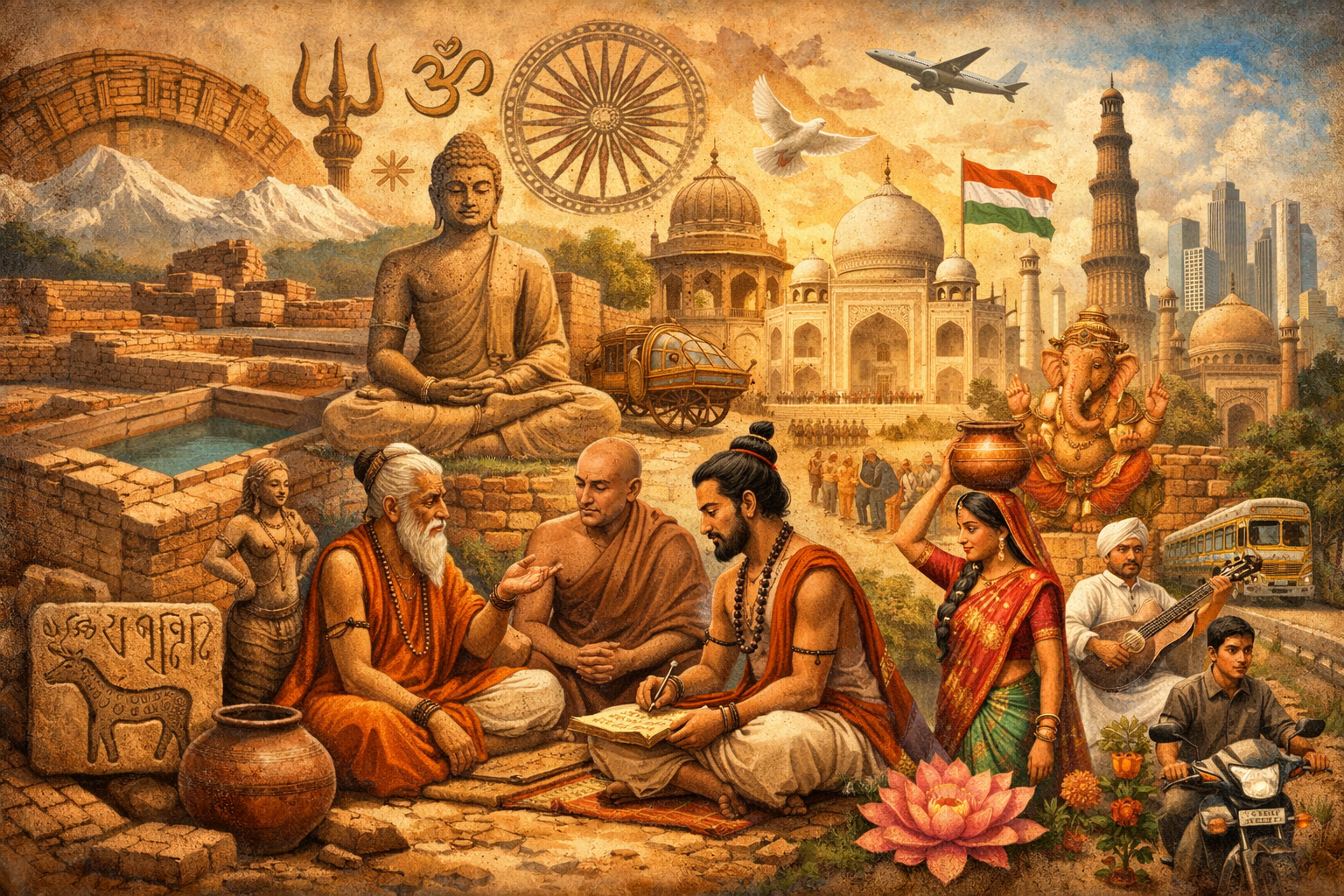
Yet these debates are not unique to the present era. Long before the emergence of modern nation-states, political parties, or digital platforms, the Indian subcontinent was already negotiating questions of identity, belonging, belief, and coexistence. India’s oldest civilizations did not exist in isolation or ideological certainty. They developed within complexity, diversity, and continuous change.
Understanding this ancient context is essential. When history is viewed selectively, it becomes a tool for division. When it is understood holistically, it becomes a source of perspective. This article examines what India’s oldest civilizations can teach us about navigating today’s cultural identity debates with maturity, depth, and historical honesty.
The Indus Valley Civilization: Order Without Cultural Assertion
The Indus Valley Civilization, flourishing between roughly 2600 and 1900 BCE, represents one of humanity’s earliest experiments in urban life. Cities such as Mohenjo-daro and Harappa reveal remarkable achievements in planning, engineering, and public infrastructure.
What is striking about these cities is not only what they contain, but what they lack. Archaeologists have not found large palaces, towering monuments dedicated to rulers, or explicit religious symbols asserting dominance over public space. There is no clear evidence of kings demanding worship or rigid social stratification enforced through architecture.
This absence challenges modern assumptions about how civilizations establish authority. The Indus Valley appears to have functioned through standardized systems rather than symbolic power. Uniform brick sizes, consistent city layouts, and advanced drainage systems suggest shared civic values rather than enforced identity narratives.
The lesson here is significant. Stability does not require constant cultural assertion. Societies can thrive when cooperation, fairness, and everyday order are prioritized over ideological dominance.
Civic Identity Versus Symbolic Identity
Modern cultural debates often revolve around symbolic identity. Flags, slogans, monuments, and historical interpretations are treated as essential markers of belonging. While symbols have their place, overreliance on them can obscure more meaningful forms of social cohesion.
The Indus Valley Civilization appears to have relied on civic identity. People were connected through shared systems of water management, trade, and urban maintenance. Identity was lived rather than declared.
This approach offers an important lesson for contemporary society. When cultural identity is reduced to symbols alone, it becomes fragile and defensive. When it is embedded in shared responsibility and mutual dependence, it becomes resilient.
Economic Exchange and Cultural Confidence
Archaeological evidence shows that the Indus Valley people engaged in extensive trade networks. Materials such as lapis lazuli, beads, and seals indicate connections with Mesopotamia, Central Asia, and coastal regions.
Such trade required openness and adaptability. It demanded trust across cultural boundaries. There is no evidence that foreign influence was perceived as a threat to identity.
This historical reality contradicts modern fears about cultural exchange. Interaction did not erase Indus Valley identity. It strengthened it.
The broader lesson is clear. Cultural confidence grows through engagement, not isolation. Civilizations that fear exchange often stagnate. Those that embrace it evolve.
The Vedic Period: Diversity Within a Shared Framework
The later Vedic period introduced new social structures, religious practices, and philosophical ideas. Unlike the urban uniformity of the Indus Valley, Vedic society was more decentralized and diverse.
Yet this diversity did not lead to cultural collapse. Instead, it produced a rich intellectual tradition rooted in inquiry and dialogue. The Vedas themselves are not monolithic texts. They contain layers of thought, ritual practices, and philosophical reflection.
Importantly, the transition from ritual-focused traditions to philosophical inquiry was not enforced through cultural suppression. It emerged organically through questioning and reinterpretation.
This evolution demonstrates that cultural identity in ancient India was flexible. Change was not seen as betrayal. It was seen as growth.
Debate as a Cultural Value
One of the most overlooked aspects of ancient Indian civilization is its respect for debate. Philosophical texts from the Upanishads to later schools of thought are structured around dialogue.
Teachers are questioned. Students challenge assumptions. Competing ideas coexist without immediate resolution. Truth is not presented as a fixed doctrine but as a pursuit.
This intellectual culture stands in contrast to modern tendencies to equate disagreement with disloyalty. Ancient India understood that questioning strengthens understanding.
The lesson is powerful. A culture that fears debate reveals insecurity. A culture that encourages debate demonstrates confidence.
Pluralism as a Historical Reality
India’s civilizational history is marked by the coexistence of multiple belief systems. Buddhism and Jainism emerged alongside Vedic traditions. Later, devotional movements reshaped religious expression across regions.
These traditions did not simply replace one another. They interacted, competed, and influenced each other. Concepts moved across boundaries. Practices evolved.
This pluralism was not always peaceful, but it was persistent. Unlike civilizations that collapsed under rigid ideological frameworks, India adapted.
The survival of Indian civilization owes much to this adaptability. Pluralism was not a moral ideal imposed from above. It was a practical necessity rooted in diversity.
Religion and Political Authority
Another important lesson from ancient India lies in the relationship between religion and governance. While religious ideas influenced society, political authority was rarely justified through absolute divine claims.
Rulers often sought legitimacy through ethical conduct, social welfare, and stability rather than religious exclusivity. Moral authority mattered more than theological dominance.
This separation limited the extent to which identity could be weaponized by the state. Cultural traditions remained dynamic rather than frozen by political decree.
Modern societies can learn from this balance. When political power seeks to define culture rigidly, it risks alienation and conflict.
Mythology as a Living Tradition
Indian myths were never static. Stories evolved across regions and eras. Deities took on new attributes. Narratives adapted to local contexts.
This fluidity allowed myths to remain relevant. Rather than enforcing uniform interpretation, ancient Indian culture allowed multiple tellings to coexist.
Modern efforts to fix mythology into one authoritative version misunderstand this tradition. Preservation does not require rigidity.
Living traditions survive through reinterpretation. Frozen traditions fade.
Language and Cultural Coexistence
Ancient India was inherently multilingual. Sanskrit coexisted with Prakrits, Pali, Tamil, and numerous regional languages.
Language was not treated as a threat to unity. Instead, it was a vehicle for expression. Different languages served different purposes: ritual, administration, literature, and everyday communication.
This linguistic coexistence offers a valuable lesson. Cultural unity does not require linguistic uniformity. Respect for diversity strengthens shared identity.
The Danger of Selective History
One of the greatest risks in modern cultural debates is selective history. When the past is reduced to isolated moments or symbols, it loses context.
Ancient India was not a utopia. It contained contradictions, conflicts, and inequalities. A mature engagement with history acknowledges complexity rather than erasing it.
Using history as a weapon simplifies reality. Using it as a guide encourages reflection.
Identity as Continuity, Not Confrontation
Ancient Indian civilizations understood identity as continuity. Traditions evolved gradually. Change was absorbed rather than resisted violently.
Modern identity debates often frame culture as something under constant attack. This mindset produces defensiveness rather than understanding.
History suggests a different approach. Identity endures through adaptation, not confrontation.
What Modern India Can Relearn
India’s oldest civilizations do not provide ready-made solutions for contemporary issues. They offer something more valuable: perspective.
They remind us that diversity is not a modern problem. Debate is not cultural decay. Change is not loss.
They show that civilizations survive not by enforcing sameness, but by managing difference.
Conclusion: Looking Back With Honesty
India’s cultural identity debates will continue. They are shaped by modern realities and cannot be resolved by historical imitation.
But history can inform how we engage with these debates. Ancient India teaches patience, humility, and openness.
It reminds us that identity is not a fortress to defend, but a river that flows, absorbs, and renews itself.
Understanding this truth is not just an academic exercise. It is a necessity for navigating the present without losing sight of the past.