Mughal Empire History: Rulers, Administration and Legacy
The Mughal Empire stands as one of the most magnificent and influential dynasties in world history, ruling the Indian subcontinent for over three centuries from 1526 to 1857. Founded by Babur, a descendant of both Timur and Genghis Khan, the Mughal Empire transformed India through military conquest, administrative innovation, cultural synthesis, and artistic patronage that produced some of humanity’s most breathtaking architectural monuments and refined artistic traditions.
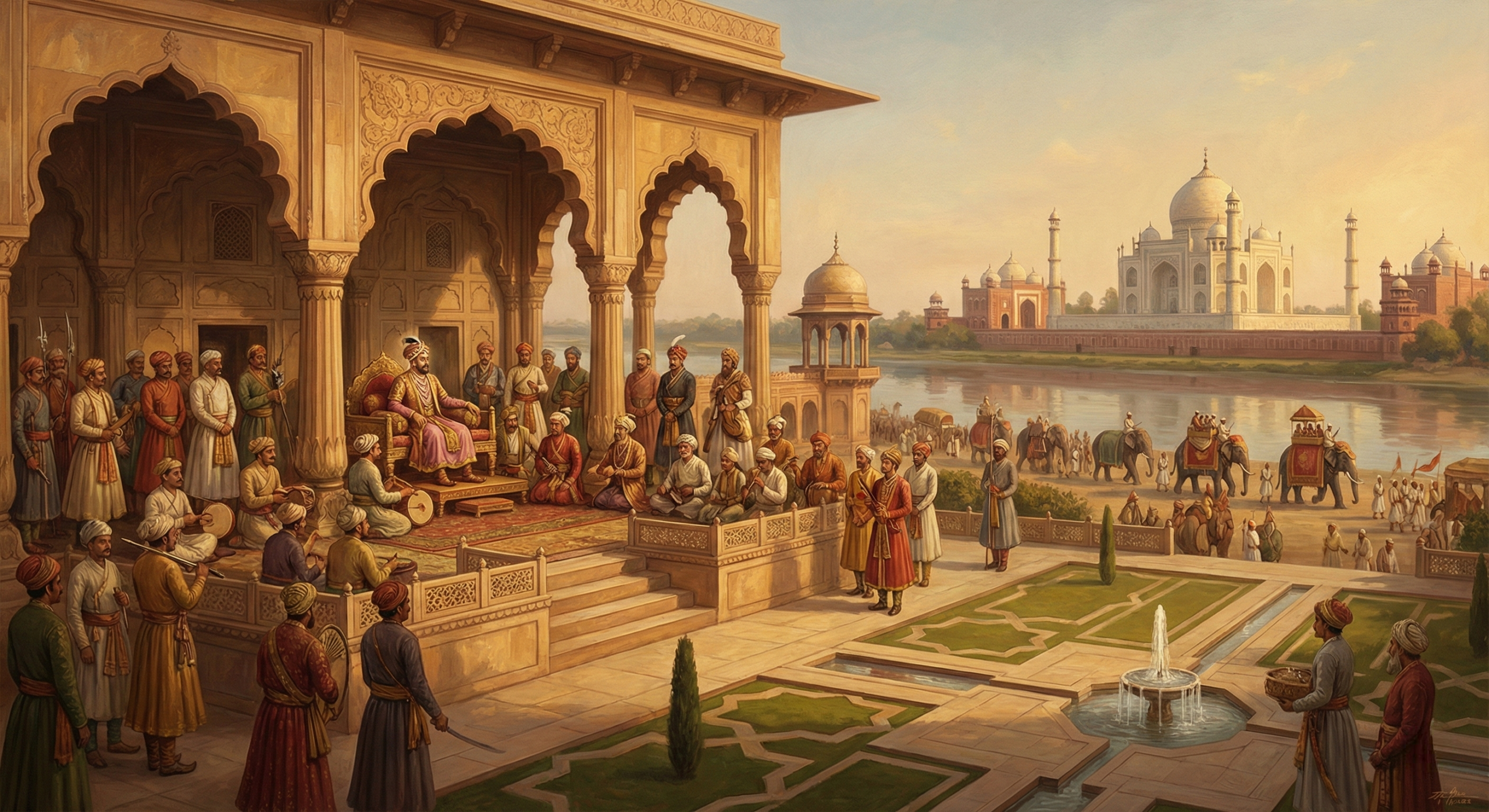
The Mughals were more than mere conquerors; they were sophisticated rulers who created a syncretic culture blending Persian, Central Asian, and Indian elements. Their legacy includes the Taj Mahal, considered one of the Seven Wonders of the World, along with countless forts, palaces, gardens, and mosques that continue to define India’s architectural heritage. Beyond physical monuments, the Mughals fostered developments in literature, painting, music, cuisine, and administrative systems that profoundly shaped South Asian civilization.
This comprehensive exploration examines the Mughal Empire’s rise to power, its golden age under enlightened rulers like Akbar, its architectural and artistic achievements, its gradual decline, and its enduring influence on modern India, Pakistan, and Bangladesh. Understanding the Mughals is essential to understanding the cultural, religious, and political forces that shaped the Indian subcontinent and continue to influence it today.
Mughal Empire: Highlights Overview
The Mughal Empire was ruled by a powerful line of emperors who shaped India’s political, cultural, and architectural history for over three centuries.
| Dynasty Name | Mughal Empire (also spelled Mogul) |
| Time Period | 1526 – 1857 CE (Over 300 years) |
| Founder | Zahir-ud-din Muhammad Babur |
| Greatest Ruler | Akbar the Great (r. 1556-1605) |
| Peak Territory | 4 million square kilometers at its zenith under Aurangzeb |
| Capital Cities | Agra, Delhi, Fatehpur Sikri, Lahore (at various times) |
| Official Languages | Persian (court language), Chagatai Turkish, Urdu, Hindi |
| Religion | Islam (Sunni), with policies varying from religious tolerance to orthodox conservatism |
| Major Emperors | Babur, Humayun, Akbar, Jahangir, Shah Jahan, Aurangzeb |
| Famous Monuments | Taj Mahal, Red Fort, Agra Fort, Fatehpur Sikri, Jama Masjid, Humayun’s Tomb |
| Architectural Style | Indo-Islamic architecture blending Persian, Central Asian, and Indian elements |
| Art Forms | Mughal miniature painting, calligraphy, textile arts, jewelry, gardens |
| Economic Strength | Controlled 25% of world GDP at its peak in the 17th century |
| Military Innovation | Effective use of gunpowder weapons, cavalry, war elephants, and siege warfare |
| Administrative System | Mansabdari system, efficient revenue collection, centralized bureaucracy |
| Cultural Contributions | Persian literature, Urdu language development, classical music, cuisine fusion |
| Decline Period | 1707-1857 (after Aurangzeb’s death) |
| Final End | 1857 – British exiled the last emperor Bahadur Shah Zafar after the Indian Rebellion |
| Legacy | Architectural heritage, cultural synthesis, administrative precedents, modern national identities |
| World Heritage Sites | Multiple UNESCO sites including Taj Mahal, Agra Fort, Fatehpur Sikri, Red Fort, Humayun’s Tomb |
The Foundation: Babur and the Birth of Mughal Power
The story of the Mughal Empire begins with Zahir-ud-din Muhammad Babur, a Central Asian prince who combined extraordinary military talent with literary genius and a restless spirit of adventure. Born in 1483 in Andijan, in present-day Uzbekistan, Babur inherited the blood of two of history’s greatest conquerors: he was a direct descendant of Timur (Tamerlane) on his father’s side and Genghis Khan on his mother’s side.
Babur’s Early Struggles
Babur’s early life was marked by dramatic reversals of fortune. At age twelve, he inherited the small kingdom of Fergana after his father’s death. He captured and lost the legendary city of Samarkand multiple times, experiencing the heights of triumph and depths of despair before his twentieth birthday. These early struggles shaped Babur’s character, making him resilient, adaptable, and keenly aware of the precarious nature of power.
After repeated failures to establish a lasting kingdom in Central Asia, Babur turned his attention southward to India. The country’s legendary wealth, combined with the political fragmentation of the Delhi Sultanate, offered opportunities that Central Asia no longer provided. Between 1519 and 1524, Babur conducted several exploratory raids into northern India, gradually building his knowledge of the terrain, political situation, and military capabilities of potential opponents.
The Battle of Panipat and Mughal Establishment
In 1526, Babur launched his decisive invasion of India. At the First Battle of Panipat on April 21, 1526, his army of approximately 12,000 men faced Ibrahim Lodi’s forces of the Delhi Sultanate, numbering around 100,000. Despite overwhelming numerical inferiority, Babur’s superior tactics, use of field artillery, and matchlock guns secured a crushing victory. Ibrahim Lodi was killed in battle, and the Delhi Sultanate ceased to exist.
Following his victory, Babur occupied Delhi and Agra, proclaiming himself emperor of Hindustan. However, establishing control proved more difficult than winning a single battle. Babur faced continued resistance from Rajput confederacies, particularly the powerful Rana Sanga of Mewar. The Battle of Khanwa in 1527 saw Babur defeat Rana Sanga’s much larger army, consolidating Mughal control over northern India.
Babur’s Legacy
Babur ruled India for only four years before his death in 1530, but he established foundations that his successors built upon. His memoir, the Baburnama, written in Chagatai Turkish, provides extraordinary insights into his personality, strategies, and observations about India. The work reveals Babur as a man of refined tastes who loved gardens, poetry, and natural beauty, yet possessed the ruthlessness necessary for conquest and rule.
Babur introduced Persian cultural influences and Central Asian administrative practices to India while beginning the process of adapting to local conditions. He established the principle of gunpowder warfare supremacy and demonstrated that technological and tactical innovation could overcome numerical disadvantages. His descendants would build on these foundations to create one of history’s most magnificent empires.
Humayun: Struggles and Exile
Humayun, Babur’s eldest son, inherited the throne in 1530 but faced immediate challenges to his authority. Unlike his father, Humayun lacked the military genius and political acumen necessary to maintain the fragile empire Babur had established. His reign became a story of loss, exile, and eventual redemption that would have profound consequences for Mughal history.
Early Reign and Afghan Challenge
Humayun faced threats from multiple directions: his own brothers contested his authority, Afghan nobles sought independence, and regional powers tested Mughal strength. The most serious threat came from Sher Shah Suri, an Afghan noble of exceptional military and administrative ability who served under the Bengal governor before establishing his own power base.
Between 1539 and 1540, Sher Shah defeated Humayun in battles at Chausa and Kannauj, driving the Mughal emperor from India entirely. This represented a catastrophic reversal; less than fifteen years after Babur established Mughal rule, his son was fleeing for his life, and the empire seemed finished.
Years of Exile
Humayun spent the next fifteen years in exile, wandering through Sindh, Rajasthan, and eventually seeking refuge at the Persian court of Shah Tahmasp. This exile period, though humiliating, proved crucial for Mughal history. At the Persian court, Humayun absorbed Persian cultural influences, artistic traditions, and administrative practices. He also gained Persian military support for his eventual return to India.
The Persian influence Humayun absorbed would profoundly shape Mughal culture. The emphasis on Persian as the language of administration and high culture, the development of Mughal miniature painting incorporating Persian techniques, and the aesthetic preferences for Persian poetry and gardens all stemmed partly from Humayun’s exile experiences.
The Return and Brief Restoration
Sher Shah’s death in 1545 and the subsequent fragmentation of the Sur dynasty created an opportunity for Humayun’s return. In 1555, with Persian backing, Humayun recaptured Delhi and Agra, restoring Mughal rule. However, his restoration was tragically brief. In January 1556, just six months after regaining his throne, Humayun died after falling down the stairs of his library while carrying books, an accident that epitomized both his scholarly interests and his misfortune.
Despite his military failures, Humayun’s contributions to Mughal culture were significant. He brought Persian artists, architects, and scholars to India, establishing traditions his son Akbar would develop further. Humayun’s tomb in Delhi, built by his widow, represents an early masterpiece of Mughal architecture and influenced the design of later monuments including the Taj Mahal.
Akbar the Great: The Golden Age Begins
Jalal-ud-din Muhammad Akbar, who ascended the throne at age thirteen in 1556, would become the greatest of the Mughal emperors and one of history’s most enlightened rulers. His nearly fifty-year reign (1556-1605) transformed the Mughal Empire from a precarious conquest state into a sophisticated, stable empire with administrative systems, cultural achievements, and religious policies that were revolutionary for their time.
Early Reign and Consolidation
Akbar’s reign began inauspiciously with the threat posed by Hemu, who had captured Delhi and crowned himself king. The Second Battle of Panipat in November 1556, where Mughal forces led by Akbar’s regent Bairam Khan defeated and killed Hemu, secured the young emperor’s throne. For the first few years, Bairam Khan effectively ruled as regent, but as Akbar matured, he gradually assumed direct control, dismissing Bairam Khan in 1560 and beginning his personal rule.
Akbar spent the next two decades consolidating and expanding Mughal power. He conquered Gujarat, Bengal, Kashmir, and much of the Deccan, while successfully subjugating Rajput kingdoms through a combination of military force and diplomatic marriage alliances. By 1580, the Mughal Empire controlled most of northern and central India, with only the Deccan sultanates and southern kingdoms remaining independent.
Revolutionary Administrative Reforms
Akbar’s administrative innovations created systems that would govern India for centuries. The Mansabdari system organized military and civil officials into a hierarchical structure where ranks (mansabs) determined salary, status, and obligations. This system separated military command from hereditary nobility, creating a meritocratic element in governance and ensuring loyalty to the emperor rather than regional power bases.
Land revenue reforms, particularly the Dahsala system developed by Akbar’s finance minister Todar Mal, assessed agricultural productivity and established fair taxation based on careful measurement and record-keeping. This reduced corruption, increased revenue predictability, and provided farmers with clear obligations rather than arbitrary demands. The system was so effective that British colonial administrators would later adopt many of its principles.
Religious Tolerance and Din-i-Ilahi
Akbar’s most revolutionary policies concerned religion. Unlike most Muslim rulers of his era, Akbar practiced active religious tolerance, viewing religious diversity as a source of strength rather than division. He abolished the discriminatory jizya tax imposed on non-Muslims, repealed laws that limited Hindu religious practices, and appointed Hindus to senior positions in his administration based on merit rather than religion.
Akbar held regular Ibadat Khana (House of Worship) sessions where scholars from different religions—Islam, Hinduism, Jainism, Christianity, Zoroastrianism—debated theological questions. These discussions convinced Akbar that no single religion held a monopoly on truth. He developed Din-i-Ilahi (Religion of God), a syncretic belief system incorporating elements from various faiths, though it never gained wide acceptance beyond a small circle of courtiers.
Akbar’s policies of religious tolerance created unprecedented harmony between Muslim and Hindu communities. He married Rajput princesses, creating political alliances that integrated Hindu nobility into the Mughal power structure. His court included talented Hindus like Raja Birbal, Raja Todar Mal, and Raja Man Singh, who held positions of genuine authority rather than merely symbolic appointments.
Cultural and Artistic Patronage
Akbar’s court became a center of cultural brilliance. He patronized the Navratnas (Nine Jewels), nine exceptional individuals including musicians like Tansen, poets like Abdul Rahim Khan-e-Khana, and administrators like Birbal. The emperor commissioned the Hamzanama, an enormous illustrated manuscript requiring 1,400 paintings, which helped establish the distinctive Mughal miniature painting style.
Architecture flourished under Akbar’s patronage. He constructed the magnificent planned city of Fatehpur Sikri near Agra, which served as his capital from 1571 to 1585. This architectural complex combined Islamic, Hindu, and Jain elements, reflecting Akbar’s syncretic vision. Though abandoned after only fourteen years due to water shortage, Fatehpur Sikri remains a UNESCO World Heritage Site and testament to Akbar’s aesthetic vision.
Jahangir: Artistic Refinement and Political Intrigue
Nur-ud-din Muhammad Salim, who took the title Jahangir (World Seizer) upon ascending the throne in 1605, inherited a stable, prosperous empire from his father Akbar. While Jahangir lacked Akbar’s administrative genius and military prowess, he possessed refined aesthetic sensibilities that made his reign a golden age for Mughal art, particularly painting and garden design.
Reign Characteristics
Jahangir’s twenty-two-year reign (1605-1627) was marked by relative stability punctuated by rebellions from his son Khusrau and later from Prince Khurram (the future Shah Jahan). The emperor was more interested in artistic pursuits, hunting, and pleasure than in active governance, increasingly delegating administrative responsibilities to his powerful and capable wife, Nur Jahan, who became the de facto ruler in the later years of his reign.
Despite his lack of administrative focus, Jahangir maintained Akbar’s policies of religious tolerance, though with slightly more orthodox Islamic tendencies. He continued appointing talented individuals regardless of religion and maintained generally positive relations with Hindu nobility and subjects.
Artistic Achievements
Mughal miniature painting reached its technical zenith under Jahangir’s patronage. The emperor had a keen eye for detail and encouraged artists to focus on naturalistic portraiture, detailed depictions of flora and fauna, and careful observation of nature. Court painters like Ustad Mansur produced works of extraordinary precision, including botanical studies and animal portraits that combined scientific accuracy with artistic beauty.
Jahangir’s memoirs, the Tuzuk-i-Jahangiri, reveal a sophisticated observer of human nature, politics, and art. Unlike typical royal chronicles that glorified the ruler, Jahangir’s memoirs include honest reflections on his failures, his struggles with alcohol addiction, and his complex relationships with family members, providing invaluable insights into Mughal court life.
Shah Jahan: The Builder Emperor
If Akbar was the greatest administrator and Jahangir the greatest art patron, Shah Jahan (r. 1628-1658) was the greatest builder. His reign represents the aesthetic peak of Mughal architecture, producing monuments of such beauty that they continue to inspire wonder four centuries later. The name Shah Jahan means “King of the World,” and his architectural achievements justified this ambitious title.
The Taj Mahal: Monument to Love
The Taj Mahal, built between 1632 and 1653 as a mausoleum for Shah Jahan’s beloved wife Mumtaz Mahal, stands as perhaps humanity’s most beautiful architectural achievement. Constructed of white marble inlaid with semi-precious stones, the Taj combines perfect proportions with exquisite decoration to create an effect of ethereal beauty. The monument embodies Persian influences in its gardens and calligraphy, Indian craftsmanship in its decoration, and universal aesthetic principles in its harmonious design.
The construction required over 20,000 workers, master craftsmen from across Asia, and materials transported from throughout India and beyond. The level of detail is extraordinary: intricate floral patterns made from precisely cut semi-precious stones, perfectly proportioned domes and minarets, and calligraphy of exceptional beauty adorn every surface. The Taj’s appearance changes throughout the day as light shifts, appearing pinkish in morning, gleaming white at midday, and golden in evening light.
Other Architectural Masterpieces
Shah Jahan’s building program extended far beyond the Taj Mahal. In Delhi, he constructed the Red Fort, a massive fortification complex that served as the Mughal palace and administrative center. The fort’s Diwan-i-Am (Hall of Public Audience) and Diwan-i-Khas (Hall of Private Audience) featured the famous Peacock Throne, studded with precious gems and valued at twice the cost of the Taj Mahal.
The Jama Masjid, India’s largest mosque, was completed in 1656 and can accommodate 25,000 worshippers. Its massive courtyard, impressive domes, and towering minarets make it a landmark of Old Delhi. In Agra, Shah Jahan extensively renovated the Agra Fort, adding marble palaces and audience halls that showcase the refined aesthetic of his reign.
Shah Jahan’s architecture represented the perfection of Mughal style. Buildings from his reign emphasize perfect proportions, extensive use of white marble, intricate inlay work with semi-precious stones, and sophisticated hydraulic engineering for fountains and water features. The aesthetic is simultaneously grand and delicate, powerful yet refined.
Reign and Deposition
Shah Jahan’s reign, despite its cultural achievements, included military campaigns that drained the treasury, particularly failed attempts to reconquer Central Asian territories lost generations earlier. His enormous building projects, while creating lasting monuments, required massive expenditures that strained imperial finances.
In 1657, Shah Jahan fell seriously ill, sparking a succession crisis among his four sons. The war of succession ended with Prince Aurangzeb emerging victorious, imprisoning his father in Agra Fort in 1658. Shah Jahan spent his last eight years in comfortable captivity, able to see the Taj Mahal from his window. He died in 1666 and was buried next to Mumtaz Mahal in the Taj.
Aurangzeb: Orthodox Reign and Imperial Zenith
Aurangzeb Alamgir (r. 1658-1707) was the last of the great Mughal emperors and a figure of profound contradiction. His nearly fifty-year reign saw the empire reach its greatest territorial extent, encompassing almost the entire Indian subcontinent. Yet his policies sowed seeds of disintegration that would lead to rapid imperial decline after his death.
Military Expansion
Aurangzeb was a brilliant military commander who spent most of his reign on campaign. He conquered the Deccan sultanates of Bijapur and Golconda, absorbed these wealthy kingdoms into the empire, and extended Mughal control into southern India farther than any previous emperor. At its peak under Aurangzeb, the Mughal Empire controlled approximately 4 million square kilometers and governed nearly 150 million people, making it one of the world’s largest empires.
However, these conquests came at tremendous cost. The prolonged campaigns in the Deccan against the Marathas drained the treasury without achieving lasting results. Aurangzeb’s forces could win battles but could not suppress Maratha guerrilla warfare. The emperor’s absence from northern India for decades weakened central authority and emboldened regional powers.
Religious Policy Reversal
Unlike his predecessors, particularly Akbar, Aurangzeb was an orthodox Sunni Muslim who believed in implementing Islamic law strictly. He reimposed the jizya tax on non-Muslims in 1679, ended many Hindu religious practices at court, and ordered the destruction of some temples. While the extent of temple destruction remains debated by historians, these policies undoubtedly alienated Hindu subjects and nobles who had been loyal to the Mughals for generations.
Aurangzeb’s religious conservatism extended to Islamic sects as well; he persecuted Shia Muslims and showed little tolerance for Sufi practices he considered unorthodox. This religious policy represented a fundamental break with the tolerant, syncretic tradition established by Akbar and maintained by Jahangir and Shah Jahan.
Personal Character and Legacy
Personally, Aurangzeb lived simply compared to his predecessors. He banned music at court, limited artistic patronage, and focused on religious devotion and military campaigns. He copied Qurans by hand to earn money independently of the treasury, demonstrating personal piety even while commanding vast imperial resources.
Aurangzeb’s legacy remains controversial. Admirers point to his military achievements, administrative efficiency, personal piety, and expansion of empire. Critics emphasize his religious intolerance, costly military campaigns, alienation of Hindu subjects, and creation of conditions that led to rapid imperial disintegration after his death. His reign represents both the territorial peak and the beginning of the end for Mughal power.
Mughal Architecture: A Legacy in Stone
Mughal architecture represents one of humanity’s greatest artistic achievements, blending Persian, Central Asian, and Indian architectural traditions into a distinctive style characterized by grand scale, refined decoration, and innovative engineering. Mughal monuments continue to define India’s architectural heritage and attract millions of visitors annually.
Architectural Characteristics
Mughal buildings feature several distinctive characteristics that make them immediately recognizable:
- Symmetry and Geometry: Mughal architects emphasized perfect proportions and bilateral symmetry, reflecting Islamic principles of order and harmony
- Domes and Arches: Persian-style bulbous domes and pointed arches became signature elements of Mughal buildings
- Minarets: Tall, slender towers flanked major buildings, serving both aesthetic and functional purposes
- Decorative Elements: Extensive use of calligraphy, geometric patterns, and floral motifs, typically avoiding figural representation in religious buildings
- Material Innovation: Progressive use of red sandstone in early period, transitioning to white marble with precious stone inlay in later period
- Gardens: Persian-style Charbagh gardens with water channels dividing space into quadrants, representing paradise on earth
- Water Features: Sophisticated hydraulic engineering created fountains, pools, and water channels for both aesthetic and cooling purposes
Major Architectural Monuments
The Taj Mahal at Agra represents the pinnacle of Mughal architecture. Its perfect proportions, exquisite marble inlay work, and setting within formal gardens create an effect of sublime beauty. The monument’s engineering is as impressive as its aesthetics, with foundations that have remained stable for over 350 years despite being built on unstable riverbank soil.
Humayun’s Tomb in Delhi, completed in 1572, established many principles that later Mughal architects would develop. It was the first garden tomb on the Indian subcontinent and introduced the Persian-style Charbagh garden to India. The tomb influenced later designs including the Taj Mahal.
Fatehpur Sikri, Akbar’s capital from 1571-1585, showcases the syncretic architectural vision of his reign. Buildings like the Panch Mahal, Buland Darwaza, and Jodha Bai’s Palace blend Islamic, Hindu, and Jain architectural elements, reflecting Akbar’s inclusive approach to culture and religion.
The Red Fort in Delhi, Shah Jahan’s palace fortress, exemplifies the grandeur of late Mughal architecture. Its massive red sandstone walls enclose marble palaces with intricate inlay work, reflecting pools, and the legendary Peacock Throne hall. The fort remains a symbol of Indian sovereignty and hosts the Prime Minister’s Independence Day address each year.
Agra Fort, though predating the Mughals, was extensively renovated by Akbar and later emperors. This massive fortification served as both military stronghold and royal residence, containing numerous palaces, mosques, and audience halls that showcase the evolution of Mughal architectural style across different reigns.
Architectural Innovation and Engineering
Mughal architects were master engineers who solved complex technical challenges. The earthquake-resistant foundations of major monuments, achieved through layered construction techniques, have preserved buildings for centuries. Advanced hydraulic systems powered fountains and cooling mechanisms, creating comfortable environments in India’s hot climate. The precise alignment of buildings for astronomical and religious purposes demonstrated sophisticated mathematical knowledge.
The use of pietra dura (stone inlay work) reached extraordinary refinement under the Mughals. Artisans cut semi-precious stones including lapis lazuli, jade, coral, and turquoise into intricate shapes, creating detailed floral patterns and calligraphic designs. The technique required exceptional skill, as stones had to fit perfectly without visible gaps.
Mughal Art: Miniature Paintings and Beyond
Mughal art synthesized Persian, Indian, and European influences to create a distinctive style renowned for its refinement, attention to detail, and sophisticated use of color. Mughal miniature paintings, in particular, represent one of the world’s great artistic traditions.
Miniature Painting Tradition
Mughal miniature painting developed from Persian miniature traditions brought by Humayun’s court artists, combined with indigenous Indian painting styles. The result was a unique aesthetic emphasizing naturalistic portraiture, detailed landscapes, and narrative storytelling. These small-scale paintings, typically created in albums or as book illustrations, required exceptional technical skill and patience.
Under Akbar’s patronage, the imperial painting workshop employed over 100 artists who created illustrated manuscripts including the Hamzanama, Akbarnama, and Baburnama. Akbar encouraged artists to sign their work, allowing us to identify masters like Daswanth, Basawan, and Abd al-Samad. The emperor personally supervised workshops, engaging with artists and commissioning works that documented his reign.
Jahangir’s period saw miniature painting reach its technical peak. The emperor’s preference for naturalistic depiction led artists to create detailed studies of plants, animals, and portraits with extraordinary precision. Master painters like Ustad Mansur produced works combining scientific observation with artistic beauty. European artistic influences, including perspective and shading techniques, were incorporated while maintaining distinctively Mughal characteristics.
Calligraphy and Decorative Arts
Islamic calligraphy held special significance in Mughal culture, as written Quranic verses adorned buildings, manuscripts, and decorative objects. Master calligraphers developed distinctive styles, with the flowing Nastaliq script becoming particularly associated with Persian and Mughal manuscripts. Calligraphy appeared on everything from monumental architecture to small jade objects, always executed with extraordinary precision and aesthetic sensitivity.
Mughal textile arts achieved international fame. Kashmiri shawls, Gujarati brocades, and Bengali muslins became luxury goods sought throughout Asia and Europe. The development of intricate weaving techniques, innovative dyeing methods, and refined embroidery created textiles of exceptional beauty. Mughal court costumes, incorporating these fine textiles with precious stones and gold thread embroidery, represented the height of sartorial elegance.
Jewelry and Metalwork
Mughal jewelers created pieces of extraordinary craftsmanship. The legendary Koh-i-Noor diamond, Peacock Throne, and numerous other treasures demonstrated the technical skill and aesthetic refinement of court artisans. Jade carving reached particular heights, with emperors commissioning intricately carved jade vessels, weapons, and decorative objects that combined functionality with artistic beauty.
Metalwork included weapons of exceptional beauty, with damascened steel blades featuring gold and silver inlay, precious stone-encrusted hilts, and elaborate scabbards. These weapons served as both functional tools and artistic statements, reflecting the owner’s status and taste.
Mughal Gardens: Paradise on Earth
Mughal gardens represented an essential element of imperial aesthetic vision, combining Persian gardening traditions with Indian conditions to create spaces that symbolized paradise while providing practical cooling and pleasure. The Persian concept of the Charbagh—a garden divided into four quadrants by water channels—became the foundation for Mughal garden design.
Garden Philosophy and Design
Mughal gardens reflected deep philosophical and religious significance. The four-fold division represented the four rivers of paradise mentioned in the Quran, while the abundance of water, fruit trees, and flowers symbolized divine bounty. Gardens provided respite from India’s heat, spaces for contemplation and pleasure, and settings for court ceremonies and entertainments.
Key design elements included:
- Water channels: Running water divided gardens into geometric sections while providing irrigation and cooling
- Terracing: Multi-level gardens created dramatic visual effects and managed water flow
- Pavilions: Elegant structures provided shaded seating areas with garden views
- Plant selection: Fruit trees, flowering plants, and aromatic herbs created sensory experiences
- Symmetry: Bilateral symmetry reflected Islamic principles of order and harmony
Famous Mughal Gardens
The gardens surrounding the Taj Mahal exemplify Mughal garden design at its finest. The raised marble water tank and channels create perfect reflections of the monument, while plantings and walkways guide visitors’ experience of approaching this magnificent building.
Shalimar Bagh in Kashmir, created by Jahangir and expanded by Shah Jahan, represents the pinnacle of Mughal garden achievement. Built on the shores of Dal Lake, the garden features multiple terraced levels with cascading fountains, pavilions with black marble water channels, and spectacular mountain views. The sophisticated hydraulic engineering required to create hundreds of fountains demonstrates Mughal technical mastery.
Other significant gardens include Nishat Bagh in Kashmir, Ram Bagh in Agra, and numerous gardens within palace complexes and forts. Many have deteriorated over centuries, but restoration efforts continue to preserve these important cultural heritage sites.
Mughal Culture and Society
The Mughal Empire fostered a sophisticated, syncretic culture that blended Persian, Central Asian, and Indian elements into distinctive forms that continue to influence South Asian civilization today.
Language and Literature
Persian served as the language of administration, high culture, and court poetry throughout the Mughal period. Major Persian poets like Faizi and Abdul Rahim Khan-e-Khana created works that enriched both Persian and Indian literary traditions. Historical chronicles including Akbarnama, Tuzuk-i-Jahangiri, and various other texts documented imperial history while exemplifying refined Persian prose.
The development of Urdu as a distinct language emerged from the interaction of Persian, Arabic, Turkish, and local Indian languages. Initially a camp language used by diverse soldiers and camp followers, Urdu gradually developed into a sophisticated literary language that would produce major poets like Mir Taqi Mir and Ghalib in later periods.
Music and Performing Arts
Mughal courts patronized classical music, with Tansen, one of Akbar’s Navratnas, representing the period’s most celebrated musician. Tansen’s compositions and innovations profoundly influenced Hindustani classical music, and he is credited with creating or perfecting several ragas. The fusion of Persian musical traditions with Indian classical music created distinctive styles that continue to evolve today.
Dance, particularly Kathak, flourished under Mughal patronage. This classical dance form incorporated Persian influences in its costumes and some movement vocabulary while maintaining Indian classical foundations. Court entertainments included dance performances, poetry recitations, and theatrical presentations that showcased the empire’s cultural sophistication.
Cuisine: The Mughal Culinary Legacy
Mughal cuisine created one of the world’s great culinary traditions by blending Persian cooking techniques with Indian ingredients and spices. The result was a refined cuisine characterized by aromatic rice dishes, tender meat preparations, rich curries, and sophisticated use of nuts, dried fruits, and saffron.
Dishes that originated or were refined in Mughal kitchens include biryani, korma, kebabs, pulao, and numerous sweets. The tandoor cooking method, though predating the Mughals, was refined and popularized during their reign. Royal kitchens employed hundreds of cooks, each specializing in specific preparations, and developed elaborate multi-course meals for imperial banquets.
The emphasis on presentation, the sophisticated use of spices, and the integration of cooking techniques from multiple traditions created a cuisine that influenced food throughout South Asia and beyond. Modern Indian, Pakistani, and Bangladeshi cuisine remain heavily influenced by Mughal culinary traditions.
The Mughal Decline: 1707-1857
After Aurangzeb’s death in 1707, the Mughal Empire entered a long period of decline characterized by weak emperors, regional fragmentation, external invasions, and the gradual rise of European colonial power. The empire that had dominated the subcontinent for nearly two centuries fragmented within a generation of its greatest territorial extent.
Causes of Decline
Multiple factors contributed to Mughal decline:
- Weak Successors: Emperors after Aurangzeb lacked the capability to manage the vast empire effectively
- War of Succession: Each transition sparked civil wars that weakened imperial authority and drained resources
- Financial Strain: Costly military campaigns and lavish court expenditures depleted the treasury
- Administrative Decay: The mansabdari system became corrupt, with positions sold rather than earned
- Regional Powers: Marathas, Sikhs, and various governors established independent kingdoms
- Foreign Invasions: Persian and Afghan invasions, particularly Nadir Shah’s 1739 sack of Delhi, devastated the empire
- European Expansion: British and French trading companies gradually acquired territorial control
The Later Mughals
Emperors following Aurangzeb—Bahadur Shah I, Jahandar Shah, Farrukhsiyar, Muhammad Shah, and others—ruled over diminishing territories with declining resources. By the mid-eighteenth century, the Mughal emperor controlled little beyond Delhi and its immediate surroundings, surviving through the tolerance of more powerful regional rulers.
The 1739 invasion by Persian emperor Nadir Shah represented a watershed moment. His forces defeated Mughal armies, sacked Delhi, and carried away the Peacock Throne along with enormous treasure. This catastrophic defeat demonstrated Mughal military weakness and encouraged regional powers to assert complete independence.
The British Takeover
The British East India Company gradually expanded its territorial control through military conquest, political manipulation, and economic dominance. The Battle of Plassey in 1757 gave the British control over Bengal, providing resources to fund further expansion. By the early nineteenth century, the Company controlled most of India directly or through subsidiary alliances, while Mughal emperors survived as pensioners under British protection.
The final act came with the Indian Rebellion of 1857 (also called the First War of Independence or the Sepoy Mutiny). Rebels proclaimed the elderly Mughal emperor Bahadur Shah Zafar as their leader, attempting to restore Mughal rule. After the British crushed the rebellion, they exiled Bahadur Shah Zafar to Burma, where he died in 1862. The Mughal Empire officially ended, and India came under direct British Crown rule.
The Mughal Legacy
Despite ending over 150 years ago, the Mughal Empire’s legacy profoundly influences modern South Asia in numerous ways, from architectural heritage to cultural traditions, linguistic development, and national identities.
Architectural Heritage
Mughal monuments remain among India’s most visited tourist attractions and important national symbols. The Taj Mahal receives over 8 million visitors annually and serves as an icon of India recognized worldwide. Multiple Mughal sites enjoy UNESCO World Heritage status, acknowledging their universal cultural value. Preservation and restoration of these monuments continue to be national priorities.
Cultural Synthesis
The Mughal period’s cultural synthesis created traditions that define South Asian identity. The blending of Persian and Indian artistic styles, the development of Urdu language and literature, the evolution of Hindustani classical music, and the refinement of numerous craft traditions all stem from Mughal patronage and the syncretic environment the empire fostered.
Administrative Precedents
Modern administrative systems in India, Pakistan, and Bangladesh retain elements inherited from Mughal governance. Land revenue systems, bureaucratic hierarchies, and certain legal concepts can trace lineage to Mughal institutions. The British colonial administration consciously built upon Mughal precedents, adapting rather than completely replacing existing systems.
Religious and Social Impact
The Mughal period significantly influenced religious development in South Asia. The interaction between Islam and Hinduism produced syncretic movements and shaped how both religions evolved in the region. Sufi traditions flourished under Mughal rule, creating shrines and practices that continue to attract followers across religious boundaries. Conversely, periods of religious intolerance contributed to communal tensions that persist in contemporary politics.
Economic Influence
At its peak, the Mughal Empire controlled approximately 25% of global GDP, making it one of history’s wealthiest states. The economic systems, trade networks, and craft traditions developed during this period laid foundations for later economic development. Mughal textiles, metalwork, and luxury goods created international markets that influenced global trade patterns.
Mughal Empire in Modern Popular Culture
The Mughal Empire continues to captivate popular imagination through various media, keeping historical memory alive while sometimes romanticizing or distorting actual history.
Films and Television
Bollywood and Pakistani cinema have produced numerous films depicting Mughal emperors and court life. Movies like “Mughal-e-Azam” (1960), “Jodhaa Akbar” (2008), and web series like “The Empire” introduce Mughal history to mass audiences. While these productions often prioritize entertainment over historical accuracy, they maintain public interest in this period and inspire deeper historical learning.
Literature and Historical Fiction
Modern authors continue to write historical novels set in the Mughal period, exploring the lives of emperors, empresses, and ordinary people. Works by authors like Indu Sundaresan, Alex Rutherford, and others blend historical research with creative imagination, making Mughal history accessible to contemporary readers worldwide.
Tourism and Heritage
Mughal monuments drive significant tourism to India, Pakistan, and Bangladesh. The Taj Mahal alone contributes billions to the Indian economy annually. Heritage tourism promotes preservation efforts, funds restoration projects, and creates economic opportunities for communities surrounding historical sites.
Preservation Challenges and Efforts
Preserving Mughal architectural heritage faces numerous challenges in the 21st century, requiring ongoing efforts from governments, international organizations, and local communities.
Environmental Threats
Air pollution, particularly in cities like Agra and Delhi, damages marble monuments through acid rain and particulate deposition. The Taj Mahal’s white marble has yellowed over time, requiring careful cleaning and protection. Climate change brings threats of flooding, extreme weather, and changing environmental conditions that affect structural stability.
Urban Development Pressure
Rapid urbanization threatens historical sites as cities expand around monuments. Balancing preservation needs with development pressures creates ongoing tensions. Regulations limiting construction near heritage sites, while necessary for preservation, sometimes conflict with urban development goals and property rights.
Conservation Efforts
The Archaeological Survey of India, UNESCO, and various international organizations support conservation efforts. Advanced technologies including 3D scanning, satellite monitoring, and sophisticated restoration techniques help preserve monuments while documenting them for future generations. Training programs ensure skilled conservators continue maintaining these irreplaceable treasures.
20 Frequently Asked Questions About the Mughal Empire
1. When did the Mughal Empire begin and end?
The Mughal Empire was founded by Babur in 1526 after his victory at the First Battle of Panipat. The empire officially ended in 1857 when the British exiled the last emperor, Bahadur Shah Zafar, following the Indian Rebellion. The empire thus lasted over 330 years, though its power declined significantly after 1707.
2. Who was the greatest Mughal emperor?
Akbar the Great (r. 1556-1605) is widely considered the greatest Mughal emperor. His military conquests, administrative innovations, policies of religious tolerance, and cultural patronage established the empire’s golden age and created systems that governed India for centuries.
3. Who built the Taj Mahal and why?
Emperor Shah Jahan commissioned the Taj Mahal between 1632 and 1653 as a mausoleum for his beloved wife, Mumtaz Mahal, who died during childbirth in 1631. The monument represents both his grief and love, creating what many consider the world’s most beautiful building.
4. What language did the Mughals speak?
The Mughal court primarily used Persian as the language of administration, literature, and high culture. The emperors’ native language was Chagatai Turkish. Over time, Urdu developed from the interaction of Persian, Arabic, Turkish, and local Indian languages, particularly among the military and common people.
5. What religion were the Mughal emperors?
The Mughal emperors were Sunni Muslims, though their religious policies varied greatly. Akbar practiced remarkable religious tolerance and even created a syncretic faith called Din-i-Ilahi. Later emperors like Aurangzeb were more orthodox and less tolerant of other religions.
6. How large was the Mughal Empire at its peak?
At its territorial peak under Aurangzeb (around 1690), the Mughal Empire covered approximately 4 million square kilometers, encompassing most of the Indian subcontinent except the far south. The empire governed nearly 150 million people and controlled about 25% of global GDP.
7. What was the Mansabdari system?
The Mansabdari system was an administrative and military ranking system introduced by Akbar. Officials received ranks (mansabs) that determined their salary, status, and military obligations. The system separated military command from hereditary nobility, creating merit-based advancement and ensuring loyalty to the emperor.
8. What are Mughal miniature paintings?
Mughal miniature paintings are small-scale, highly detailed paintings that blended Persian and Indian artistic traditions. Created for albums or book illustrations, these works featured portraits, court scenes, natural history subjects, and narrative illustrations. They represent one of the world’s great artistic traditions.
9. What was Akbar’s policy of religious tolerance?
Akbar abolished the discriminatory jizya tax on non-Muslims, appointed Hindus to senior positions, married Rajput princesses, held interfaith debates, and generally treated all religions respectfully. His policies created unprecedented harmony between Muslim rulers and Hindu subjects, contributing to the empire’s stability and prosperity.
10. What is Fatehpur Sikri?
Fatehpur Sikri is a planned city built by Akbar near Agra that served as the Mughal capital from 1571 to 1585. This magnificent complex blends Islamic, Hindu, and Jain architectural elements, reflecting Akbar’s syncretic vision. It was abandoned due to water shortage but remains a UNESCO World Heritage Site.
11. Why did the Mughal Empire decline?
The empire declined due to multiple factors: weak successors after Aurangzeb, costly military campaigns, financial strain, administrative decay, the rise of regional powers like the Marathas, foreign invasions by Persians and Afghans, and the gradual expansion of British colonial control through the East India Company.
12. What was Aurangzeb’s religious policy?
Aurangzeb was an orthodox Sunni Muslim who reversed many of his predecessors’ tolerant policies. He reimposed the jizya tax on non-Muslims, ordered the destruction of some Hindu temples, and showed little tolerance for religious diversity. These policies alienated Hindu subjects and nobility who had been loyal to earlier Mughal emperors.
13. What are UNESCO World Heritage Mughal sites?
Multiple Mughal monuments enjoy UNESCO World Heritage status, including the Taj Mahal, Agra Fort, Fatehpur Sikri, Humayun’s Tomb, and the Red Fort Complex. These sites are recognized for their outstanding universal value and exceptional cultural significance.
14. What was the relationship between Mughals and Rajputs?
Akbar established alliance through marriage, marrying Rajput princesses and creating political partnerships with Rajput kingdoms. This policy integrated Rajput nobility into the Mughal power structure, with Rajput nobles serving as senior administrators and military commanders, strengthening both the empire and ensuring peace.
15. What was Mughal cuisine like?
Mughal cuisine blended Persian cooking techniques with Indian ingredients, creating refined dishes like biryani, korma, kebabs, and numerous rich curries. The cuisine emphasized aromatic spices, nuts, dried fruits, saffron, and sophisticated preparation methods. It profoundly influenced modern Indian, Pakistani, and Bangladeshi food.
16. Who were the Navratnas of Akbar’s court?
The Navratnas (Nine Jewels) were nine exceptional individuals in Akbar’s court, including the musician Tansen, poet Abdul Rahim Khan-e-Khana, administrator Raja Todar Mal, and the witty advisor Raja Birbal. They represented the cultural and intellectual brilliance of Akbar’s reign.
17. What happened to the Peacock Throne?
The legendary Peacock Throne, commissioned by Shah Jahan and studded with precious gems worth twice the Taj Mahal’s cost, was looted by Persian emperor Nadir Shah when he sacked Delhi in 1739. The throne was later broken up, with various pieces dispersed. Its exact fate remains uncertain.
18. How did the British end Mughal rule?
The British East India Company gradually reduced Mughal territory and power through military conquest and political manipulation. After the 1857 Indian Rebellion, where rebels proclaimed Mughal emperor Bahadur Shah Zafar their leader, the British crushed the uprising, exiled the emperor to Burma, and ended Mughal rule permanently.
19. What is Mughal garden design?
Mughal gardens followed Persian Charbagh (four-fold garden) design, with water channels dividing gardens into geometric quadrants representing paradise. They featured terracing, pavilions, fruit trees, flowering plants, fountains, and sophisticated hydraulic engineering. Examples include Taj Mahal gardens and Shalimar Bagh in Kashmir.
20. What is the Mughal Empire’s legacy today?
The Mughal legacy includes magnificent architectural monuments, the development of Urdu language, synthesis of Indo-Islamic culture, classical music traditions, culinary influences, administrative systems that influenced later governance, and significant impact on modern South Asian identity and culture in India, Pakistan, and Bangladesh.
Conclusion
The Mughal Empire stands as one of history’s most remarkable civilizations, combining military prowess with cultural sophistication, political power with artistic refinement, and conquering ambition with cosmopolitan tolerance. From Babur’s initial conquest in 1526 to the final British exile of Bahadur Shah Zafar in 1858, the Mughals ruled India for over three centuries, profoundly shaping the subcontinent’s trajectory.
The empire’s greatest achievements lie not in territorial expansion or military victories, but in the cultural and artistic legacy it created. Monuments like the Taj Mahal transcend their historical context to become universal symbols of beauty and human creativity. Mughal miniature paintings represent aesthetic peaks in world art history. The synthesis of Persian, Central Asian, and Indian traditions created new cultural forms that continue to evolve and inspire.
The Mughal period demonstrates how enlightened leadership, particularly under Akbar, can create prosperous, tolerant societies where diverse communities coexist peacefully and contribute to shared cultural achievements. Conversely, it shows how intolerance, military overextension, and administrative decay can destroy even the most powerful empires within a few generations.
Modern South Asia remains deeply influenced by its Mughal past. Languages, cuisines, music, art, architecture, and cultural traditions all bear Mughal imprints. The questions Mughal rulers grappled with—how to govern diverse populations, balance religious identity with political pragmatism, maintain military security while promoting prosperity, and create lasting cultural achievements—remain relevant to contemporary societies.
As we study Mughal history today, we encounter not just a vanished empire but a civilization that continues to speak to us through its monuments, artistic creations, and cultural legacies. The Mughals showed that power need not preclude beauty, conquest need not exclude tolerance, and military might can coexist with artistic refinement. Their legacy reminds us that civilizations are ultimately judged not by territories conquered but by beauty created, knowledge advanced, and humanity enriched.