Harappan Civilization: India’s Oldest Urban Culture
Harappan Civilization, also known as the Indus Valley Civilization, is regarded as the earliest urban culture of the Indian subcontinent, flourishing roughly between 3300 BCE and 1300 BCE along the Indus and its tributaries. Planned cities, baked brick houses, advanced drainage and long-distance trade networks place it alongside Egypt and Mesopotamia as one of the great Bronze Age civilizations.
This civilization is called Harappan because it was first identified at the site of Harappa in present-day Pakistan, but it actually spread across parts of modern Pakistan, northwest India and eastern Afghanistan. At its mature peak (c. 2600–1900 BCE), it showcased a sophisticated urban lifestyle, standardized weights and measures, and an economy based on agriculture, crafts and commerce.
Overview Table of Harappan Civilization
| Aspect | Details |
|---|---|
| Time Period | Approx. 3300–1300 BCE; Mature / Urban phase around 2600–1900 BCE. |
| Alternate Names | Indus Valley Civilization (IVC), Harappan Culture, Indus-Sarasvati Civilization. |
| Geographical Extent | From northeast Afghanistan through Pakistan to northwest India (Punjab, Haryana, Rajasthan, Gujarat). |
| Major Cities | Harappa, Mohenjo-daro, Dholavira, Lothal, Kalibangan, Rakhigarhi and many others. |
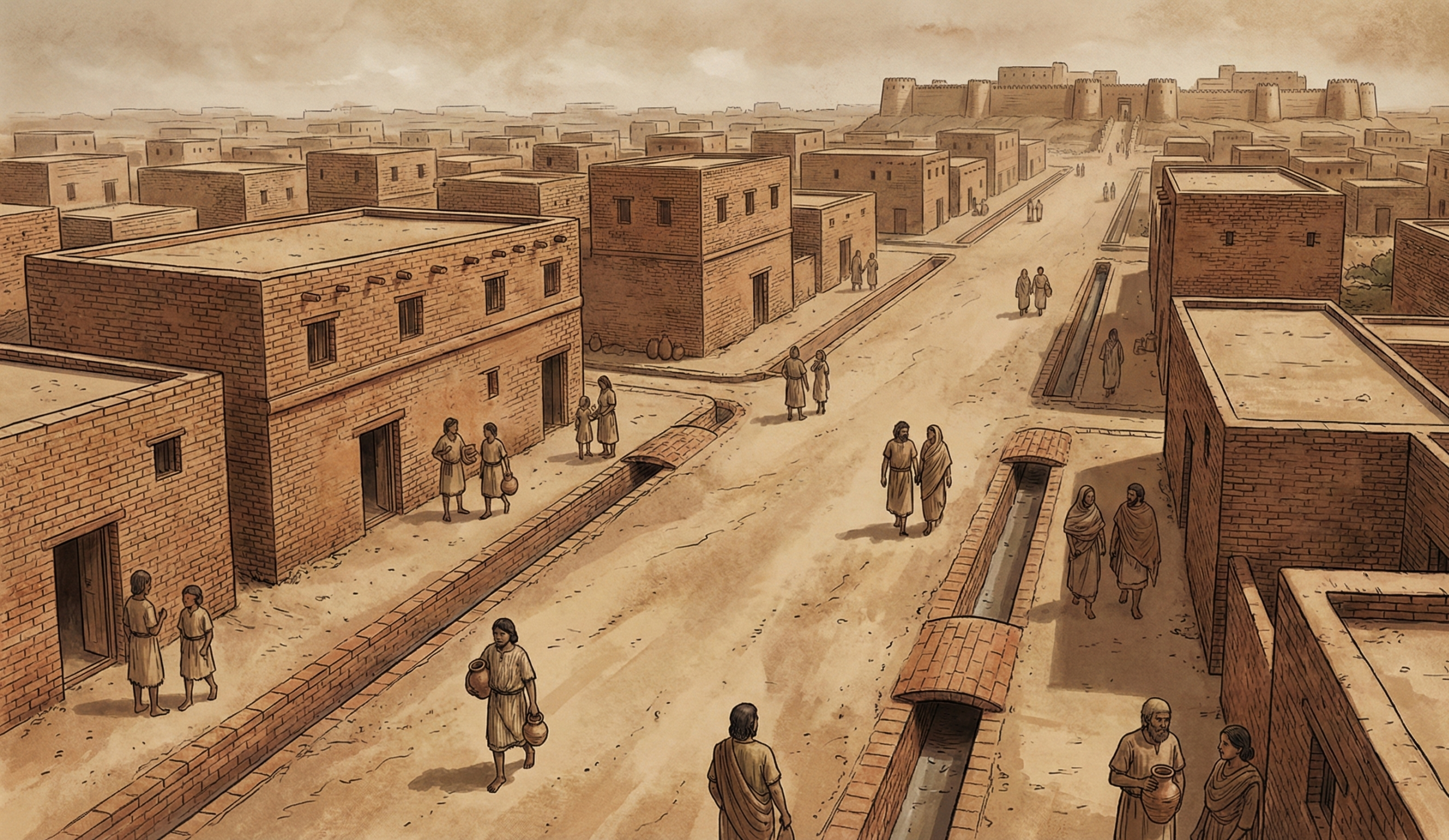
| Urban Features | Grid-pattern streets, citadel and lower town, brick houses, public wells, covered drains. |
| Economy | Agriculture, animal husbandry, craft production (beads, metals, pottery) and long-distance trade. |
| Script | Short inscriptions in an undeciphered pictographic script on seals and objects. |
| Religion | Evidence of mother goddess figures, a horned “proto-Shiva” figure, tree and animal worship. |
| Decline | Gradual decline after 1900 BCE, linked to climate change, river shifts and economic stress. |
Introduction to Harappan Civilization
The Harappan or Indus Valley Civilization emerged in the northwestern part of the Indian subcontinent and is one of the world’s earliest urban civilizations. Archaeological discoveries at Harappa and Mohenjo-daro in the 1920s revealed large, well-planned cities, challenging earlier beliefs that Indian civilization began only with the Vedic age.
More than a thousand settlements of different sizes have now been identified, from large urban centers to smaller towns and villages. The uniformity in bricks, town planning and material culture across this huge area indicates a shared cultural framework, often referred to as Harappan Culture.
Phases of Harappan Culture
Early Harappan Phase
The Early Harappan phase (c. 3300–2600 BCE) represents the formative stage, with small agricultural villages gradually developing into proto-urban settlements. Pottery styles, storage facilities and evidence of craft specialization show trends toward increasing social complexity.
Mature Harappan (Urban) Phase
The Mature Harappan phase (c. 2600–1900 BCE) marks full urban development, with large cities, standardized weights and measures, elaborate drainage and flourishing long-distance trade. This is the period usually meant when people speak of Harappan Civilization as India’s oldest urban culture.
Cities such as Harappa, Mohenjo-daro, Dholavira and Lothal demonstrate a striking degree of planning and coordination in layout, building technology and civic amenities. The scale and organization of these centers suggest strong urban governance and sophisticated management of resources.
Late Harappan Phase
In the Late Harappan phase (c. 1900–1300 BCE), many major cities declined or were abandoned, and smaller rural settlements became more common. Changes in pottery, architecture and settlement patterns point to a shift away from the earlier urban model.
This phase shows regional diversification and cultural transformations, rather than a sudden disappearance, indicating that Harappan traditions continued in altered forms in later societies.
Town Planning: India’s Earliest Urban Design
Grid Layout and City Structure
A hallmark of Harappan towns is their grid pattern: streets ran north–south and east–west, intersecting at right angles to form well-defined blocks. Major streets were wide and straight, with smaller lanes branching off to residential areas, reflecting clear planning principles.
Many cities were divided into an elevated citadel area and a lower residential town, often surrounded by defensive walls. The citadel likely housed important public buildings, granaries or ceremonial structures, while the lower town contained most of the houses and workshops.
Drainage, Water Supply and Sanitation
Harappan drainage and sanitation were highly advanced for their time, with covered brick-lined drains running along streets and connecting to individual houses. Many houses had bathrooms with sloping floors leading to soak pits or drains, suggesting concern for hygiene and cleanliness.
Public and private wells were widely used, ensuring regular access to water even within dense urban neighborhoods. Some cities like Dholavira also show sophisticated water-harvesting systems, including reservoirs and channels to capture seasonal flows.
Major Harappan Sites and Their Features
Harappa and Mohenjo-daro
Harappa, located in present-day Punjab (Pakistan), has yielded large granaries, residential areas, workshops and numerous seals and inscriptions. Standardized brick sizes, carefully laid streets and public structures highlight its role as a key urban center.
Mohenjo-daro is famous for its Great Bath, a large tank-like structure thought to be used for ritual or communal bathing. The city exhibits multi-roomed houses, some with upper stories, courtyards and sophisticated plumbing, showcasing elite urban living during the Bronze Age.
Dholavira and Lothal
Dholavira, in present-day Gujarat, stands out for its unique three-part town planning, massive fortifications and a remarkable series of water reservoirs carved into the bedrock. An inscription-like signboard found here suggests that writing or symbols were displayed in public spaces as well.
Lothal, also in Gujarat, is renowned for its dockyard, often described as one of the earliest known tidal docks in the world. The site also provides evidence of bead-making workshops, shell working and other crafts that were closely linked to overseas trade.
Economy: Agriculture, Crafts and Trade
Agricultural Base and Animal Husbandry
The Harappan economy rested on a strong agricultural base, cultivating wheat, barley, pulses and in some regions rice, supported by irrigation and seasonal floods. They are also considered among the earliest people to systematically grow cotton, which later impressed Greek observers.
Animal husbandry included cattle, buffalo, sheep, goats and possibly elephants, while bullock carts and ploughs indicate developed farming and transport technologies. This agricultural surplus supported dense urban populations and specialized craftspeople in the cities.
Craft Specialization and Long-distance Trade
Harappan artisans were skilled in bead-making, metallurgy, pottery, shell and ivory work, and faience production. Workshops at sites like Mohenjo-daro and Lothal reveal mass production techniques and a high level of standardization.
Evidence from Mesopotamian texts referring to a region called “Meluhha,” along with Harappan seals found in West Asia, suggests long-distance trade links via land and sea. The presence of standardized weights and measures further indicates a regulated commercial system and sophisticated economic organization.
Society and Governance
Urban Social Structure
While the exact social hierarchy is not fully known, variations in house size and location suggest differences in wealth and status. Larger homes with multiple rooms and courtyards likely belonged to elites or powerful families, whereas smaller, simpler houses were occupied by ordinary artisans and laborers.
The overall uniformity in material culture across a vast region implies some shared social norms, administrative practices and cultural values. The absence of ostentatious palaces or royal tombs, however, sets Harappan society apart from contemporary Egyptian or Mesopotamian models.
Administration and Urban Governance
Large-scale construction of citadels, granaries, dockyards and water systems would have required strong coordination and organized labor. This points to some form of urban governance, even though no written records describing political institutions have survived or been deciphered.
The standardized bricks, weights and seals across many distant sites imply either a central authority or a network of city-states adhering to common standards. Whether there was a single overarching state or multiple cooperating centers remains debated among scholars.
Religion and Belief Systems
Mother Goddess and Nature Worship
Terracotta female figurines found at several sites are often interpreted as representations of a mother goddess or fertility cult. These figurines typically emphasize reproductive features and adornment, which may symbolize prosperity and growth.
Seals and figurines depicting sacred trees, animals like bulls and composite creatures suggest that elements of nature occupied a central place in Harappan religious imagination. Such practices may have influenced later South Asian traditions of tree and animal veneration.
Proto-Shiva and Ritual Architecture
One notable seal shows a horned figure seated in a yogic posture surrounded by animals, often identified as a “Proto-Shiva” or “Pashupati” figure, though this interpretation is debated. It at least indicates an early association between ascetic postures, animal symbolism and religious authority.
Architectural features like the Great Bath at Mohenjo-daro, fire altars at some sites and possible ritual platforms suggest public ceremonies involving water, fire and communal gatherings. Regular bathing and ideas of ritual purity were probably significant in Harappan religious practice.
Script, Seals and Art
Indus Script
The Harappans used a short, logo-syllabic or pictographic script, typically comprising brief inscriptions of 4–5 signs on seals, pottery and other objects. Despite numerous attempts, this script remains undeciphered due to the lack of a bilingual text and limited inscription length.
Because of this, historians rely heavily on archaeological evidence rather than written documents to understand Harappan politics, society and religion. A successful decipherment in the future could transform our knowledge of this ancient culture.
Seals, Sculpture and Terracotta
Harappan seals, often made of steatite, depict a variety of animals (bulls, elephants, unicorn-like creatures), symbols and the Indus script. They may have served as identity markers, trade labels or amulets with religious significance.
Famous artifacts such as the bronze “Dancing Girl” statue and realistic male busts exhibit advanced metal casting and artistic skills. Terracotta toys, carts and animal figures reveal aspects of daily life, entertainment and the emotional world of Harappan people.
Decline of Harappan Civilization
Environmental and Climatic Factors
By around 1900 BCE, many Harappan cities show signs of decline, including poorer construction, reduced maintenance of drains and shrinking urban areas. Studies of climate and river systems suggest that weakening monsoons and the drying or shifting of rivers like the Ghaggar-Hakra played a major role.
Reduced water availability would have undermined agriculture and urban life, forcing populations to disperse into smaller rural settlements. Over time, this contributed to the end of large-scale urbanism in the region, even though cultural elements persisted.
Economic and Social Changes
Shifts in trade routes, overuse of local resources and possible socio-economic stresses may have compounded environmental problems. The breakdown of centralized standards and craft networks is visible in the changing material culture of the Late Harappan phase.
Earlier theories that blamed foreign invasions or sudden catastrophes are now considered less convincing, as the archaeological record shows a more gradual, regionally varied transformation.
Legacy and Significance
Influence on Later Indian Culture
Although direct continuity is debated, many scholars see echoes of Harappan practices in later Indian traditions, such as the use of wells, courtyards, brick construction and certain religious motifs. Ideas of ritual bathing, sacred trees and animal symbols also find parallels in subsequent South Asian religions.
The Harappan achievement in urban planning, standardized measures and water management continues to inspire modern urban design discussions in India. Recognizing it as India’s oldest urban culture helps situate the subcontinent firmly within the global story of early civilizations.
Frequently Asked Questions About Harappan Civilization
1. What is meant by Harappan Civilization?
Harappan Civilization refers to the Bronze Age urban culture that developed in the Indus River valley and adjacent regions between about 3300 and 1300 BCE.
2. Why is it also called the Indus Valley Civilization?
It is called the Indus Valley Civilization because many important sites lie along the Indus River and its tributaries, and early archaeologists focused on this river valley.
3. What makes Harappan Civilization India’s oldest urban culture?
It is the earliest known culture in the subcontinent to have large planned cities, drainage systems, standardized bricks and organized trade on a wide scale.
4. Which are the main Harappan cities?
Major cities include Harappa, Mohenjo-daro, Dholavira, Lothal, Kalibangan, Rakhigarhi and several others spread across modern Pakistan and northwest India.
5. What is special about Harappan town planning?
Harappan towns follow a grid layout with straight streets, well-defined blocks, separate citadel and lower town, and efficient drainage and water supply systems.
6. What kind of script did the Harappans use?
They used a short pictographic script, mainly on seals and pottery, but it has not yet been deciphered, so their language remains unknown.
7. What was the main basis of the Harappan economy?
The economy was based on agriculture, supported by animal husbandry, craft production and long-distance trade by land and sea.
8. Did the Harappans trade with other civilizations?
Yes, archaeological and textual evidence suggests trade with Mesopotamia and regions of the Persian Gulf, often referred to as trade with “Meluhha.”
9. What crops did Harappan farmers grow?
They cultivated wheat, barley, pulses and, in some areas, rice, and are considered pioneers in growing cotton on a large scale.
10. What were the main religious beliefs of the Harappans?
Evidence points to mother goddess worship, reverence for animals and trees, and possibly a horned deity seated in yogic posture, sometimes linked to proto-Shiva.
11. What is the Great Bath and where is it located?
The Great Bath is a large rectangular tank-like structure at Mohenjo-daro, likely used for ritual or communal bathing.
12. Why has the Harappan script not been deciphered?
The script remains undeciphered due to very short inscriptions, absence of a bilingual text and uncertainty about the underlying language family.
13. What caused the decline of Harappan Civilization?
Most scholars link the decline to climate change, weakening monsoons, river shifts and economic stresses rather than a single catastrophic event.
14. Did foreign invasions destroy the Harappan Civilization?
There is little archaeological evidence for large-scale violent destruction, so invasion theories are now considered less likely.
15. What crafts were the Harappans famous for?
They were known for bead-making, metallurgy, pottery, shell and ivory work, and fine terracotta and bronze sculptures.
16. How were Harappan houses built?
Most houses were made of baked bricks, with flat roofs, courtyards, rooms opening onto side lanes, and bathrooms connected to drains.
17. Did Harappan cities have defensive structures?
Many sites show fortification walls around citadels or entire settlements, suggesting concern for defense or control of access.
18. What is the significance of Harappan seals?
Seals bearing animals and script were likely used for identification, trade and possibly religious or administrative purposes.
19. How many Harappan sites have been discovered?
Researchers have identified over a thousand settlements of different sizes, indicating a very extensive civilization.
20. What is the legacy of Harappan Civilization for modern India?
It established the earliest urban traditions in the region, influencing later patterns of settlement, water management and religious symbolism in South Asia.
Conclusion
The Harappan Civilization reflects India’s early brilliance in urban planning, trade, and social organization. Its discoveries continue to shape our understanding of ancient Indian history.