[india_weather]

Harappan Civilization: India’s Oldest Urban Culture
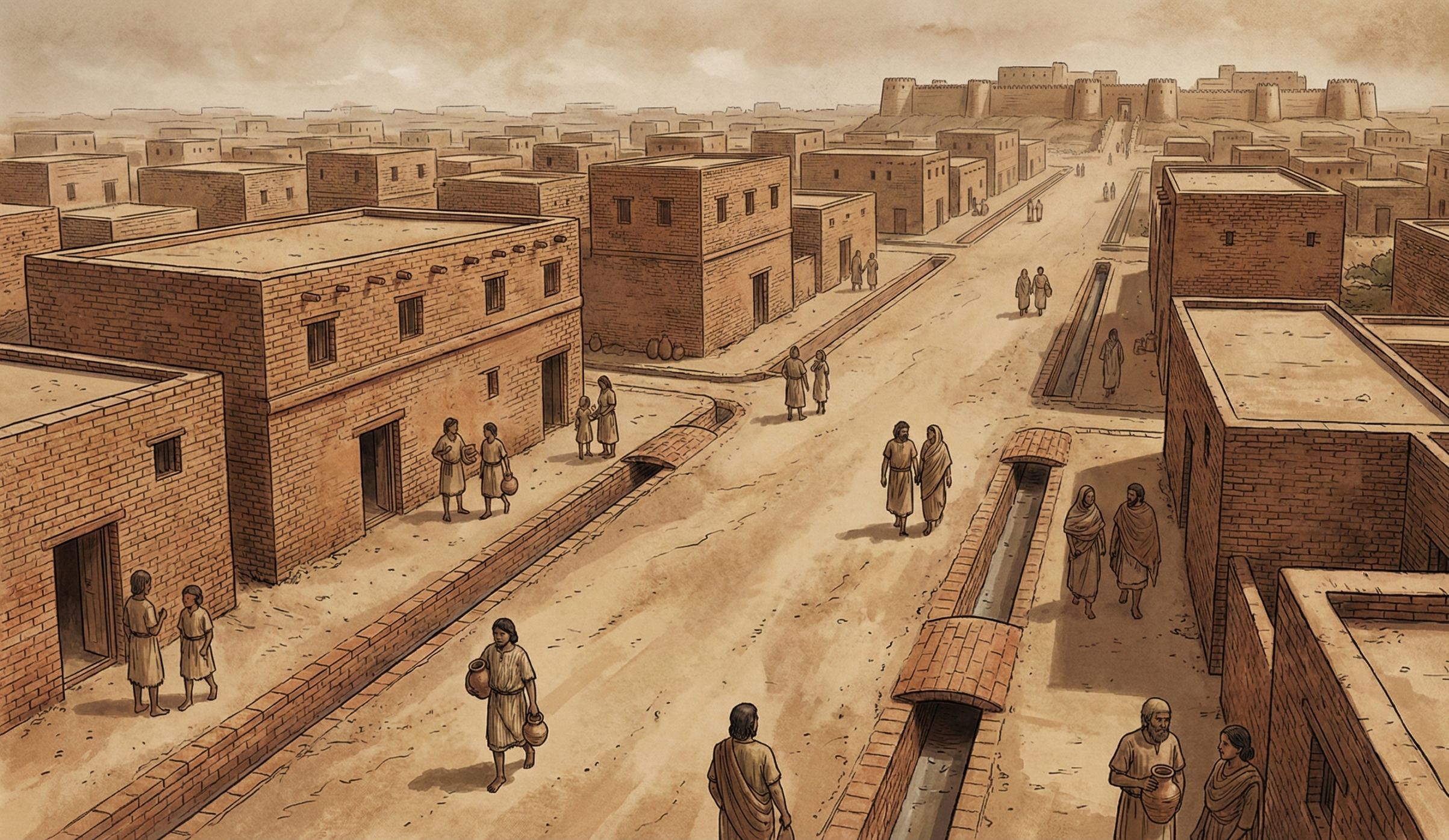
Around 2500 BCE, a family in Mohenjo-daro could take a bath in a brick-floored room, and the dirty water would run through a clay pipe into a covered drain under the street outside. That one detail tells you a lot about the Harappan Civilization, also called the Indus Valley Civilization. It flourished roughly between 3300 BCE and 1300 BCE along the Indus and its tributaries, and it was the first culture in the Indian subcontinent to build planned cities.
Its baked-brick houses, drainage systems and long-distance trade put it in the same league as Egypt and Mesopotamia, the other great Bronze Age civilizations. Yet it is the least understood of the three, because nobody can read its script. Everything we know comes from what archaeologists have dug out of the ground.
Harappan Civilization at a glance
| Aspect | Details |
|---|---|
| Time Period | Approx. 3300-1300 BCE; Mature / Urban phase around 2600-1900 BCE. |
| Alternate Names | Indus Valley Civilization (IVC), Harappan Culture, Indus-Sarasvati Civilization. |
| Geographical Extent | From northeast Afghanistan through Pakistan to northwest India (Punjab, Haryana, Rajasthan, Gujarat). |
| Major Cities | Harappa, Mohenjo-daro, Dholavira, Lothal, Kalibangan, Rakhigarhi and many others. |
| Urban Features | Grid-pattern streets, citadel and lower town, brick houses, public wells, covered drains. |
| Economy | Agriculture, animal husbandry, craft production (beads, metals, pottery) and long-distance trade. |
| Script | Short inscriptions in an undeciphered pictographic script on seals and objects. |
| Religion | Mother goddess figurines, a horned “proto-Shiva” figure on a seal, tree and animal worship. |
| Decline | Gradual decline after 1900 BCE, linked to climate change, river shifts and economic stress. |
Why is it called Harappan?
Archaeologists name a culture after the first site where it was identified. That site was Harappa, on the banks of the Ravi in present-day Punjab, Pakistan. Daya Ram Sahni excavated there in 1921, and R. D. Banerji began work at Mohenjo-daro in Sindh the following year. In 1924 John Marshall, then Director-General of the Archaeological Survey of India, announced that the two sites belonged to a single, previously unknown civilization.
The discovery changed the textbook account of Indian history. Until then, most scholars assumed Indian civilization began with the Vedic age. Harappa pushed the story of Indian cities back by well over a thousand years.
The name “Indus Valley Civilization” came from the fact that the early sites lay along the Indus and its tributaries. It is a little misleading today. More than a thousand settlements have now been found, from large cities to small villages, and many of them lie far from the Indus, in Haryana, Rajasthan and Gujarat. What ties them together is a shared material culture: bricks of the same proportions, similar town plans, the same kind of seals and pottery.
The three phases of Harappan culture
Historians usually divide the civilization into three stages. The dates are approximate and vary from region to region.
Early Harappan (c. 3300-2600 BCE)
This was the formative stage. Small farming villages slowly grew into proto-urban settlements. Pottery styles, storage facilities and early signs of craft specialization show society becoming more complex.
Mature Harappan (c. 2600-1900 BCE)
This is the period most people mean when they talk about the Harappan Civilization. Large cities appeared, along with standardized weights and measures, careful drainage and trade over long distances. Harappa, Mohenjo-daro, Dholavira and Lothal all reached their peak in this phase, with a degree of planning in layout and building that suggests some form of strong civic management.
Late Harappan (c. 1900-1300 BCE)
Many big cities shrank or were abandoned, and smaller rural settlements became common. Pottery, architecture and settlement patterns changed. The culture did not vanish overnight. It broke into regional variants, and Harappan traditions carried on in altered forms.
How Harappan cities were planned
Grid streets, citadel and lower town
Harappan towns were laid out on a grid pattern. Main streets ran north-south and east-west and crossed at right angles, dividing the town into blocks. Smaller lanes branched off these streets into the residential areas.
Many cities were split into two parts. An elevated citadel on the west held large public buildings, possibly granaries or ceremonial structures. A larger lower town held most of the houses and workshops. Walls often surrounded the citadel, and sometimes the whole settlement.
Houses were built of baked bricks and usually had flat roofs. Doors tended to open onto side lanes rather than the main street, and many homes were arranged around a courtyard.
Drains, wells and water
The drainage system is what most students remember, and rightly so. Covered, brick-lined drains ran along the streets and connected to individual houses. Bathrooms had sloping floors so water flowed out into the drains or into soak pits.
Public and private wells gave even crowded neighbourhoods a steady water supply. Dholavira, in a much drier part of Gujarat, went further. Its builders cut a series of reservoirs into the rock and built channels to catch seasonal rainwater.
Major sites of the Harappan Civilization
Harappa and Mohenjo-daro
Harappa has yielded large granaries, residential quarters, workshops and many seals and inscriptions. Its standardized bricks and carefully laid streets mark it as a major urban centre.
Mohenjo-daro, on the Indus in Sindh, is the best known of all the sites. Its Great Bath is a large rectangular tank, made watertight with fitted bricks and a layer of bitumen, that was probably used for ritual or communal bathing. The city also has multi-roomed houses, some with upper storeys, courtyards and their own plumbing.
Dholavira and Lothal
Dholavira, on Khadir island in the Rann of Kutch, has an unusual three-part plan: citadel, middle town and lower town. It also has massive fortifications and the rock-cut reservoirs mentioned above. A row of large Harappan signs found near one of its gateways may have been a public signboard, which suggests writing was displayed in open spaces. Dholavira was declared a UNESCO World Heritage Site in 2021.
Lothal, near the Gulf of Khambhat in Gujarat, is known for a large brick basin that is often described as one of the earliest tidal docks in the world. The site also had bead-making workshops and shell working, crafts closely tied to overseas trade.
Kalibangan and Rakhigarhi
Kalibangan in Rajasthan, on the dried-up Ghaggar river, has given us a ploughed field from the Early Harappan period and a row of fire altars. Rakhigarhi in Haryana is the largest Harappan site found in India so far, and excavation there is still going on.
What did the Harappans eat, make and trade?
Farming and animals
The economy rested on agriculture. Harappan farmers grew wheat, barley and pulses, and in some regions rice, helped by irrigation and seasonal floods. They were also among the earliest people anywhere to grow cotton systematically. Much later, Greek writers were struck by Indian cotton, which they described as wool growing on trees.
They kept cattle, buffalo, sheep and goats, and may also have tamed elephants. Terracotta models of bullock carts and the ploughed field at Kalibangan show how farming and transport worked. The surplus from the fields fed the cities and the specialist craftspeople who lived in them.
Crafts
Harappan artisans worked in beads, copper and bronze, pottery, shell, ivory and faience. Workshops at Mohenjo-daro and Lothal show production on a large scale, with very consistent results. Carnelian beads from Gujarat were especially prized.
Trade with Mesopotamia
Mesopotamian texts mention a region called “Meluhha”, which most historians identify with the Indus region. Harappan seals have been found in West Asia, which supports the idea of trade by land and sea. Weights made of chert followed a fixed system, doubling from one unit upwards in the smaller sizes, which points to a regulated system of exchange.
Who ruled the Harappan cities?
This is one of the big open questions. Building citadels, granaries, docks and water systems on this scale needed organized labour and someone to coordinate it. But no written record of a ruler or a government has been deciphered.
Unlike Egypt or Mesopotamia, the Harappan cities have no grand palaces and no royal tombs. Differences in house size suggest some people were richer than others, with larger courtyard houses probably belonging to wealthy families and smaller ones to artisans and labourers. The same bricks, weights and seals appear across hundreds of kilometres, so there was either a central authority or a network of city-states that followed common standards. Scholars still argue about which.
What did the Harappans believe?
Mother goddess, trees and animals
Terracotta female figurines, often heavily ornamented, have been found at many sites. They are commonly read as images of a mother goddess or a fertility cult. Seals show sacred trees, bulls and composite creatures, so nature clearly mattered in Harappan religion. Similar reverence for trees and animals shows up in later South Asian traditions.
The “Pashupati” seal and the Great Bath
A seal from Mohenjo-daro shows a horned figure seated in a yogic posture, surrounded by animals. John Marshall called it “Proto-Shiva”, and it is also known as the Pashupati seal. Many scholars now treat that identification with caution, but the seal does at least link a seated, meditative posture with animals and religious authority.
The Great Bath, the fire altars at Kalibangan and Lothal, and other possible ritual platforms point to public ceremonies involving water and fire. Ritual bathing and ideas of purity were probably part of Harappan religious life.
The Indus script, seals and art
Why the script is still undeciphered
Harappan inscriptions are short, usually around four or five signs, written on seals, pottery and other objects. There have been many attempts to read them, but three problems stand in the way. The texts are very short, no bilingual inscription has been found, and nobody knows which language family the script records.
So historians build their picture of Harappan society almost entirely from archaeology. If the script is ever read, much of what is written in textbooks today could change.
Seals and sculpture
Most seals are made of steatite and show animals such as bulls, elephants and the famous one-horned “unicorn”, along with a line of script. They may have been used to mark goods for trade, to identify their owners, or as amulets.
The bronze “Dancing Girl” from Mohenjo-daro shows that Harappan metalworkers knew the lost-wax casting method. The stone bust often called the “Priest-King” comes from the same city. Terracotta toys, carts and animal figures tell us something about everyday life and how children played.
Why did the Harappan Civilization decline?
From about 1900 BCE, many cities show signs of decline: poorer construction, drains that were no longer maintained, and urban areas shrinking. Studies of climate and river systems suggest that weaker monsoons and the drying or shifting of rivers such as the Ghaggar-Hakra were major factors.
Less water meant less farming, and less farming could not support large cities. People moved into smaller rural settlements. Shifts in trade routes, overuse of local resources and social stress may have made things worse, and the breakdown of shared standards is visible in Late Harappan pottery and crafts.
Older theories blamed foreign invaders or a sudden catastrophe. There is little archaeological evidence of large-scale violent destruction, so most historians now see a gradual change that happened differently in different regions.
What Harappa left behind
Whether there is a direct line from Harappa to later Indian culture is debated. Still, many scholars point to echoes: wells and courtyard houses, brick building, ritual bathing, and the reverence for sacred trees and animals found in later South Asian religions.
Read Next
- Lessons From India’s Oldest: Civilizations for Today’s Cultural Identity Debates
- The Rise of the Mauryan Empire: How India’s First Great Empire Was Built
- Gupta Empire History: Golden Age of Ancient India Explained
Frequently Asked Questions
How many Harappan sites have been discovered?
Researchers have identified more than a thousand settlements of different sizes. Most are small villages, and only a handful, such as Harappa, Mohenjo-daro, Dholavira and Rakhigarhi, were large cities.
Did the Harappans use iron?
No. The Harappan Civilization belongs to the Bronze Age. Its tools and ornaments were made of copper, bronze, stone, shell and clay.
Did Harappan cities have defensive walls?
Many sites had fortification walls around the citadel or the entire settlement. They may have been for defence, for flood protection, or for controlling who came in and out.
What is the best book to start with for UPSC?
Start with the chapter “Bricks, Beads and Bones” in the NCERT Class 12 textbook Themes in Indian History, Part I, which covers Harappan town planning, crafts, seals and the debate over decline in a few readable pages.