Brihadeeswarar Temple History: A Masterpiece of Chola Architecture
Brihadeeswarar Temple, also known as Peruvudaiyar Kovil or the Big Temple, is one of the greatest architectural achievements of the Chola Empire and a crown jewel of Dravidian temple design in South India. Dedicated to Lord Shiva and built over 1,000 years ago in Thanjavur, Tamil Nadu, it still dominates the skyline with its towering vimana and majestic granite Nandi.
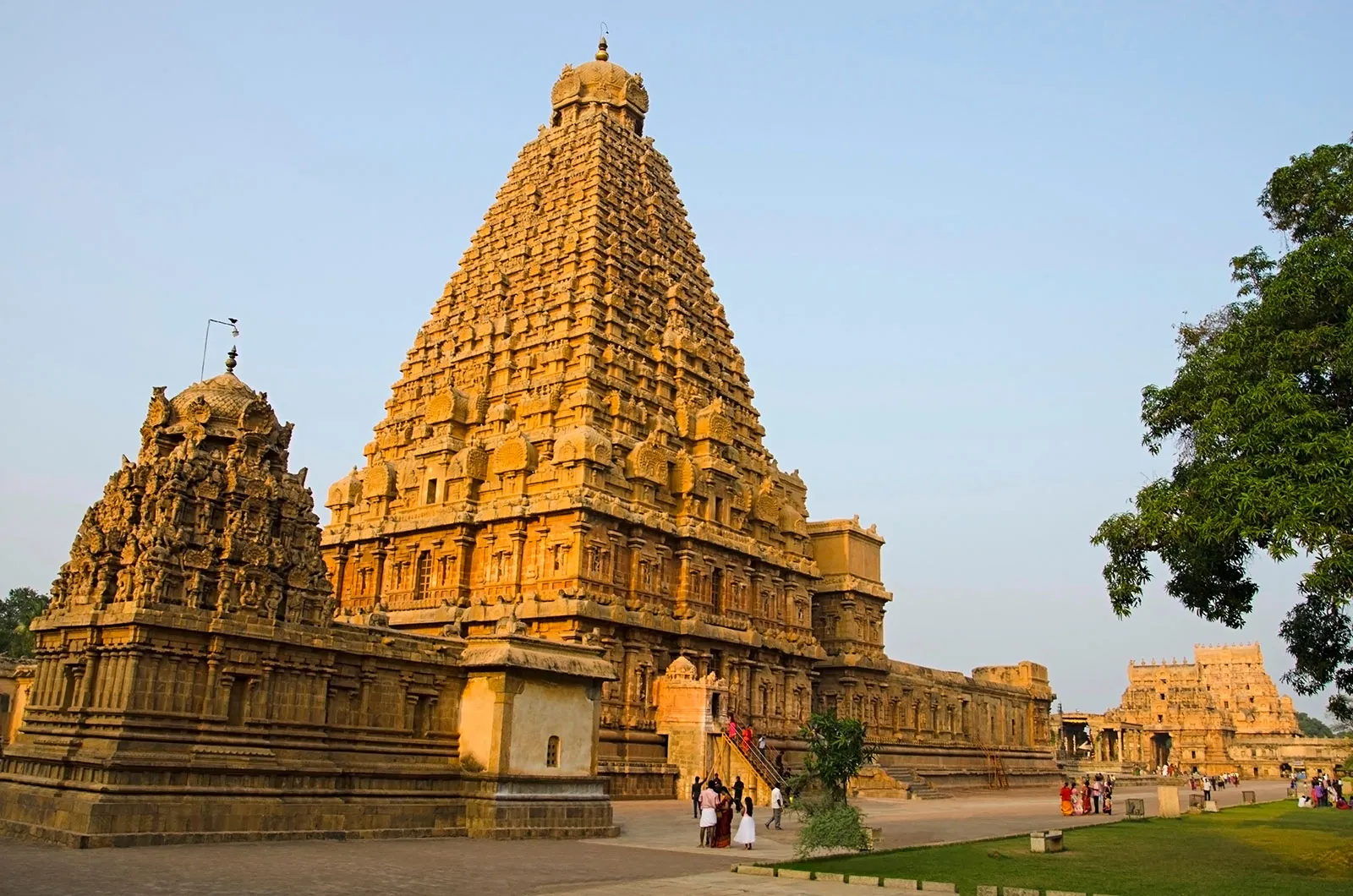
Commissioned by the mighty Rajaraja Chola I at the height of Chola power, the temple stands as a fusion of political ambition, religious devotion, and advanced engineering. Today it is part of the UNESCO-recognized Great Living Chola Temples and continues to be a living centre of worship, art, music, and culture.
Overview Table of Brihadeeswarar Temple
| Aspect | Details |
|---|---|
| Location | Thanjavur (Tanjore), Tamil Nadu, India |
| Deity | Lord Shiva (Brihadisvara) in the form of a massive Shiva Lingam |
| Builder / Patron | Rajaraja Chola I (Rajaraja the Great), Chola Emperor |
| Period of Construction | c. 1003 – 1010 CE (early 11th century) |
| Dynasty | Chola Empire |
| Architectural Style | Dravidian (South Indian) temple architecture, mature Chola phase |
| Main Tower (Vimana) | Approx. 60–66 m (around 200–216 ft) tall stone tower above the sanctum |
| Material | Primarily granite, including gigantic monolithic components |
| UNESCO Status | Part of “Great Living Chola Temples” World Heritage Site |
| Other Names | Peruvudaiyar Kovil, Rajarajeswaram, Big Temple |
Historical Background: The Age of Rajaraja Chola
Chola Power at Its Peak
By the late 10th and early 11th centuries, the Chola Empire had become the dominant power of South India, controlling fertile river valleys, rich temple towns and maritime trade routes stretching to Sri Lanka and Southeast Asia. Rajaraja Chola I, one of the greatest Chola rulers, consolidated these gains through military campaigns and administrative reforms.
Amid this political and economic strength, Rajaraja envisioned a monumental temple that would both glorify Lord Shiva and immortalize his reign. The result was Brihadeeswarar Temple in Thanjavur, conceived not as a modest shrine but as a cosmic statement of imperial devotion.
Foundation and Inscriptions
The temple’s construction is believed to have started around 1003 CE and completed around 1010 CE, a remarkably short span for such a massive structure. Inscriptions on the temple walls record incredible details about land grants, donations, temple staff, musicians, dancers and daily rituals, giving historians a rare, precise window into Chola society.
Rajaraja originally named the temple “Rajarajeswaram” after his own regnal title, only later widely known as Brihadeeswarar or Peruvudaiyar Kovil. These inscriptions also celebrate his conquests and piety, linking divine worship directly to royal authority.
Architectural Layout: Planning the Big Temple
Temple Complex and Orientation
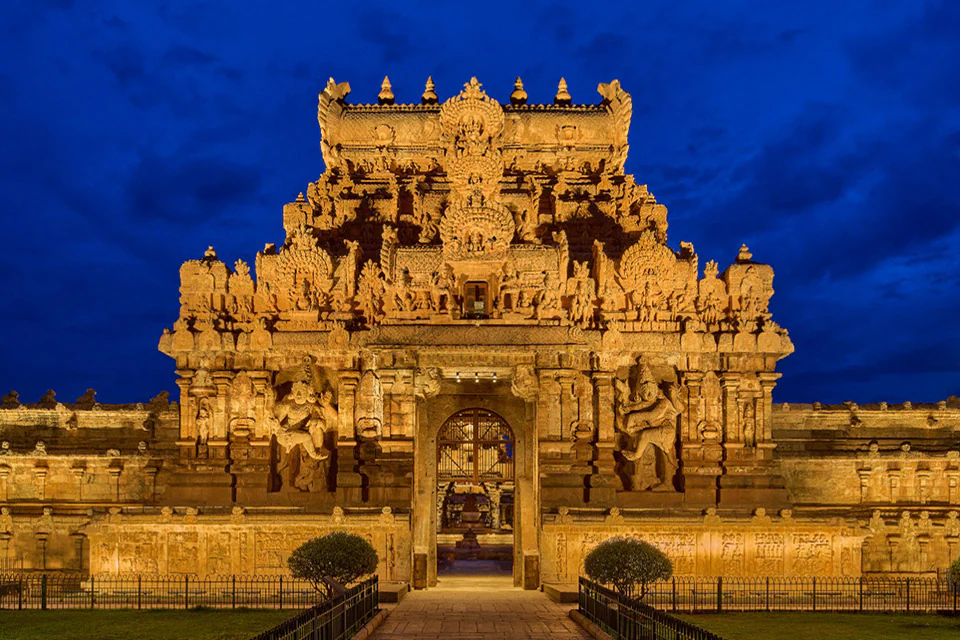
The temple complex follows a grand rectangular plan aligned along an east–west axis, with the main entrance gateways (gopurams) leading towards the central sanctuary. The outer walls, prakara (enclosures), subsidiary shrines and courtyards are arranged to guide devotees progressively inward, both physically and spiritually.
An immense courtyard surrounds the central shrine, allowing large gatherings for festivals, processions and temple rituals. The overall layout follows principles of Vastu Shastra, symbolically connecting the temple’s geometry with cosmic order and stability.
Main Components of the Complex
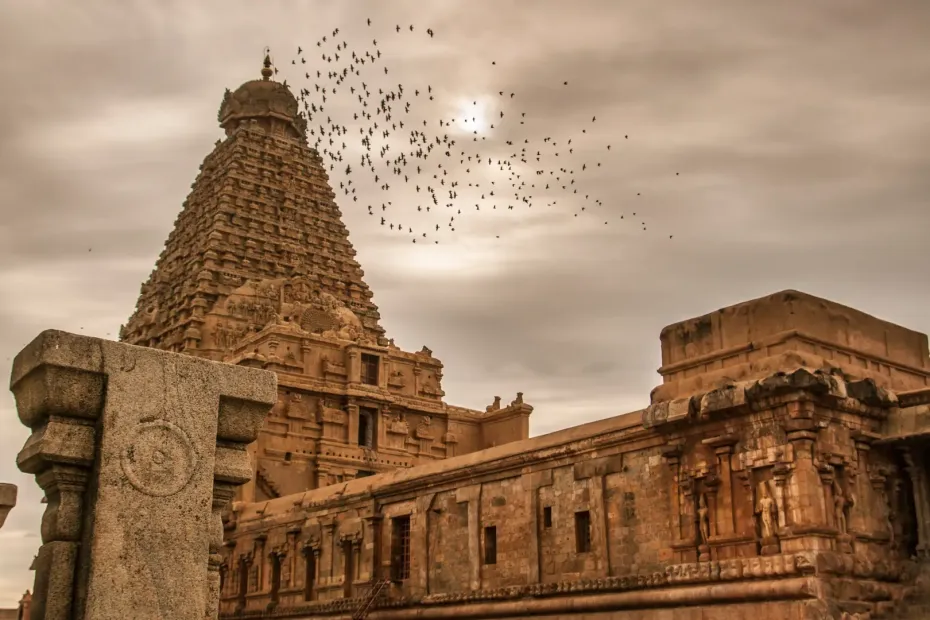
- The towering vimana (main tower) directly above the sanctum sanctorum (garbhagriha).
- The huge Shiva Lingam in the inner sanctum, the core focus of worship.
- The massive monolithic Nandi mandapam with one of India’s largest Nandi statues facing the sanctum.
- Sub-shrines dedicated to various deities and forms of Shiva.
- Long pillared mandapas (halls) for rituals, music, dance and assemblies.
- Outer prakara with walls, corridors and inscription panels.
The Vimana: Towering Symbol of Chola Genius
While Brihadeeswarar’s vimana represents the height of Dravidian temple architecture, eastern India expressed monumentality through a different architectural vision. A notable example is the Sun Temple at Konark, designed as a colossal stone chariot dedicated to the Sun God and renowned for its symbolic and astronomical precision.
Height, Structure and Symbolism
The most striking feature of Brihadeeswarar is its soaring vimana, often measured around 60–66 meters (about 200–216 feet) high, making it one of the tallest temple towers of its time. Unlike many later South Indian temples where the entrance gopuram dominates, here the vimana over the sanctum is the main vertical emphasis.
The pyramidal vimana rises in multiple stepped storeys, each tier adorned with miniature shrines and sculpted motifs. Symbolically, it represents Mount Meru, the cosmic mountain at the centre of the universe in Hindu cosmology, linking the temple’s inner sanctum to the heavens.
Engineering Marvel: The Capstone
The vimana is crowned by a massive stone shikhara and a bulbous finial (kalasha), believed to weigh many tons. Traditional accounts suggest an ingenious ramp system several kilometres long was used to haul this stone to the top, demonstrating extraordinary engineering and organization.
The tower’s proportions, balanced massing and precise alignment have led many to describe the structure as a “stone mountain” rather than a mere building. Its visual impact, especially against the open Thanjavur sky, remains overwhelming even to modern visitors.
Granite, Scale and Construction Techniques
India’s architectural history also includes extraordinary rock-cut engineering achievements. A striking parallel to Brihadeeswarar’s stone construction is the Kailasa Temple at Ellora, a complete Shiva temple carved top-down from a single rock, demonstrating a different but equally remarkable approach to ancient Indian engineering.
Use of Granite and Logistics
One of the temple’s defining aspects is its almost exclusive use of granite, a hard stone not abundantly found in the immediate vicinity. This required transporting enormous blocks over significant distances, likely via a combination of river and land routes.
The precision with which these blocks were cut, placed and interlocked without modern machinery reveals an advanced understanding of stone construction. Many joints are so fine that no mortar is visible, relying on sheer weight and gravity for structural stability.
Shadow Myth and Alignment
A popular legend claims that the vimana casts no shadow at noon, adding a mystical aura to the temple. While this is more poetic symbolism than literal physics, it reflects the careful alignment and proportioning that minimize certain shadows at specific times.
What remains undeniable is the way light and shadow play across the carvings and surfaces throughout the day, creating a dynamic visual effect that enhances the temple’s divine atmosphere.
Sculpture, Frescoes and Inscriptions
Exterior Reliefs and Iconography
The walls of Brihadeeswarar are richly carved with panels depicting various deities, celestial beings, guardians and mythological scenes. These reliefs combine devotion, narrative and refined artistry, showcasing the skill of Chola sculptors.
Yalis (mythical lion-like creatures), dwarapalas (door guardians), ganas and dancers embellish pillars and niches, creating a visual universe around the central Shiva Lingam. Each sculptural element is integrated into the architecture rather than merely attached as decoration.
Inscriptions as Historical Records
Extensive Tamil inscriptions detail temple endowments, measurements of land, lists of donors, and the duties of priests, dancers, musicians and accountants. They reveal how the temple functioned as an economic, social and cultural centre in addition to being a religious site.
Through these records, historians can reconstruct aspects of Chola taxation, land management, caste roles, and even wages paid to various temple employees. Few other monuments provide such a rich documentary archive carved in stone.
Nandi Mandapam and Inner Sanctum
The Monolithic Nandi
Facing the main shrine, in a separate pavilion, stands a colossal monolithic Nandi (bull), the vehicle of Lord Shiva. Carved out of a single block of granite, it is one of the largest Nandi statues in India, with impressive dimensions and finely finished surfaces.
The Nandi mandapam itself is richly carved, with pillared supports and a vaulted roof that frame the sacred bull. Devotees often circumambulate Nandi before proceeding towards the sanctum, symbolically asking his permission to approach Shiva.
Garbhagriha and Shiva Lingam
The inner sanctum (garbhagriha) houses an enormous Shiva Lingam, towering several meters high, emphasizing the immeasurable nature of the divine. The space is relatively dark and enclosed, focusing the devotee’s attention solely on the Lingam, illuminated by lamps and minimal daylight.
Priests perform daily rituals, abhishekas (libation ceremonies) and special pujas following centuries-old Agamic traditions. Despite its monumental scale, the core experience inside remains intimate, centered on personal darshan of the deity.
Cultural Life: Music, Dance and Temple Economy
Devadasis, Musicians and Ritual Specialists
Historical records indicate that Brihadeeswarar employed numerous devadasis (temple dancers), singers, instrumentalists and ritual specialists as part of daily worship. Dance and music were integral to temple rituals, turning the complex into a living performance space.
The temple’s wealth, generated through land grants, donations and state patronage, supported this extended ecosystem of artists and artisans. In many ways, it functioned as a cultural academy where arts, spirituality and royal prestige intersected.
Temple as an Economic Hub
Land, villages and resources were gifted to the temple, making it a major landlord and economic institution. Local farmers, merchants and craftsmen were integrated into the temple economy through obligations, trade and service roles.
This integration meant that Brihadeeswarar was not only a spiritual centre but also a financial engine for the region, redistributing resources through religious, cultural and social activities.
Later Dynasties and Preservation
Nayak and Maratha Contributions
After the Cholas, the Nayaks of Madurai and later the Marathas of Tanjore made additions and renovations to the temple. They repaired damaged parts, commissioned new paintings and sculptures, and continued traditional festivals.
Some of the vibrant mural paintings and additional mandapas seen today reflect these later artistic layers, enriching the temple’s historical timeline without erasing its Chola core.
Modern Recognition and Conservation
In the 20th and 21st centuries, Brihadeeswarar Temple has undergone conservation efforts, including structural repairs, restoration of frescoes and improved visitor facilities. Its inclusion in the UNESCO World Heritage list as part of the Great Living Chola Temples has further highlighted its global significance.
Today, it attracts pilgrims, tourists, architects and historians from around the world, all drawn by its combination of spiritual depth and architectural brilliance.
Frequently Asked Questions About Brihadeeswarar Temple
1. Where is Brihadeeswarar Temple located?
Brihadeeswarar Temple is located in Thanjavur (Tanjore) in the state of Tamil Nadu, South India, on the fertile plains of the Cauvery river.
2. Who built Brihadeeswarar Temple?
The temple was built by Rajaraja Chola I, a powerful emperor of the Chola dynasty, during the early 11th century as a symbol of his devotion and imperial glory.
3. When was the temple constructed?
Construction is generally dated between about 1003 and 1010 CE, meaning the temple is now over a thousand years old and still actively used for worship.
4. To which deity is the temple dedicated?
Brihadeeswarar Temple is dedicated to Lord Shiva, worshipped here as Brihadisvara or Peruvudaiyar, represented by an enormous Shiva Lingam in the sanctum.
5. Why is it called the Big Temple?
It is popularly called the Big Temple because of its massive scale: the towering vimana, gigantic Nandi, huge courtyard and monumental stone structures dwarf many other South Indian temples.
6. What is special about the vimana?
The vimana above the sanctum rises around 60–66 meters, built entirely of stone in a pyramidal form. Its height, stability and intricate detailing make it a masterpiece of Chola architecture.
7. Is it true that the temple has no shadow at noon?
A popular legend claims the vimana casts no shadow at noon, symbolizing its perfection. In reality, shadows are present but cleverly minimized due to the tower’s proportions and the sun’s angle.
8. What is unique about the Nandi statue?
The Nandi statue is carved from a single block of granite and is one of the largest in India. It is placed in its own pavilion, directly facing the main sanctum.
9. What style of architecture does the temple represent?
Brihadeeswarar is a prime example of Dravidian temple architecture in its mature Chola phase, characterized by tall vimanas, pillared halls, detailed carvings and axial layouts.
10. Is Brihadeeswarar Temple a UNESCO World Heritage Site?
Yes, it is part of the “Great Living Chola Temples” UNESCO World Heritage group, along with Gangaikondacholisvaram and Airavatesvara temples in Tamil Nadu.
11. What do the temple inscriptions tell us?
Inscriptions record donations, land grants, temple staff lists, wages, ritual details and royal achievements, offering a detailed picture of Chola administration and society.
12. Are there paintings inside the temple?
Yes, the temple contains mural paintings from the Chola period as well as later Nayak additions, depicting deities, legends and ritual scenes on walls and ceilings.
13. How was such a huge structure built without modern technology?
Engineers used massive granite blocks, inclined ramps, rollers and human/animal labour, combined with careful planning and geometric precision, to achieve the towering structure.
14. Is the temple still active for worship?
Yes, Brihadeeswarar is a “living temple” where daily pujas, festivals and special rituals continue according to traditional Shaiva Agamic practices.
15. Which festivals are important at Brihadeeswarar?
Major festivals include Maha Shivaratri, Kumbhabhishekam (consecration), annual Brahmotsavam and various processions where the deity is taken around the temple in decorated chariots.
16. Did later dynasties modify the temple?
Yes, Nayak and Maratha rulers made repairs, built additional mandapas and enhanced paintings, preserving the temple while adding new artistic layers.
17. Why is Brihadeeswarar important for architecture students?
It offers a perfect case study in structural engineering, proportion, iconography, and urban-temple relationship, illustrating how sacred and political ideas shape built form.
18. What is the best time to visit the temple?
Early morning or late afternoon visits are ideal, when temperatures are milder and the changing light highlights the carvings and silhouette of the vimana.
19. Is photography allowed inside?
Photography is generally allowed in the outer areas and courtyards, but restrictions may apply inside certain shrines or during rituals, so visitors should follow current temple rules.
20. What makes Brihadeeswarar a true “masterpiece”?
Its combination of towering scale, structural daring, intricate sculpture, rich inscriptions, living ritual tradition and continuous relevance for over a millennium make it a unique masterpiece of Chola and Indian architecture.
Conclusion
The Brihadeeswarar Temple stands as a timeless symbol of the Chola dynasty’s vision, power, and artistic excellence. Built over a thousand years ago, it reflects not only religious devotion but also extraordinary achievements in architecture, engineering, and town planning. The precision with which the massive vimana was constructed, using granite and without modern binding materials, continues to impress historians and engineers even today.
More than a place of worship, the temple represents the cultural confidence of its era. It shows how the Cholas combined spirituality, science, and statecraft into a single monumental form. As a UNESCO World Heritage Site, the Brihadeeswarar Temple remains a living legacy of India’s architectural genius and a powerful reminder of the advanced knowledge and creativity of ancient South India.