[india_weather]

Rural Lifestyle in India: Village Life, Farming, and Community Structure
About two out of every three Indians still live in a village. The 2011 census counted around 640,000 villages and about 833 million rural people, and with population growth the figure today is usually put at around 900 million, more than the entire population of every country except China. The rural lifestyle in India varies enormously from a Punjab wheat village to a Kerala paddy hamlet, but there are patterns in how village life works across the country, and they say a lot about the India most Indians actually live in.
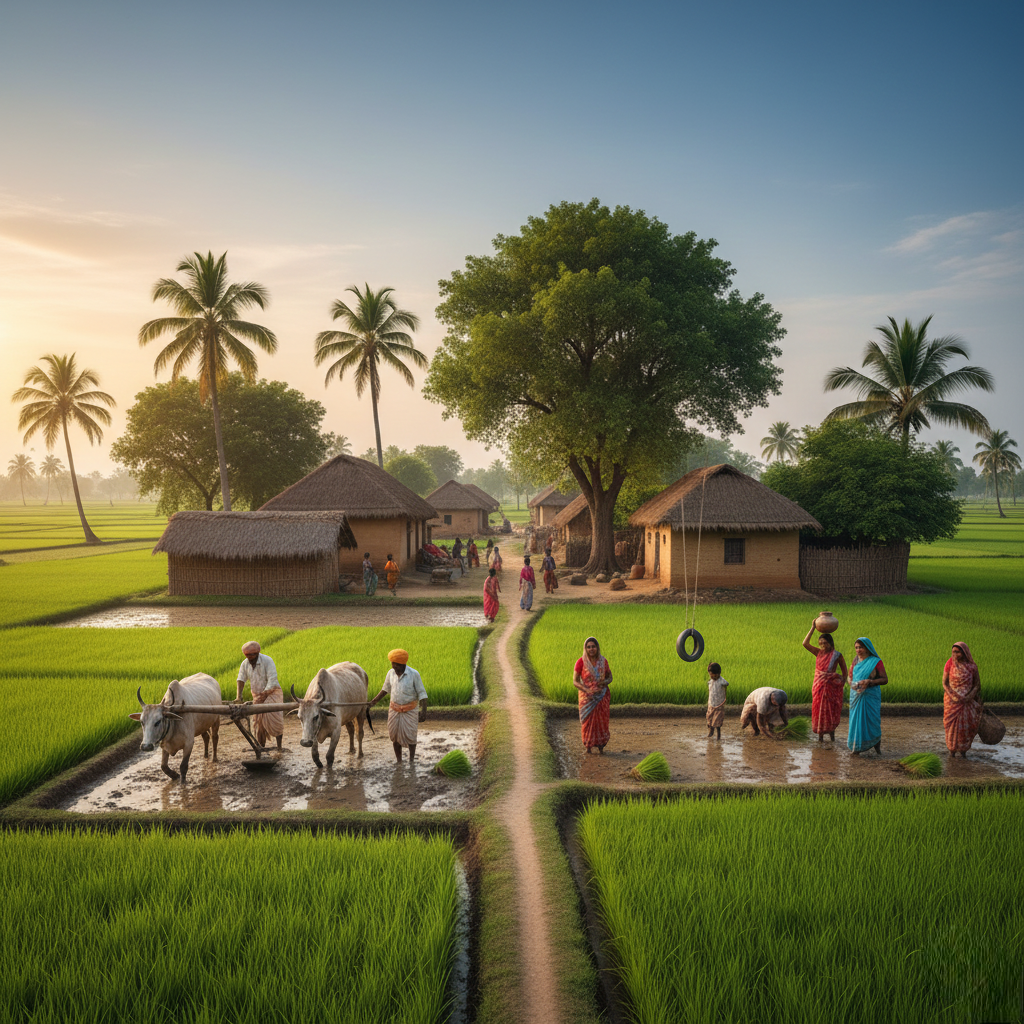
What does a typical Indian village look like?
Most Indian villages are small, and the typical one has fewer than a thousand residents. A few hundred houses cluster around a central point, usually a temple, a well, a large tree, or all three. The farm plots run around the houses, and beyond them there may be common grazing land for cattle and, where any survives, a patch of forest.
House styles change with the climate. In Punjab you see flat-roofed brick houses built around a central courtyard. In Kutch in Gujarat, the traditional home is the bhunga, a round, one-room mud hut with a conical thatched roof that copes well with desert winds and earthquakes.
In Kerala the traditional family home is the nalukettu, a large wooden house built around an open courtyard that lets air and light into every room. In Assam and the north east, houses are often raised on bamboo stilts to stay above floodwater. Along the Konkan coast, sloping tiled roofs shed the heavy monsoon rain.
A day in village life
A village day starts early, usually between 4:30 and 5:30 in the morning, and the women are generally up first. Water is fetched from a hand pump or well, and the courtyard is swept. In many homes a fresh coat of cow dung is spread over the mud floor of the compound, which keeps the dust down and is traditionally believed to keep insects away, and a rangoli is drawn at the doorstep with rice flour or coloured powder.
By about 6 am the men have left for the fields, often with the cattle. Field work carries on until 10 or 11 am, when the sun gets too strong, and then everyone comes home for a heavy meal and rests through the hottest hours. Work starts again in the late afternoon and goes on until sunset.
Evening is the social part of the day. Older men gather at the chaupal (the village meeting place) or the panchayat ghar (village council building) to talk, children play in the lanes, and dinner comes late, around 8 or 9 pm.
Farming and the rural lifestyle in India
Village life follows the farming calendar, and the farming calendar follows the monsoon. India has three main crop seasons:
- Kharif: paddy, cotton, maize and groundnut, sown with the monsoon in June and July and harvested in October and November.
- Rabi: wheat, barley, mustard and gram, sown in November and harvested in March and April.
- Zaid: watermelon, cucumber and vegetables, grown in the short summer gap between April and June.
The Green Revolution of the 1960s and 1970s changed farming in Punjab, Haryana and western Uttar Pradesh. High-yielding varieties of wheat and rice, along with chemical fertiliser and tube-well irrigation, pushed yields up sharply, and tractors replaced bullocks in the better-off villages. India became self-sufficient in food grains and later began exporting rice.
The same change also split rural India. Irrigated, mechanised districts grew prosperous, while rain-fed regions in central and eastern India were left far behind. When people talk about “the farmer” in India, it is worth asking which of these two very different farmers they mean.
The joint family
The traditional village household is a joint family: several generations, and often several brothers with their wives and children, living in one house or one compound. The eldest man is usually the head. Land, income and daily decisions are shared.
The joint family has been breaking up in urban India for decades, but in many rural regions it is still the norm. One practical reason is land. Splitting a small farm between brothers can leave each share too small to be worth farming, so families often keep the land, and themselves, together.
Women carry most of the household work: cooking, cleaning, fetching water, looking after the vegetable patch, the children and the elderly. They also work in the fields at sowing and harvest. In many parts of rural India women do as much farm work as men or more, though much of it is unpaid and does not show up fully in official statistics.
Caste and community in the village
Indian villages have long been organised by caste. Farmers, traders, weavers, potters, blacksmiths, barbers, washermen and sanitation workers each had their own community, and each had its place in the village layout, with higher castes living near the temple and lower castes at the edges.
This structure has weakened a good deal since Independence. The Constitution abolished untouchability, and reservations for Scheduled Castes and Scheduled Tribes opened up education, jobs and seats in elected bodies. Still, in many villages the old pattern can be seen in who lives where, who draws water from which well, and who eats with whom.
Harvest festivals
Village festivals are, at heart, farming festivals, and their agricultural side is much clearer in the countryside than in cities. Makar Sankranti, in mid-January, marks the start of the harvest season across much of India. In Tamil Nadu the same time is Pongal, a four-day thanksgiving to the sun and to cattle.
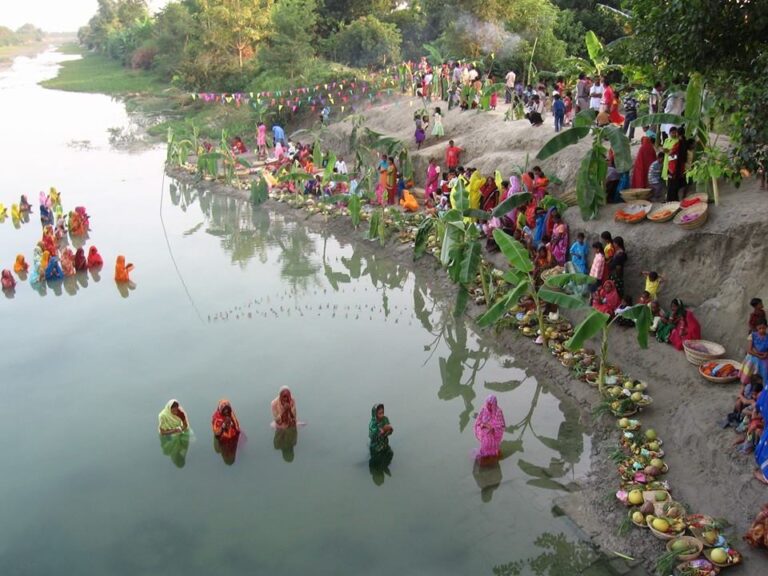
Baisakhi in Punjab celebrates the wheat harvest in April. Onam in Kerala honours the return of the legendary king Mahabali and also falls at harvest time. Chhath, in Bihar and eastern Uttar Pradesh, is a festival of sun worship held twice a year, once after the monsoon and once in early summer.
The panchayat and village government
The panchayat, or village council, is mentioned in Indian texts going back more than two thousand years. Today it is the lowest level of elected government. The gram panchayat is chosen by all adult villagers and runs basic local services, and it also handles part of the money from central and state schemes for housing, drinking water and rural employment.
The 73rd Constitutional Amendment, which came into force in 1993, made panchayat elections regular and compulsory and reserved one-third of seats for women. With hundreds of thousands of elected bodies, Panchayati Raj is one of the largest experiments in local democracy anywhere in the world.
How village life has changed in recent decades
Rural India has changed enormously in the last thirty years. Electricity has reached over 99 percent of villages, and mobile phones with 4G internet are now close to universal. The Jan Dhan scheme opened bank accounts for most rural households, and UPI payments now work in very small villages. Solar pumps, solar street lights and small solar home systems give energy options that did not exist a generation ago.
At the same time, many young people are leaving. Every year large numbers of rural Indians, mostly young men, move to cities for better-paid work, and many villages now have mainly older people and children for much of the year. Men spend months away in Delhi, Mumbai, Bengaluru or the Gulf, and the money they send home supports a large share of household income in states such as Kerala, Punjab, Bihar and Uttar Pradesh.
Problems villages face
The difficulties are real. Groundwater tables are falling in Punjab, Haryana and much of the south. Farm incomes have not kept pace with the cost of seeds, fertiliser and diesel, and farmer suicides remain tragically common in some states. Rural healthcare is thin, with too few doctors and long distances to the nearest hospital.
Girls’ schooling has improved a great deal but still lags behind boys’ in many areas, and climate change is making the monsoon less predictable for farmers who depend on it. Yet villages also keep habits the rest of the world is rediscovering, such as using cow dung as fuel and manure, harvesting rainwater in tanks and ponds, and repairing things rather than replacing them.
Read Next
- Urban Lifestyle in India: Life in Delhi, Mumbai, Bengaluru, and Other Metros
- Lohri and Makar Sankranti: The Harvest Festivals That Still Shape Life in India
- Chaudhary Charan Singh: The Farmer Prime Minister Who Ended Zamindari
Frequently Asked Questions
What is the main occupation in rural India?
Agriculture is still the largest source of work in rural India. It is followed by livestock rearing, wage labour, small crafts and small trading.
What share of India’s population lives in villages?
According to the 2011 census, about 69 percent of Indians lived in rural areas. The share has been falling slowly as towns grow, but villages still hold a clear majority of the population.
Which Indian state has the largest rural population?
Uttar Pradesh, India’s most populous state, also has the largest rural population, followed by Bihar. Kerala and Goa, by contrast, have such spread-out settlements that the line between village and town is often blurred.
Sources and Further Reading
- Government of India, Census of India 2011, Rural Urban Distribution of Population
- Ministry of Panchayati Raj, Government of India, Devolution Report
- NABARD, All India Rural Financial Inclusion Survey
- Jean Drèze and Amartya Sen, An Uncertain Glory: India and Its Contradictions, Penguin