[india_weather]
Lohri and Makar Sankranti: The Harvest Festivals That Still Shape Life in India
On the night of 13 January, Punjabi families gather round a bonfire and throw sesame, jaggery and popcorn into the flames. The next morning, the sky over Ahmedabad fills with kites and Tamil households set pots of rice boiling until they spill over. Lohri and Makar Sankranti fall on consecutive days and carry different names in almost every state, but both mark the same turn of the farming year in mid January.

When are Lohri and Makar Sankranti celebrated?
Lohri is usually celebrated on 13 January and Makar Sankranti on 14 January. Because Sankranti follows the solar calendar, its date barely moves from year to year, unlike Diwali or Holi, which follow the moon.
For 2027, most calendars give Lohri as Wednesday, 13 January 2027 and Makar Sankranti as Thursday, 14 January 2027. In some years the exact moment of the sun’s entry into Makara falls late in the day and many panchangs then shift Sankranti to 15 January, with Lohri moving with it. Check your local panchang closer to the date before you plan travel or leave.
What is Lohri?
Lohri is a festival of Punjab, Haryana, Himachal Pradesh and Delhi. It marks the end of the coldest stretch of winter and the start of longer days.
The bonfire is the centre of it. After sunset, families and neighbours gather round the fire and offer sesame seeds, jaggery, popcorn and dry fruits to Agni, the fire god. Children go from door to door singing Lohri songs, the best known of which is about Dulla Bhatti, a Robin Hood figure of Punjabi folklore who, during the reign of Akbar, rescued village girls from being sold into slavery.
A family’s first Lohri after a wedding or the birth of a baby is celebrated with extra fuss. Relatives and neighbours drop in to bless the couple or the newborn, and sweets go round the whole street.
What is Makar Sankranti?
Makar Sankranti is the day the sun enters Makara, the sign of Capricorn, in the Indian sidereal zodiac. Traditionally it marks the start of Uttarayan, the six months when the sun is seen to move northward and the days grow longer.
The festival goes by many names. In Punjab it is Maghi, and in Gujarat and Rajasthan it is Uttarayan. Tamil Nadu celebrates Pongal, Karnataka has Suggi and in Andhra Pradesh it is simply Sankranti. Assam marks Bhogali Bihu and Bengal celebrates Poush Sankranti.
Why Lohri and Makar Sankranti fall together
Both festivals come out of the same farming rhythm. In north India the rabi crops are sown in October and November, and by mid January the fields of wheat and mustard are well established while sugarcane is being cut. For farmers the hardest part of winter is over and the year’s main crop is on its way.
Lohri’s bonfire is a way of giving thanks for that. Makar Sankranti, the next day, is the astronomical marker that the sun is turning back towards spring. You can read the two as one celebration spread over a night and a morning, the fire at the end of winter followed by the sun’s new course.
Regional traditions of Makar Sankranti
Gujarat and Rajasthan
Uttarayan in Gujarat means kites, and the skies over Ahmedabad are packed with them from dawn till dark. The next day, Vasi Uttarayan, families go back up to the rooftops to fly more kites and finish the leftovers. The international kite festival held in Ahmedabad draws visitors from many countries.
Tamil Nadu
Pongal runs for four days around 14 January. On Bhogi, old things are burned to make way for new. Thai Pongal is the main day of prayer and cooking, when the pongal rice is boiled in a new clay pot until it overflows. Mattu Pongal honours cattle, which are washed, garlanded and fed sweet pongal, and on Kaanum Pongal families go visiting.
Maharashtra and Karnataka
In Maharashtra people exchange tilgul with the words tilgul ghya ani god god bola, “take this sweet and speak sweetly”. Many wear black on this day, a colour that holds the winter sun’s warmth, and kites are flown here too. In Karnataka, farmers offer freshly cut sugarcane and pongal to their cattle.
Uttar Pradesh, Bihar, Bengal and Assam
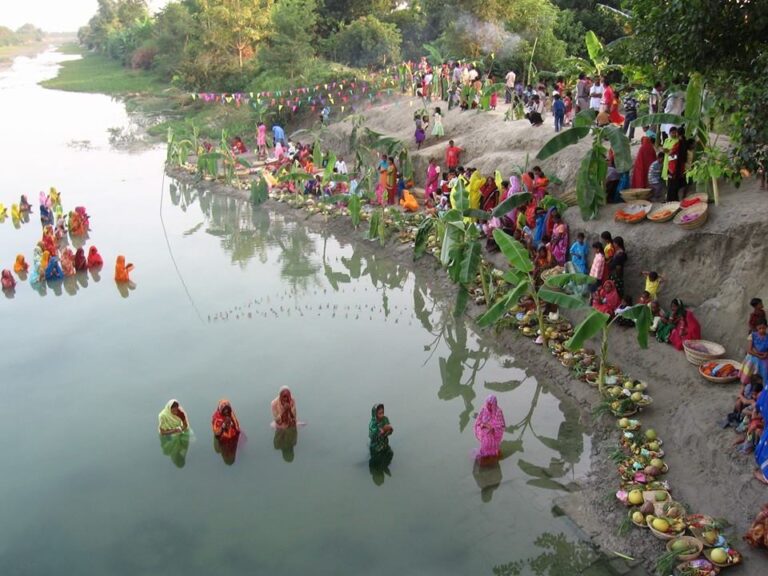
In Uttar Pradesh and Bihar people take a dip in the Ganga before dawn, and the festival is often simply called Khichdi after the dish eaten that day. In West Bengal, pilgrims gather at Ganga Sagar, where the Ganga meets the sea. In Assam, Bhogali Bihu brings community feasts, often held in temporary bamboo and thatch huts called meji that are burned the next morning.
In Kumbh years, Makar Sankranti at Prayagraj marks the first major bathing day of the great gathering, and millions of pilgrims enter the Sangam.
Foods of Lohri and Makar Sankranti
Almost everything cooked at this time has sesame (til) or jaggery (gud) in it. Sesame is a warming food and jaggery gives quick energy, so both have long been eaten in the cold months. Here is what you will find on plates across the country:
- Til gud laddoo or tilgul, small balls of sesame and jaggery, handed to guests in Maharashtra and beyond
- Gajak and chikki, brittle sesame or peanut sweets sold everywhere from Delhi to Jaipur
- Sarson ka saag and makki di roti, the classic Punjabi meal for Lohri night
- Pongal, rice and lentils cooked in a new clay pot until the milk boils over, a sign of plenty
- Puran poli, a sweet flatbread filled with jaggery and lentils, made in Maharashtra and Gujarat
- Undhiyu, a Gujarati mixed vegetable dish traditionally cooked in earthen pots buried upside down in the ground, eaten at Uttarayan
- Khichdi, the simple rice and lentil dish offered at Ganga Sagar and eaten across Uttar Pradesh and Bihar
Many of these dishes turn up across the winter in Punjab and the plains. Our guide to North Indian food covers saag, makki di roti and gajak in more detail.
Tips for celebrating
If you are planning to see Uttarayan in Ahmedabad, book a stay in the old city early, because rooftop space for the kite day goes fast. Wear gloves or tape your fingers if you fly with sharp manja, and keep an eye out for birds, since many local groups run bird rescue camps over these two days.
For Lohri, the fire is usually lit just after sunset, so arrive early if you are joining a neighbourhood bonfire. The next festival on the calendar is Basant Panchami, when the mustard fields that were green at Lohri are in yellow flower.
Read Next
- Basant Panchami: The Festival of Knowledge, Spring, and Goddess Saraswati
- Diwali: Festival of Lights, Legends, Rituals, and Modern Celebrations
- Veer Bal Diwas: The Story of the Sahibzadas and India’s Youngest Martyrs
Frequently Asked Questions
Are Lohri and Makar Sankranti the same festival?
No. They are separate festivals on consecutive days with a shared farming theme. Lohri belongs mainly to Punjab, Haryana and Himachal Pradesh, while Makar Sankranti is marked across almost all of India under regional names.
Why do people fly kites on Makar Sankranti?
Kite flying is strongest in Gujarat and Rajasthan. It is often said to have begun as a royal pastime in the Mughal era, and some see it as a way of reaching up towards the sun. Practically, mid January in western India brings clear skies and steady winds.
What is Maghi?
Maghi is the Punjabi name for Makar Sankranti, celebrated the day after Lohri. Many Sikh families visit the gurdwara on this day.
Sources and Further Reading
- Ministry of Culture, Government of India, Festivals of India archive
- Sahapedia, Regional Celebrations of Makar Sankranti and Pongal
- KT Achaya, The Story of Our Food, Universities Press