[india_weather]

Chaudhary Charan Singh: The Farmer Prime Minister Who Ended Zamindari
Every year on 23 December, India marks Kisan Diwas, National Farmers’ Day. The date is the birthday of Chaudhary Charan Singh, the fifth Prime Minister of India, who described himself all his life as a farmer. His time as Prime Minister lasted only 170 days, and he never faced Parliament in that office. His real mark was made earlier, in Uttar Pradesh, where the land reform law he drafted turned millions of tenants into owners of the fields they worked.
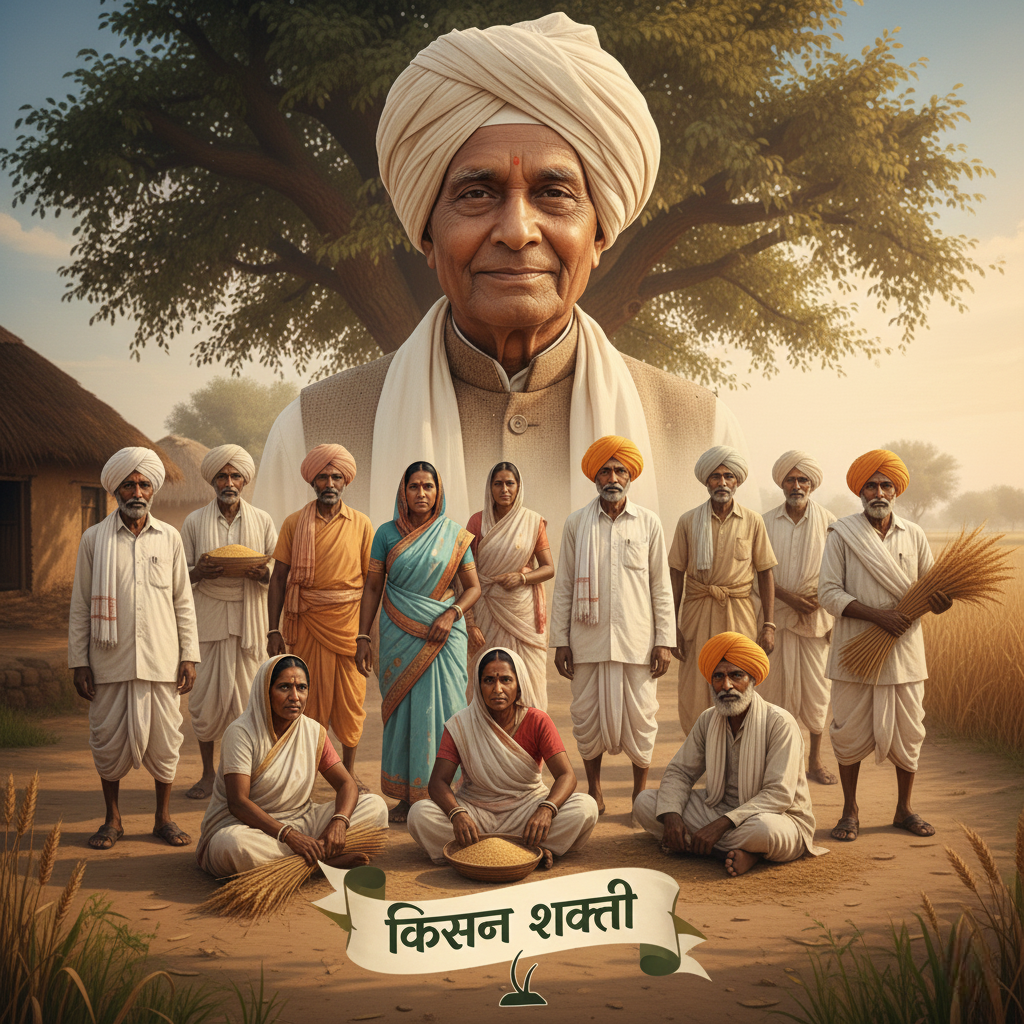
Early life of Chaudhary Charan Singh
Charan Singh was born on 23 December 1902 in Noorpur, a village then in Meerut district of the United Provinces and now in Hapur district, Uttar Pradesh. His family were Jats, and his father, Chaudhary Mir Singh, was a small farmer of modest means. The family put its savings, and some borrowed money, into sending him to school.
He passed his matriculation from the government high school in Meerut in 1919. He then took a BSc from Agra College in 1923 and an MA in history in 1925. After qualifying in law he set up practice at the Ghaziabad bar in 1928, and for the next decade he combined legal work with Congress organising in Meerut district.
Jail and the freedom struggle
Charan Singh joined the Indian National Congress in the late 1920s, drawn by Gandhi and by the party’s growing attention to peasants. He was arrested during the Salt Satyagraha of 1930, again in the Individual Satyagraha of 1940, and again in the Quit India movement of 1942. In all he spent close to three years in British jails between 1930 and 1945.
These were also the years in which he started writing. His pamphlets and articles dealt with rural debt, insecure tenancy and the way colonial revenue policy left cultivators with little to show for their labour. The arguments he worked out in this period stayed with him for the rest of his career.
How Charan Singh ended zamindari in Uttar Pradesh
Under the zamindari system, which took its colonial shape under the British from the Permanent Settlement of 1793 onwards, intermediary landlords held the rights over large tracts of village land. The people who actually ploughed and harvested were their tenants. They paid rent, were often forced into unpaid labour (begar), and could be evicted.
Charan Singh argued again and again that independence meant little to a peasant who was still economically bound to a landlord. He served first as a parliamentary secretary and then as a cabinet minister in the Uttar Pradesh government. In that role he was the main architect of the Uttar Pradesh Zamindari Abolition and Land Reforms Act of 1950, one of the most important land reform laws passed anywhere in India.
The Act abolished zamindari in the state and gave ownership rights to the cultivators who tilled the land. The figure usually quoted is that over twenty million tenant farmers in Uttar Pradesh gained ownership as a result. Landlords fought it in court and enforcement was uneven, but the transfer was real.
The law broke the power of the old landed families in India’s most populous state. In their place it created a large class of independent smallholders, the farmers who have shaped Uttar Pradesh politics ever since.
Leaving the Congress and becoming Chief Minister
In 1967, after almost four decades in the Congress, Charan Singh left the party, accusing it of neglecting the rural poor. He led a breakaway group that became the Bharatiya Kranti Dal and, on 3 April 1967, became Chief Minister of the first non-Congress government in Uttar Pradesh. That government fell within a year, and he returned as Chief Minister briefly in 1970.
As Chief Minister he kept the focus on agriculture. Support prices for crops were raised, farm loans were restructured and small farmers’ cooperatives were encouraged. He also had a reputation for personal simplicity and for taking on senior Congress leaders over rural policy.
Charan Singh in the Janata government
After the Emergency, Charan Singh’s party merged into the Janata Party, which won the 1977 general election. He became Union Home Minister in Morarji Desai’s government. His relationship with Desai was difficult from the start, and he was dropped from the cabinet in 1978 before returning in early 1979 as Deputy Prime Minister and Finance Minister.
His one budget, in 1979, was openly tilted towards agriculture, with cuts in duties on fertiliser and other farm inputs. Critics called it a “kulak budget” that favoured richer farmers, a label that stuck to his politics more generally.
Prime Minister for 170 days
By mid-1979 the Janata Party was splitting apart, and Desai resigned. Charan Singh, with the support of Indira Gandhi’s Congress from outside, was sworn in as Prime Minister on 28 July 1979, without a majority of his own in the Lok Sabha.
Just before he was due to seek a vote of confidence, Indira Gandhi withdrew her party’s support. Charan Singh resigned rather than face a vote he was sure to lose, and so he never met the Lok Sabha as Prime Minister. He stayed on as caretaker until 14 January 1980, after fresh elections in which the Congress returned to power.
His total of 170 days makes his one of the shortest tenures of any Indian Prime Minister. He spent the rest of his life in opposition.
His books on farming and the economy
Charan Singh wrote more than most politicians of his generation, and he wrote about economics rather than memoir. His main books are Abolition of Zamindari (1947), Joint Farming X-Rayed (1959), India’s Poverty and Its Solution (1964), India’s Economic Policy: The Gandhian Blueprint (1978) and Land Reforms in UP and the Kulaks (1986).
Across these books the argument is consistent. India should build its economy on small, independent family farms. He opposed collective or cooperative joint farming of the kind Nehru’s planners favoured in the late 1950s, and he distrusted heavy industrialisation that drew investment away from villages.
What agriculture needed, he wrote, was public money for irrigation, extension services and rural credit, and state support for crop prices so that farm incomes were protected. Many of these positions were controversial then and some still are. For anyone studying the debate between agrarian and industrial models of Indian development, his books remain the clearest case for the agrarian side made by a working politician.
Kisan Diwas and Kisan Ghat
The Government of India declared 23 December as Kisan Diwas in 2001, fourteen years after Charan Singh’s death. On the day, the President and Prime Minister issue tributes, and agricultural universities and state governments hold seminars and farmers’ meetings. Since the farmer protests of 2020 and 2021 against the three farm laws, the day has also carried a sharper political edge.
His samadhi, Kisan Ghat, is on the banks of the Yamuna in Delhi, near Raj Ghat. On 23 December, leaders from parties across the spectrum go there to lay flowers.
Death, Bharat Ratna and the family party
Chaudhary Charan Singh died on 29 May 1987, at the age of 84. In 2024, the Government of India announced that he would be given the Bharat Ratna, the country’s highest civilian honour, posthumously.
His son Ajit Singh led the Rashtriya Lok Dal (RLD), the party that grew out of Charan Singh’s Lok Dal, until his death in 2021. His grandson Jayant Chaudhary leads the RLD today, and its base remains the farming belt of western Uttar Pradesh.
The question historians still argue over is who gained most from his reforms. His admirers see the 1950 Act as the moment the tiller finally owned the field. His critics point out that the biggest gains went to middle-peasant castes such as his own Jats, while landless labourers, many of them Dalits, received far less, and that tension still runs through farm politics in the state.
Read Next
- Sardar Vallabhbhai Patel: The Iron Man Who Held India Together
- Rural Lifestyle in India: Village Life, Farming, and Community Structure
- Indian Freedom Struggle: Timeline, Movements and Leaders
Frequently Asked Questions
Which number Prime Minister was Charan Singh?
He was the fifth Prime Minister of India, in office from 28 July 1979 to 14 January 1980.
Why did Charan Singh never face Parliament as Prime Minister?
Indira Gandhi’s Congress, whose outside support kept his government in office, withdrew that support just before the confidence vote. He resigned instead of facing a vote he would have lost.
When did Charan Singh get the Bharat Ratna?
The award was announced in 2024, posthumously, about 37 years after his death.
Was Charan Singh ever Deputy Prime Minister?
Yes. In 1979, in Morarji Desai’s Janata government, he served as Deputy Prime Minister and Finance Minister before becoming Prime Minister himself.
Sources and Further Reading
- Government of Uttar Pradesh, text of the UP Zamindari Abolition and Land Reforms Act, 1950
- Chaudhary Charan Singh, India’s Economic Policy: The Gandhian Blueprint
- Government of India, Press Information Bureau, Bharat Ratna announcement, 2024