[india_weather]

Kailasa Temple Ellora: The Monolithic Wonder Carved From a Single Rock
Most temples are built from the ground up. The Kailasa Temple at Ellora was cut from the top down. Sometime between 756 and 773 CE, under the Rashtrakuta king Krishna I, stonecutters started at the top of a basalt hill and kept cutting downward, removing hundreds of thousands of tonnes of rock, until a complete three-storey Shiva temple, with its courtyard, gateway, shrines and pavilions, stood free in a pit of its own making. If you are planning a trip to Kailasa Temple Ellora, or just studying it for an exam, this guide covers who built it, how, what to look for and how to visit.
Quick Facts
| Built by | Rashtrakuta king Krishna I |
|---|---|
| When | About 756 to 773 CE |
| Where | Cave 16, Ellora, near Chhatrapati Sambhajinagar (Aurangabad), Maharashtra |
| Size | About 82 m long, 46 m wide and 30 m tall |
| Rock removed | Around 400,000 tonnes of basalt |
| UNESCO status | Part of the Ellora Caves World Heritage Site since 1983 |
| Closed | Tuesdays |
What is the Kailasa Temple?
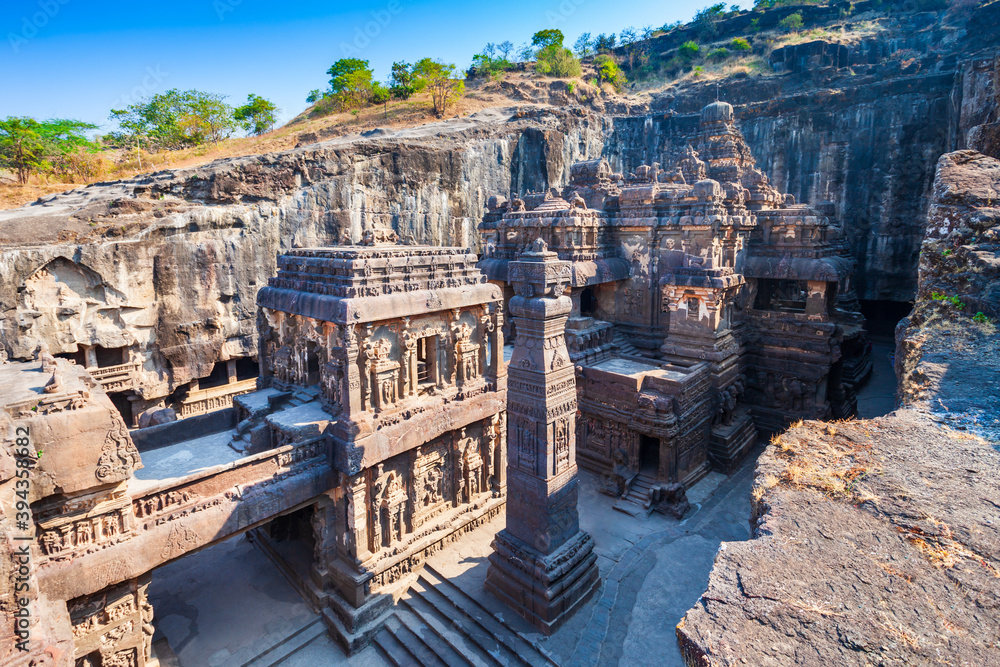
The Kailasa Temple is Cave 16 of the Ellora complex in Maharashtra. Ellora has thirty four main caves, and Kailasa is by far the largest. The temple complex measures about 82 metres long, 46 metres wide and 30 metres tall, and is often said to cover roughly twice the area of the Parthenon in Athens.
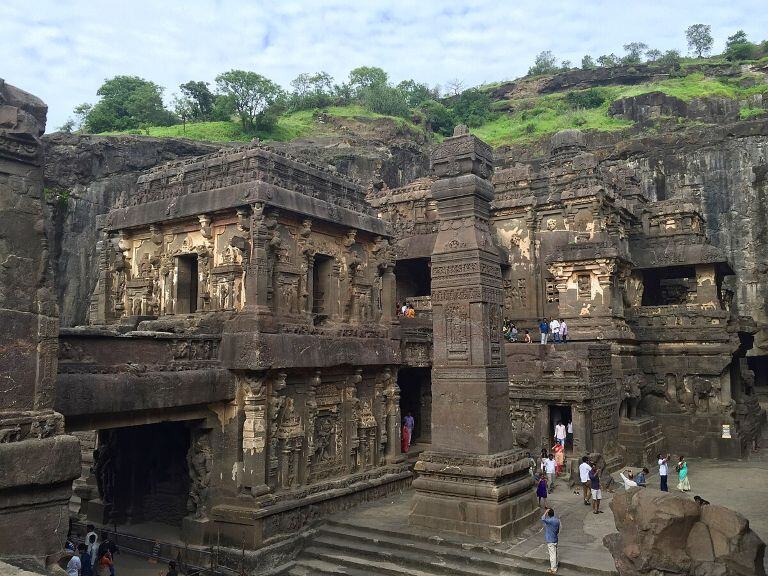
Calling it a cave is a little misleading. It is a full temple, but every part of it, the main shrine, the courtyards, the side pavilions, the rows of elephants around the base and the pillars at the entrance, is cut from one continuous mass of rock. There are no joints and no separate stones.
The temple is dedicated to Shiva as Kailasanatha, lord of Mount Kailash. In Hindu tradition Kailash is Shiva’s home on earth, and the temple was meant as a stone image of that mountain. The upper surfaces were once covered in white plaster, which would have made the comparison with a snowy peak much easier to see than it is today.
Who built the Kailasa Temple?
The temple is credited to Krishna I of the Rashtrakuta dynasty, who ruled from 756 to 773 CE. The Rashtrakutas were then the strongest power in the Deccan, with territory stretching from Gujarat to Andhra. Krishna I took over a stable kingdom from his predecessor, which gave him the time and money for a project of this size.
The main evidence for his role is a copper-plate grant issued by a later Rashtrakuta ruler in 812 CE, found at Baroda, which praises Krishna I for building an astonishing temple at Elapura (the old name of Ellora). The names of the architect and the workers have not survived.
Krishna I chose a site that was already sacred. Ellora had Buddhist caves by then, and Hindu caves were being cut alongside them. His temple was meant to be the centrepiece.
How long did it take to build?
The usual answer is about eighteen years, roughly the length of Krishna I’s reign. That figure assumes the main work was finished while he was alive, and it is the one you will find in most guidebooks and exam notes.
Many historians think the work took longer. Some of the carving and side shrines appear to have been added or finished under later Rashtrakuta kings, so the full complex as you see it today may be the work of several generations. Either way, the core temple was planned and largely carved within a single reign, which is still hard to believe when you stand in the courtyard.
How was it carved?
The technique is called top-down excavation. Workers first cut three deep trenches into the hillside to isolate a huge block of rock. Then they began at the top and worked down.
The shikhara, the tower over the sanctum, was shaped first. Then the workers moved down a level to cut the roofs of the surrounding shrines, then the main hall, and so on, until they reached the courtyard floor 30 metres below their starting point. Every carving, from the lotus medallions on the ceilings to the elephants around the base, was cut in place.
Estimates of the rock removed range from about 200,000 to 400,000 tonnes. The tools were iron chisels, hammers and wooden wedges. A serious mistake could not be repaired, because you cannot add rock back. The whole plan had to be worked out in advance and followed level by level.
What to see at the Kailasa Temple
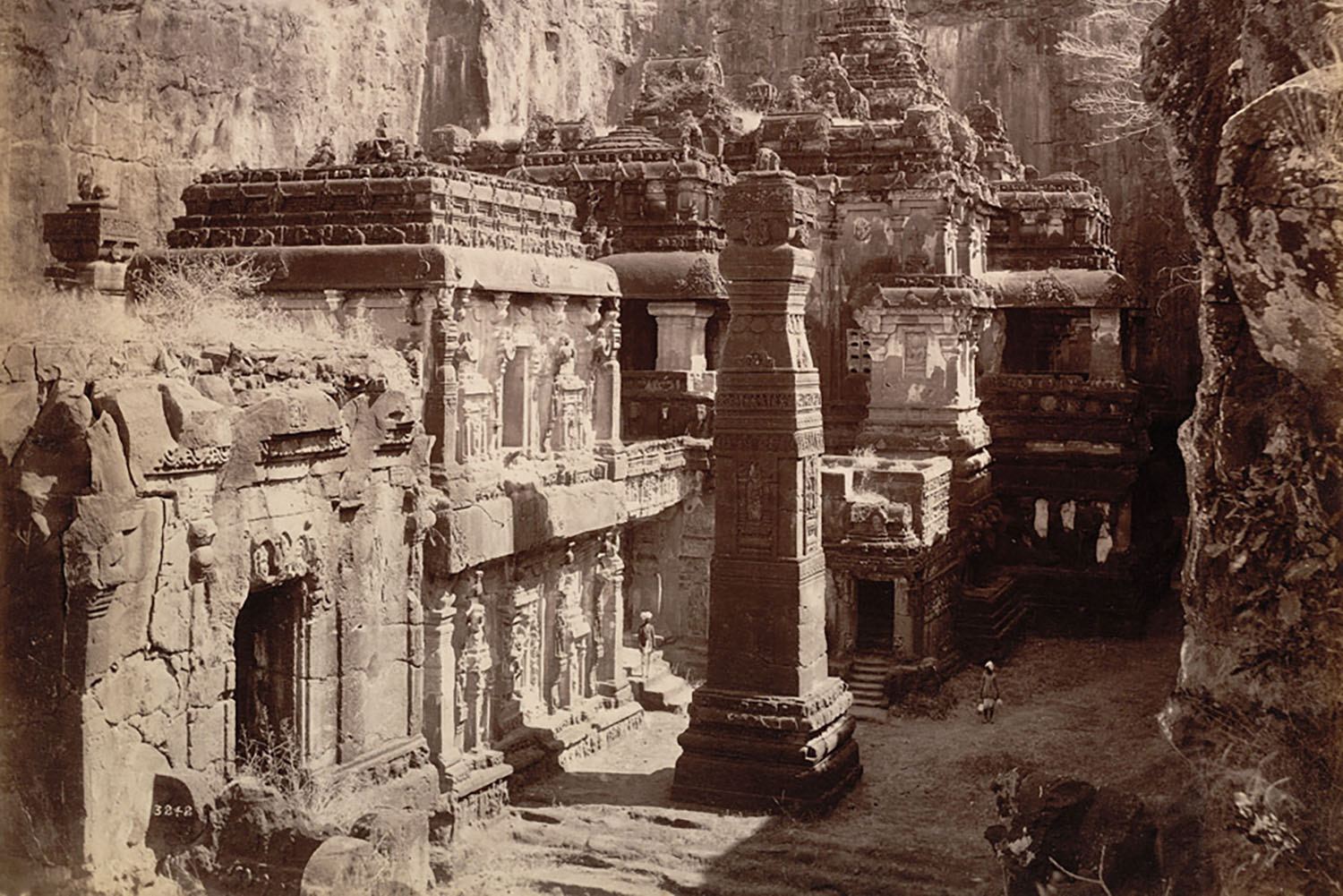
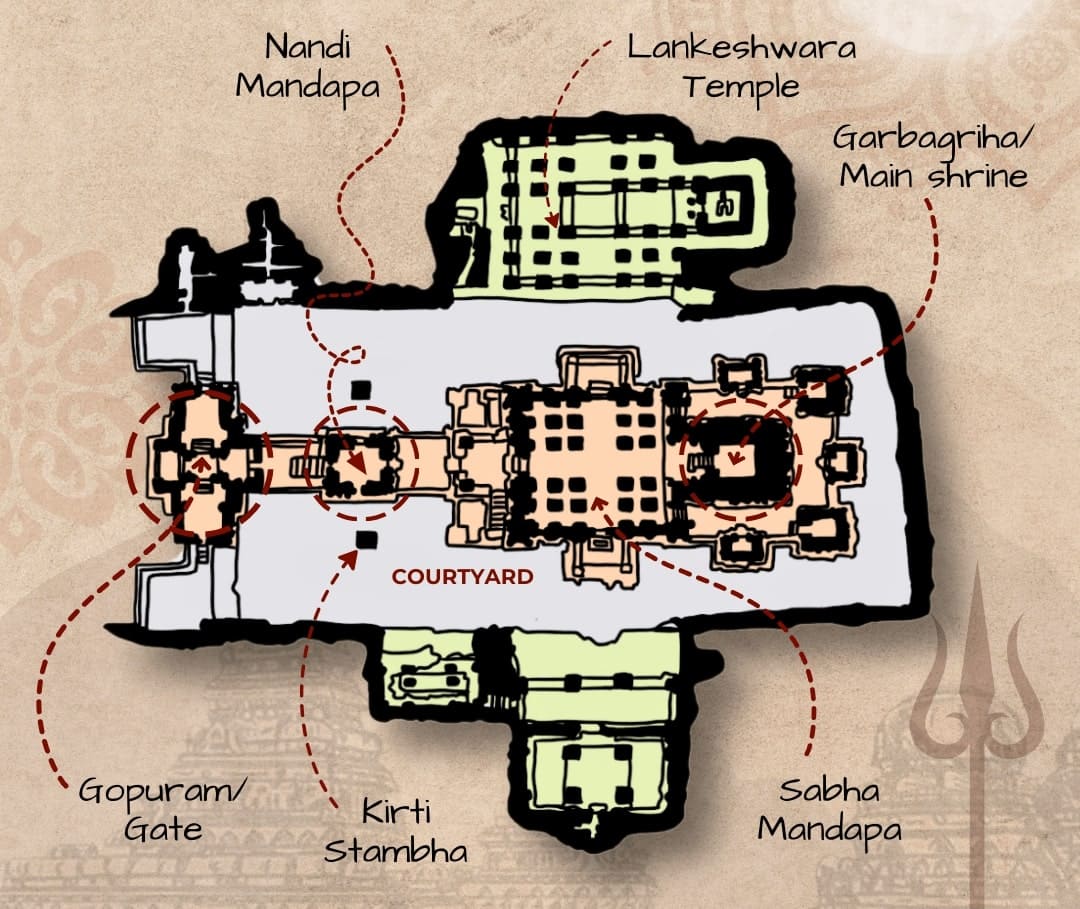
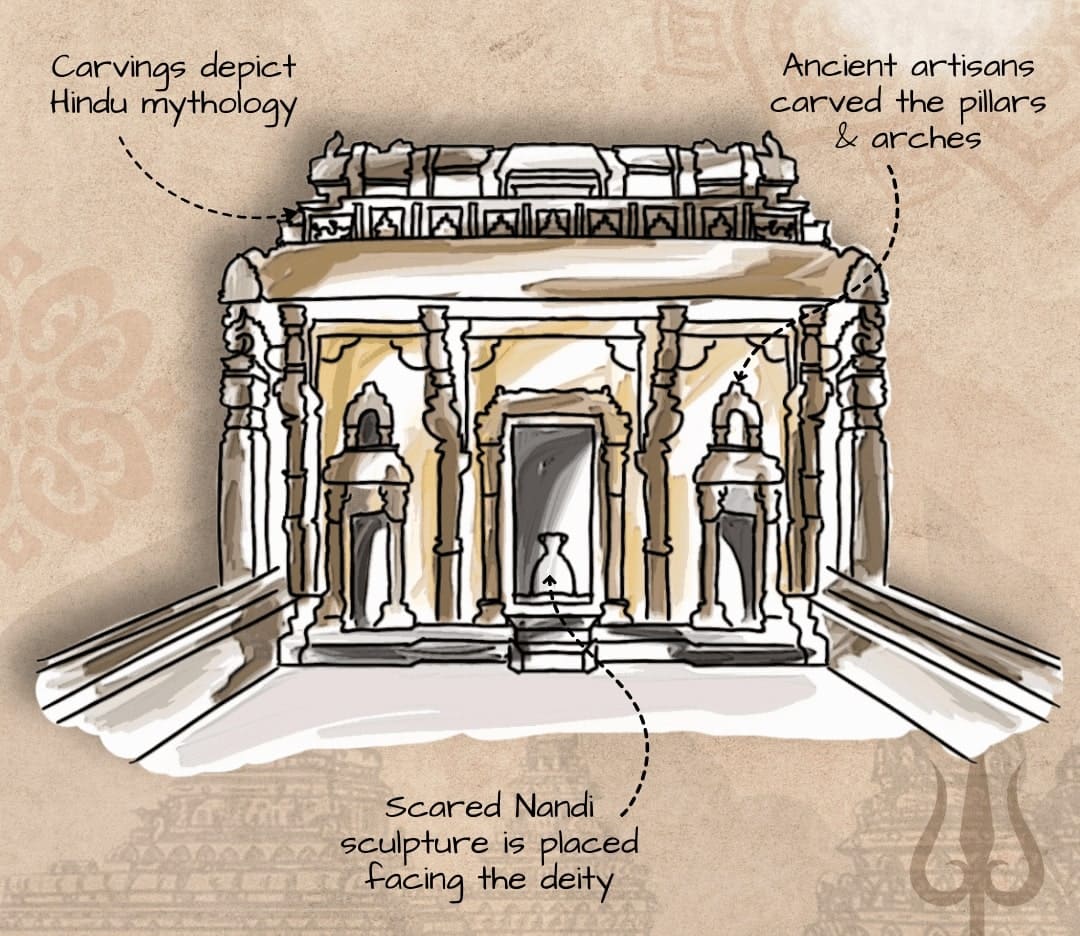
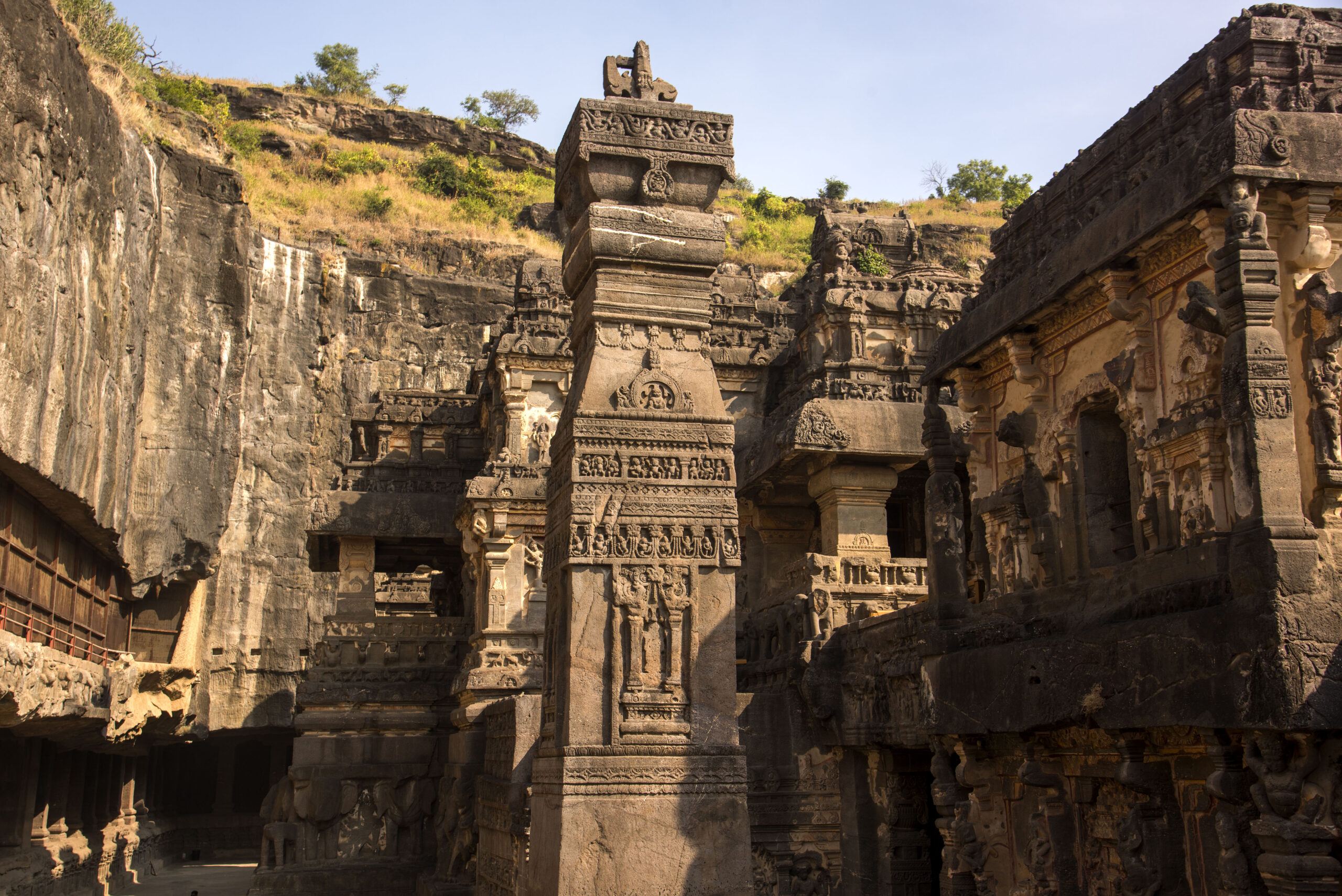
You enter through a gateway cut into the cliff face, and the whole complex opens out in front of you. Straight ahead is the Nandi pavilion, for the bull that Shiva rides, joined by a rock bridge to the main shrine behind it. On either side of the courtyard stand two tall carved pillars and two life-size stone elephants.
The main shrine sits on a high plinth, and its tower rises about 30 metres above the courtyard floor. Look at the base of the plinth: a row of large elephants and lions is carved as if they are carrying the whole temple on their backs.
The walls are covered with relief panels. The one most people come to see shows the ten-headed Ravana trying to lift Mount Kailash, with Shiva calmly pressing down with his foot. It is one of the most dramatic narrative sculptures in India. Other panels show scenes from the Ramayana, the Mahabharata and the Puranas, and the outer walls carry river goddesses, dancers and the eight Dikpalas, guardians of the directions.
Before you leave, climb the path up the cliff around the pit. From the top you can look down on the roof and the shikhara and see how the whole temple sits inside the hill it was cut from.
The Rashtrakuta style
The temple draws on two earlier southern traditions. From the Pallavas of Kanchipuram came the pyramid-shaped Dravidian tower. From the Chalukyas, whose rock-cut work you can see at Badami, came refined relief carving and elements of the mixed Vesara style. Architectural historians often point to the Chalukya temples of the region as a direct model.
What was new at Ellora was the scale, and the decision to carve in one piece. Nothing at Kanchipuram or Badami comes close to its size.
Ellora beyond Cave 16
Kailasa makes more sense once you see the rest of the site. Caves 1 to 12 are Buddhist, dating mostly from the fifth to seventh centuries. Caves 13 to 29 are Hindu, with Kailasa the greatest of them. Caves 30 to 34 are Jain, dating from the eighth and ninth centuries.
Together they cover more than five hundred years and three religions on a single stretch of cliff. The Kalachuris, the Chalukyas and the Rashtrakutas all supported more than one faith here. If you have time, walk to the Jain caves at the northern end, especially Cave 32, which is quieter than Kailasa.
Kailasa Temple Ellora: timings, tickets and getting there
Ellora is about 30 km from Chhatrapati Sambhajinagar (formerly Aurangabad), which has the nearest airport and railway station. The caves are open every day except Tuesday, from 6:00 am to 6:00 pm. Entry costs around 40 rupees for Indian visitors and 600 rupees for international visitors.
Most people combine Ellora with Ajanta, about 100 km away. Plan two full days for the pair. The best months are October to February, and it is wise to avoid the peak monsoon in July and August.
Go to Kailasa as soon as the gates open, before the tour buses arrive, and keep the Buddhist and Jain caves for later in the day.
Read Next
- Ajanta Caves: The Ancient Buddhist Paintings of Maharashtra
- Badami Caves: The Early Chalukya Rock Temples of Karnataka
- Brihadeeswarar Temple Thanjavur: The Great Chola Masterpiece
Frequently Asked Questions
What is a monolithic temple?
A monolithic temple is carved from a single piece of rock instead of being assembled from separate stones. The Kailasa Temple is the largest monolithic rock-cut temple in the world.
Is the Kailasa Temple a UNESCO World Heritage Site?
Yes. The whole Ellora complex, including Kailasa as Cave 16, was declared a UNESCO World Heritage Site in 1983.
How much time do I need at the Kailasa Temple?
Give Kailasa alone at least two hours, including the walk up the cliff path. Seeing all three groups of caves at Ellora properly takes most of a day.
Sources and Further Reading
- Archaeological Survey of India website (asi.nic.in)
- UNESCO World Heritage Centre, Ellora Caves nomination file, 1983
- Michell, George, The Hindu Temple, University of Chicago Press
- Owen, Lisa, Carving Devotion in the Jain Caves at Ellora, Brill