Amer Fort Jaipur: Complete History, Architecture & Visitor Guide
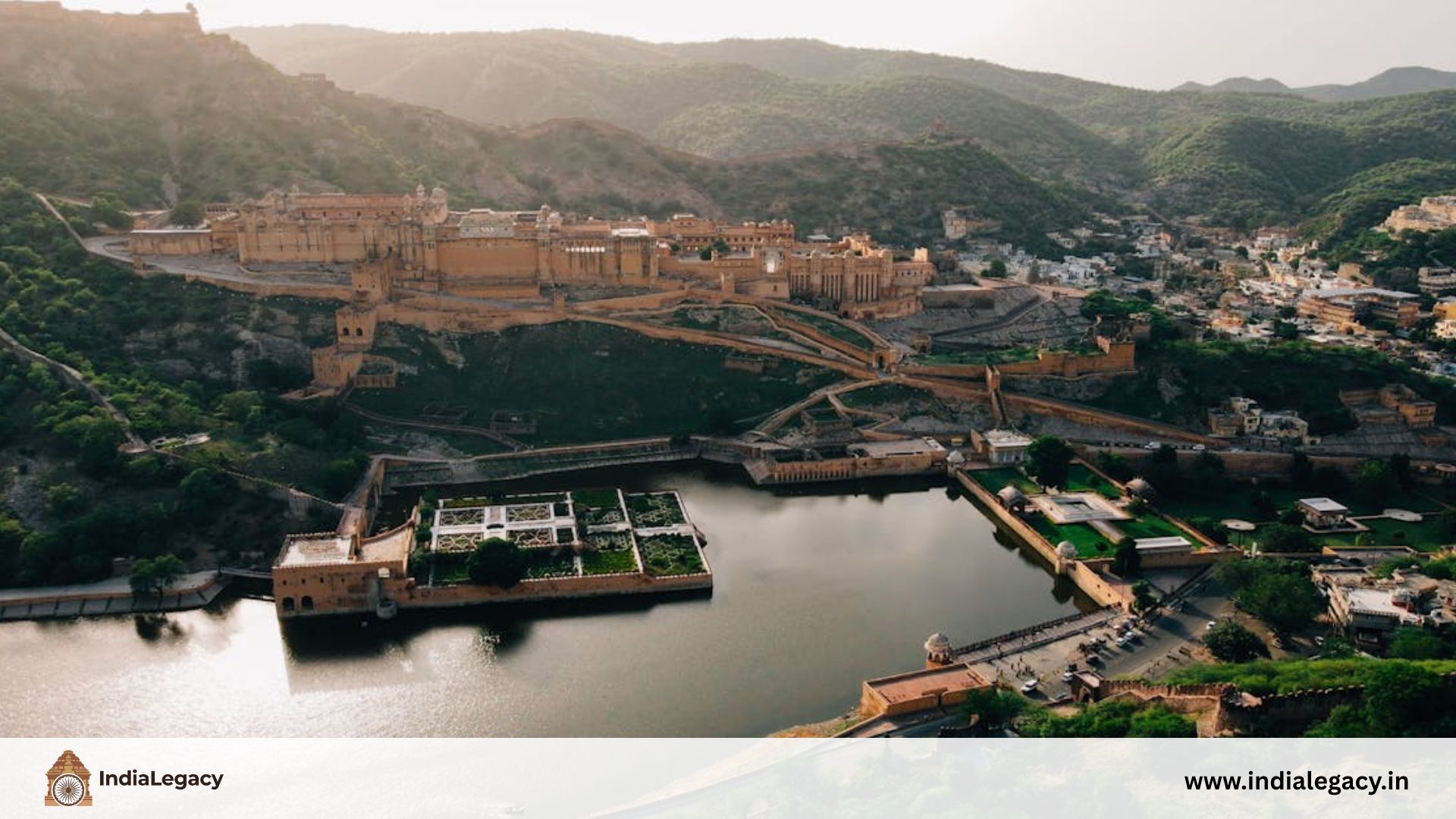
Amer Fort (also spelled Amber Fort) stands as one of India’s most magnificent examples of Rajput military architecture — a golden-hued fortress complex that has watched over Jaipur for more than four centuries. Perched on the rugged Aravalli Hills overlooking the shimmering Maota Lake, Amer Fort is not merely a structure of stone; it is a living chronicle of royal ambition, artistic genius, and political cunning that shaped medieval Rajasthan.
Built primarily under Raja Man Singh I in 1592 CE and expanded by successive Kachhwaha rulers, the fort seamlessly blends Hindu Rajput grandeur with Mughal refinement — a rare architectural marriage born of a powerful political alliance between Jaipur’s ruling clan and Emperor Akbar’s imperial court. Today, it draws over 5,000 visitors daily and stands as Rajasthan’s most visited heritage monument.
From the ivory-inlaid Sheesh Mahal (Palace of Mirrors) that glitters like a constellation from a single candle flame, to the hidden tunnels connecting Amer Fort to Jaigarh Fort four kilometres away, this fortress holds secrets that most visitors never discover. This comprehensive guide explores the fort’s complete history, architectural wonders, royal stories, and everything you need to plan a perfect visit.
🔗 Also Read on India Legacy
Amer Fort: Quick Reference
| Detail | Information |
|---|---|
| Built by | Raja Man Singh I (1592 CE); expanded by Mirza Raja Jai Singh I & Sawai Jai Singh II |
| Location | Amer, 11 km from Jaipur city centre, Rajasthan |
| Architectural Style | Rajput-Mughal (Indo-Saracenic blend) |
| UNESCO Status | World Heritage Site (2013) — Hill Forts of Rajasthan |
| Area | Approx. 4 sq km (fort complex + adjoining walls) |
| Altitude | 1,148 ft (350 m) above sea level |
| Timings | 8:00 AM – 5:30 PM (daily); Light & Sound Show: 7:00 PM & 8:00 PM |
| Entry Fee | Indians: ₹100 | Foreigners: ₹500 | Students (with ID): ₹10 |
| Best Time to Visit | October to March (winter months) |
| Nearest Airport | Jaipur International Airport (30 km) |
The History of Amer Fort: From Ancient Mina Tribe to Mughal Alliance
Long before Amer Fort became the symbol of Rajput glory, the hill on which it stands was occupied by the Mina tribe, who built an early settlement called Amber — possibly derived from Ambikeshwar, a name for Lord Shiva. The Minas worshipped Goddess Gatta Rani, whose temple still stands inside the fort complex today.
Kachhwaha Conquest (967 CE)
Around 967 CE, the Kachhwaha Rajput clan under Raja Dhola Rai defeated the Minas and seized control of the Amer region. The Kachhwahas established Amer as their capital and began constructing early defensive structures on the hill. For nearly six centuries, successive kings fortified and expanded Amer, but it was not until the Mughal era that the fort we see today began to take shape.
Raja Man Singh I and the Mughal Alliance (1592 CE)
The most transformative chapter of Amer Fort’s history begins with Raja Man Singh I (1589–1614 CE), commander-in-chief of Emperor Akbar’s army and one of the most powerful Rajput nobles in the Mughal court. The alliance between the Kachhwaha clan and the Mughals — cemented by royal marriages and military loyalty — gave Man Singh immense wealth and access to the finest architects, craftsmen, and materials from across the empire.
In 1592 CE, Man Singh began constructing the grand palace complex. He imported white marble from Makrana (the same quarries that supplied marble for the Taj Mahal), engaged Persian tile-workers for the Sheesh Mahal, and brought Mughal garden designers to craft the elegant Char Bagh courtyard. The result was a palace that matched Mughal opulence while retaining distinctly Rajput spatial planning and deity-worship traditions.
Mirza Raja Jai Singh I: The Great Expansion (1621–1667 CE)
Raja Man Singh’s grandson, Mirza Raja Jai Singh I, carried out the most ambitious expansions. He added the iconic Sheesh Mahal, the Jai Mandir (Hall of Victory), and the Sukh Niwas (Hall of Pleasure) — a chamber cooled by water channels through perforated marble screens that functioned as an ancient air-conditioning system. Jai Singh I also connected Amer to Jaigarh Fort through a 4-km long underground tunnel used as a royal escape route.
Sawai Jai Singh II and the Move to Jaipur (1727 CE)
In 1727 CE, Sawai Jai Singh II made the historic decision to move the capital from Amer to the newly planned city of Jaipur — the famous Pink City. While Jaipur became the new royal seat, Amer Fort never lost its ceremonial importance. The Shila Devi temple remained a site of profound royal devotion; Sawai Jai Singh II himself prayed here before every major military campaign.
Architecture of Amer Fort: A Rajput-Mughal Masterpiece
Amer Fort’s architecture is unlike any other in Rajasthan. Where most Rajput forts are purely martial — thick walls, narrow passages, angular bastions — Amer is simultaneously a formidable military stronghold and an exquisitely refined palace. Its layout spans four main sections, each built in a different era, creating a layered palimpsest of royal history.
The Four Courtyard Layout
- First Courtyard (Jaleb Chowk): The public courtyard where armies assembled and returns from battle were celebrated. Elephants were stabled here; today, visitors ride decorated elephants up the steep hill path from this level.
- Second Courtyard (Shila Devi Temple): Houses the revered Shila Devi temple dedicated to Goddess Kali, brought by Raja Man Singh I from Bengal after a victorious military campaign.
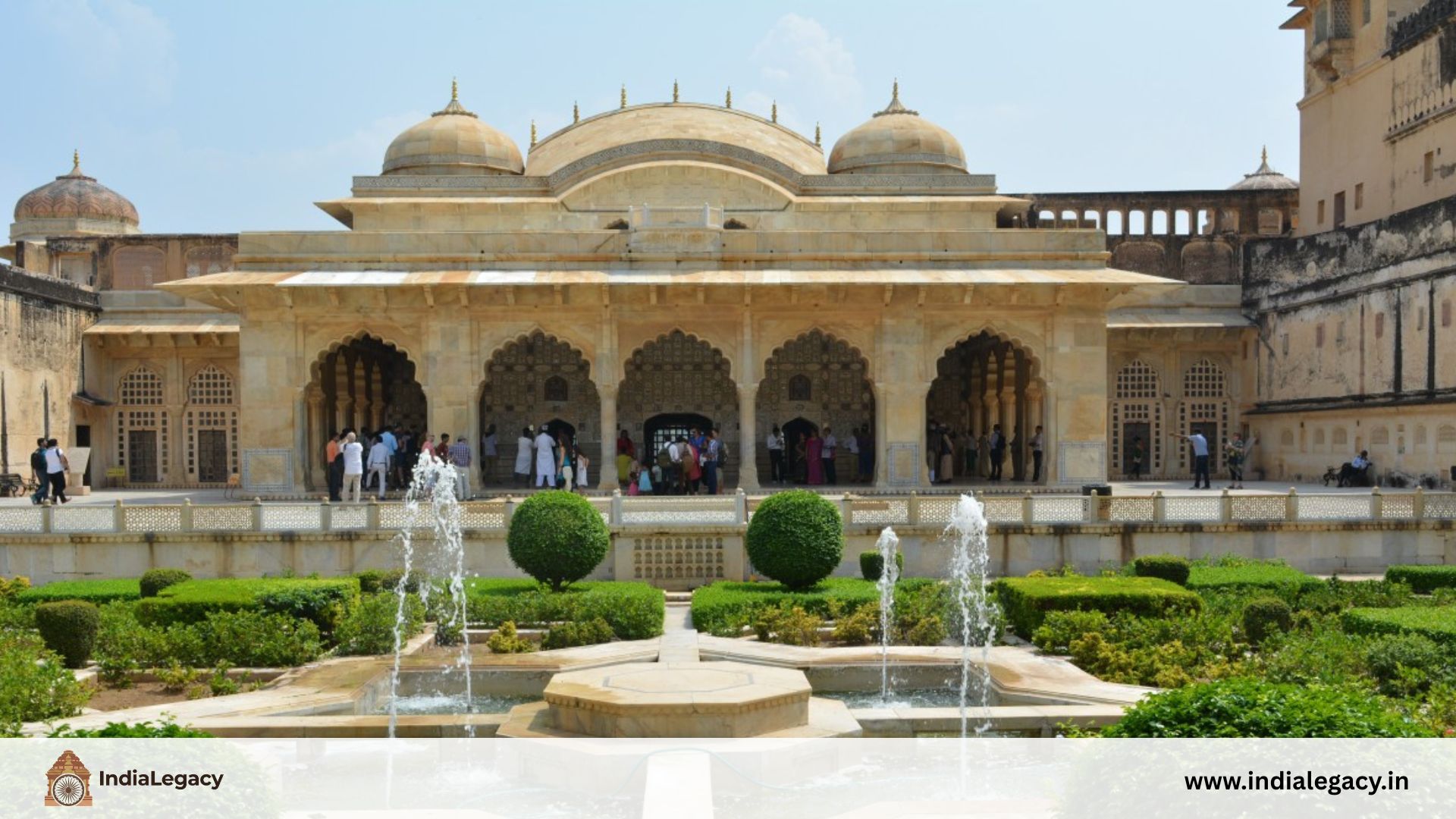
- Third Courtyard (Diwan-i-Khas & Sheesh Mahal): The private royal quarters — the architectural crown of Amer Fort — containing the Jai Mandir, the Sheesh Mahal, and the Sukh Niwas.
- Fourth Courtyard (Zenana or Women’s Quarters): Private apartments of the queens and royal women, designed as a self-contained palace with separate garden, wells, and prayer spaces. Twelve queens each had separate apartments here.
Ganesh Pol: The Gateway of Fortune
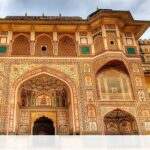
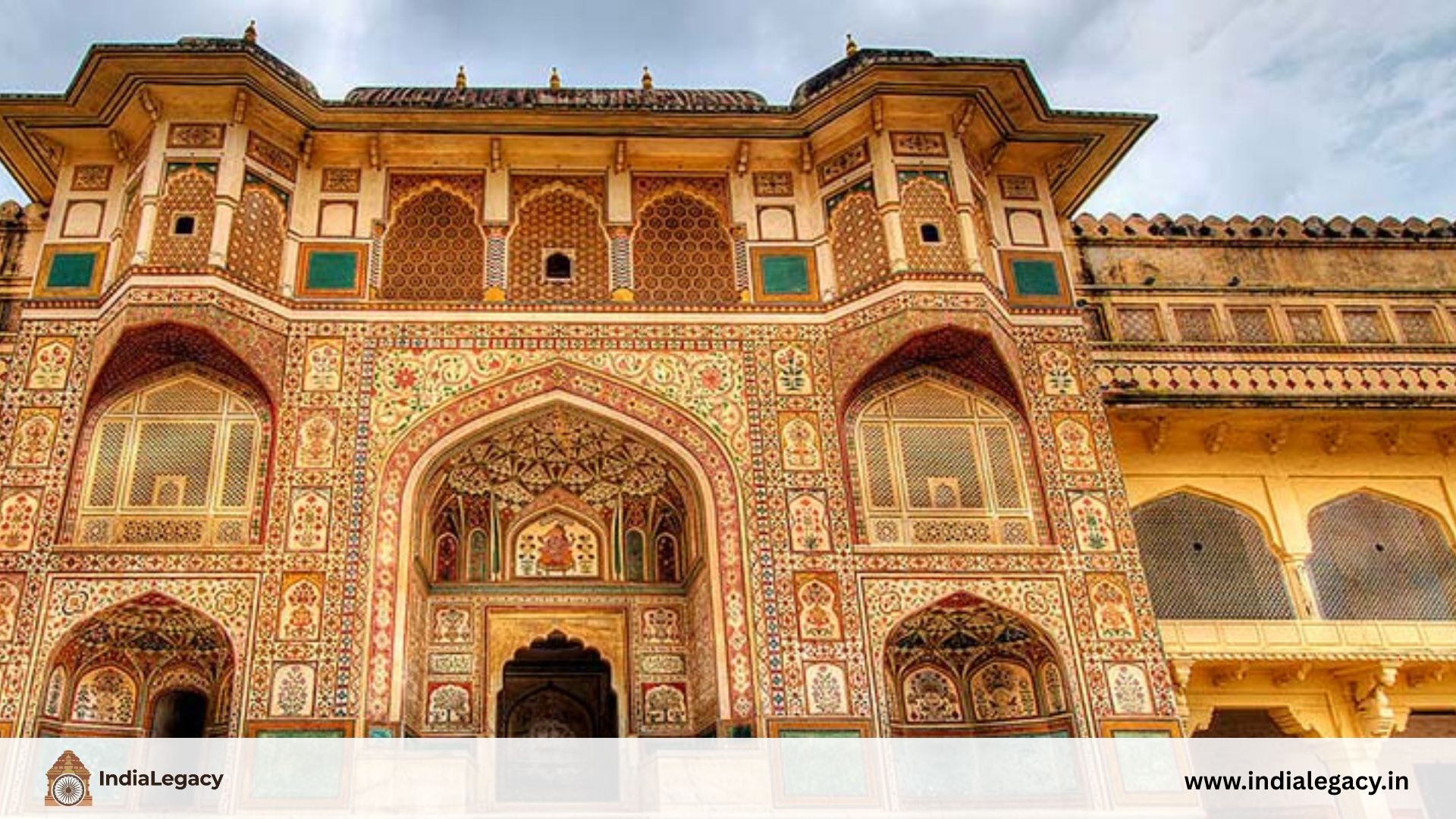
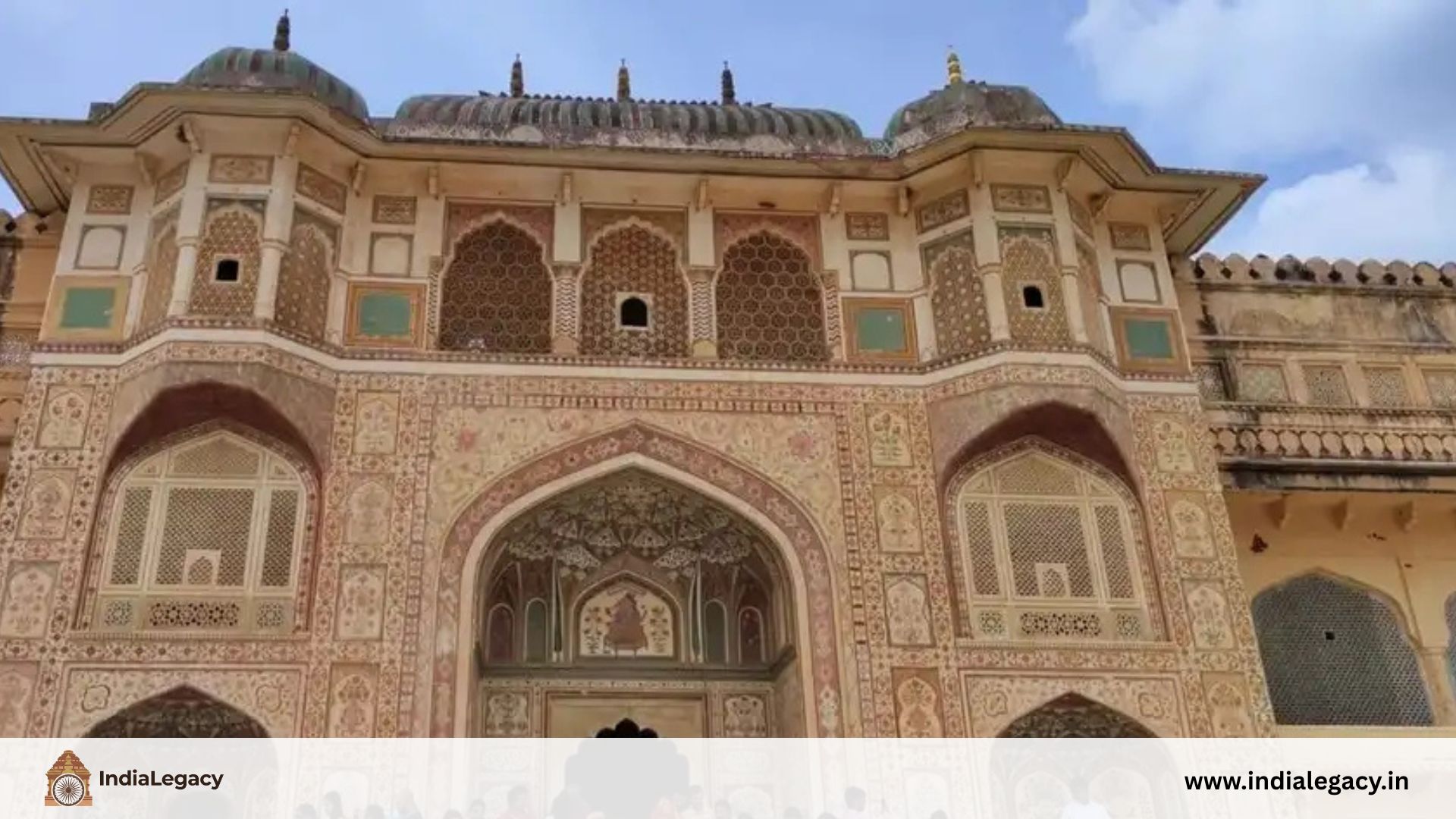
The Ganesh Pol is arguably Amer Fort’s most photographed element — a three-storey ornamental gateway adorned with intricate frescoes, mosaic tilework, and delicate jali screens. Built in 1611 CE, it served as the formal entrance to the royal apartments. The upper level, called Suhag Mandir, was where royal women observed public ceremonies through perforated screens, invisible to the public below. Every square inch of its facade is painted with 400-year-old mineral pigment paintings that have never been chemically restored.
Sheesh Mahal: The Palace of Ten Thousand Mirrors
No element of Amer Fort generates more wonder than the Sheesh Mahal. Built under Mirza Raja Jai Singh I, its ceiling and walls are encrusted with thousands of convex mirror pieces — each individually set into plasterwork using a technique called ainakari — combined with coloured glass, semi-precious stones, and gilded stucco. A single candle lit inside creates a shimmering constellation effect across the entire ceiling. Persian craftsmen worked alongside local artisans to create this marvel, and the technique became one of Rajasthan’s most celebrated art forms.
Architectural Innovation — The World’s First Air Conditioning: The Sukh Niwas (Hall of Pleasure) features an early cooling system — marble channels carried water from Maota Lake through the walls, while pierced marble screens (jalis) allowed wind to pass over this water before entering the room. This system could reduce interior temperatures by 6–8°C, making it comfortable even in harsh Rajasthan summers — predating modern air conditioning by nearly 300 years.
The Magic Flower: Amer’s Hidden Carving
Amer Fort contains one of India’s most remarkable pieces of stone artistry — a single marble panel near the Jai Mandir known as the Magic Flower carving. This palm-sized floral motif contains seven distinct images hidden within its design: a fish tail, a cobra, an elephant trunk, a lion’s tail, a lotus, a cob of corn, and a scorpion. Most visitors walk past it without a second glance. It is believed to have been created as a test of a stonecutter’s mastery.
Hidden Secrets of Amer Fort: Stories Most Visitors Never Hear
The Underground Tunnel to Jaigarh Fort
A secret tunnel connects Amer Fort to Jaigarh Fort, located 4 km away on an adjacent hilltop. Built as a royal escape route in times of siege, the tunnel was wide enough for an elephant to pass through — a critical requirement when the royal treasury stored in Jaigarh needed rapid evacuation. The tunnel was sealed for centuries and opened for limited public access only after 2010. Even today, only a small portion is accessible to visitors.
Twelve Queens, Twelve Apartments
The Zenana (women’s quarters) of Amer Fort was designed so that the Maharaja could visit any of his twelve queens without being seen by the others. Twelve separate apartments — each identical in size — open onto a shared courtyard but with separate entrances from a long corridor. The Maharaja could slip into any apartment from the corridor without the other queens knowing which door he had chosen. This architectural ingenuity was both a practical and a diplomatic solution to managing a large royal household.
The Shila Devi — A Story of Victory and Devotion
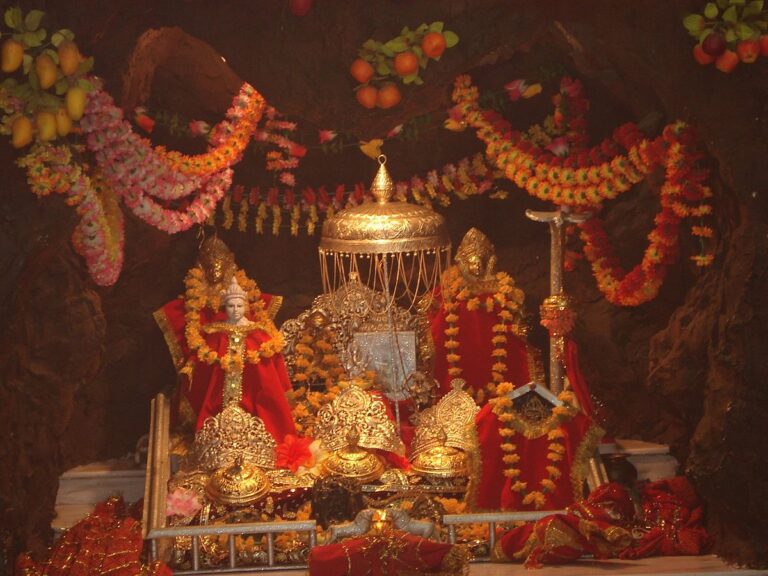
The Shila Devi (Stone Goddess) temple holds one of the most powerful origin stories in Rajasthan’s royal history. Before his Bengal campaign, Raja Man Singh I prayed to Goddess Kali for victory. The goddess reportedly appeared to him in a dream and commanded him to retrieve her idol from the bottom of the ocean. After his victory, the king found a large stone slab — the shila — from which the idol was carved. The temple’s silver doors, donated by Sawai Jai Singh II, weigh approximately 150 kg each.
Complete Visitor Guide: Timings, Tickets & Tips
| Category | Details |
|---|---|
| Opening Hours | 8:00 AM – 5:30 PM (Fort & Palaces) Light & Sound Show: 7:00 PM (Hindi) & 8:00 PM (English) |
| Ticket — Indians | ₹100 per person; Elephant ride: ₹900–₹1,100 per elephant (2 persons) |
| Ticket — Foreigners | ₹500 per person |
| Students (with ID) | ₹10 per person |
| Light & Sound Show | ₹295 (Indians) | ₹595 (Foreigners) |
| Guided Tours | Government-certified guides at the gate: ₹500–₹800 (2 hrs) |
| How to Reach | Auto-rickshaw or taxi from Jaipur city (30–40 min). No direct metro. |
| Parking | Available at the base of the hill (₹50 for cars) |
| Best Time to Visit | October – March; Early morning (8–10 AM) to avoid crowds and heat |
| Time Required | 3–4 hours for the full fort complex |
| Nearby Attractions | Jaigarh Fort (4 km), Nahargarh Fort (8 km), Jal Mahal (6 km) |
Pro Tip: Book your entry ticket online at the Rajasthan Tourism official portal to skip the queue — especially on weekends when waiting time can exceed 45 minutes. The Audio Guide (available in 5 languages at the ticket counter for ₹150) covers 22 spots inside the fort that most self-guided visitors completely miss.
Amer Fort’s UNESCO Recognition & Living Legacy
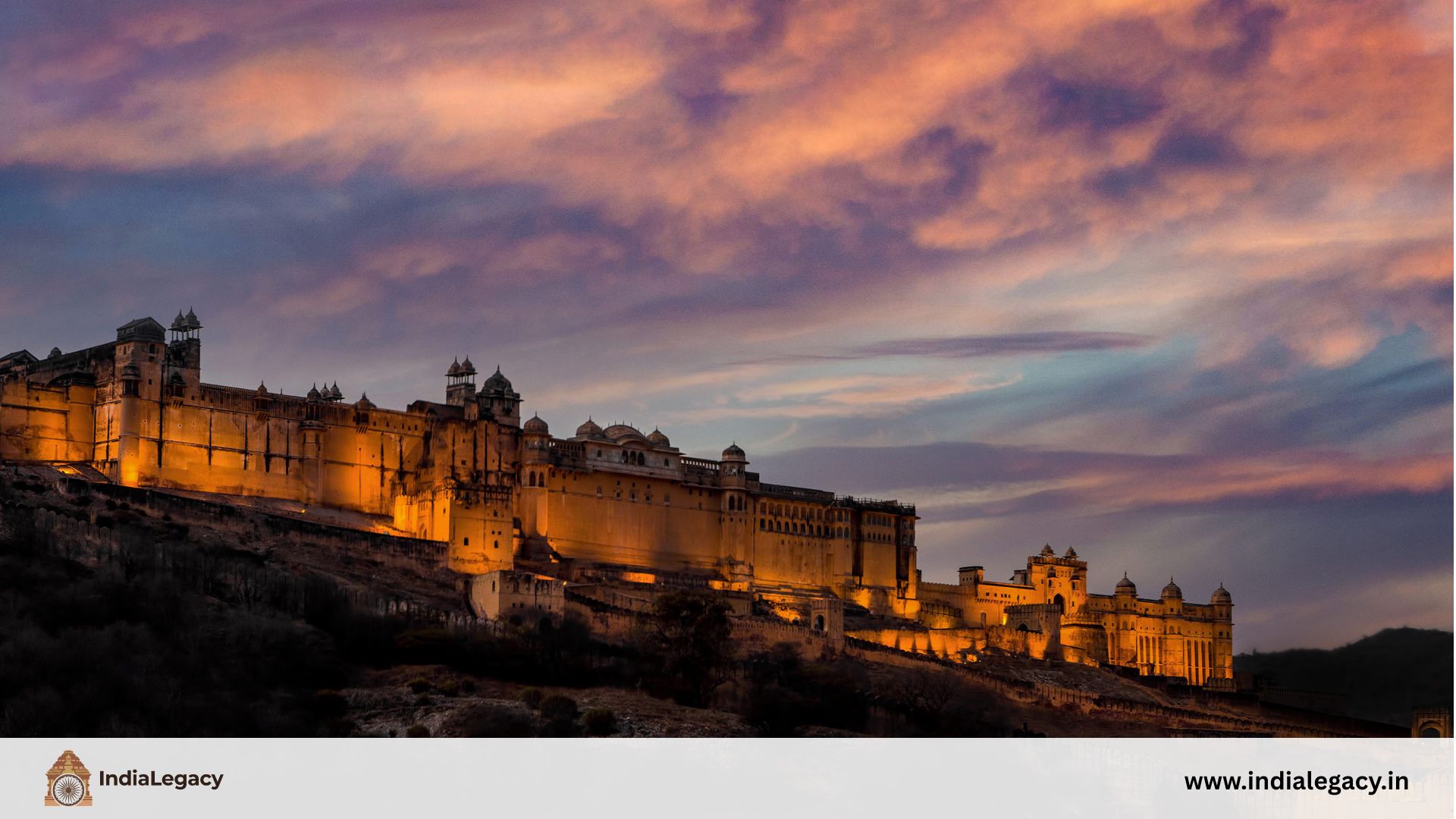
In 2013, Amer Fort was inscribed as a UNESCO World Heritage Site as part of the collective designation “Hill Forts of Rajasthan” — a group of six forts recognised for their exceptional universal value in demonstrating the evolution of Rajput military architecture and statecraft. The six forts are Chittorgarh, Kumbhalgarh, Ranthambore, Gagron, Jaisalmer, and Amer.
Amer Fort’s inscription recognised not just its architectural achievement but its role as a living cultural landscape — the Shila Devi temple still holds active religious festivals, the Gangaur procession still passes through its courtyards, and the Light and Sound show every evening keeps its stories alive for new generations. The fort also played a significant role in Indian cinema — its dramatic courtyards and marble galleries have appeared in dozens of Bollywood films, including Mughal-E-Azam (1960) and Jodhaa Akbar (2008).
🔗 Explore More Monuments on India Legacy
Amer Fort’s Architectural Highlights at a Glance
| Feature | Why It Matters |
|---|---|
| Sheesh Mahal | Thousands of convex mirror pieces; single candle creates a star-like reflection across the entire ceiling |
| Ganesh Pol | 400-year-old frescoes, never chemically restored; named for Lord Ganesha carved at its crown |
| Sukh Niwas | Ancient passive cooling system using water channels through marble — functional 300 years before modern AC |
| Magic Flower Carving | Seven images hidden within one carved marble panel — a masterpiece of medieval stone artistry |
| Underground Tunnel | 4-km tunnel to Jaigarh Fort, wide enough for an elephant; used as a royal escape route |
| Shila Devi Temple | Active temple with 150-kg silver doors; site of unbroken royal devotion since 1604 CE |
| Zenana (Women’s Palace) | 12 identical apartments with a secret corridor — a diplomatic architectural solution to royal protocol |
| Diwan-i-Khas | Hall of Private Audience with double-row columns of grey and pink sandstone, Mughal in proportion |
Frequently Asked Questions: Amer Fort Jaipur
1. What is the difference between Amer Fort and Amber Fort?
There is no difference — they are the same monument. “Amber” is the older Anglicised spelling used during British rule, while “Amer” is the correct Hindi/Rajasthani spelling used in official government documents and UNESCO records. Both names refer to the same fort complex near Jaipur.
2. Who built Amer Fort and in which year?
Raja Man Singh I, commander-in-chief of Emperor Akbar’s army, began the main palace complex in 1592 CE. However, the site had earlier Kachhwaha Rajput structures dating to 967 CE. Subsequent rulers — particularly Mirza Raja Jai Singh I and Sawai Jai Singh II — added major expansions through the 17th and early 18th centuries.
3. Is Amer Fort a UNESCO World Heritage Site?
Yes. Amer Fort was inscribed as a UNESCO World Heritage Site in 2013, as part of the collective “Hill Forts of Rajasthan” designation, which includes six forts: Amer, Chittorgarh, Kumbhalgarh, Ranthambore, Gagron, and Jaisalmer.
4. What is the Sheesh Mahal in Amer Fort?
The Sheesh Mahal (Palace of Mirrors) is a royal chamber whose ceiling and walls are encrusted with thousands of convex mirror pieces, coloured glass, and semi-precious stones using the Persian ainakari technique. A single candle lit inside creates a stunning star-like reflection across the entire room. It was built by Mirza Raja Jai Singh I.
5. Is there a tunnel connecting Amer Fort to Jaigarh Fort?
Yes. A 4-km underground tunnel connects Amer Fort to Jaigarh Fort on an adjacent hilltop. Built as a royal escape route in case of siege and wide enough for an elephant to pass through, the tunnel was sealed for centuries and opened for limited public access only after 2010.
6. What are the entry fees for Amer Fort in 2026?
₹100 for Indian nationals, ₹500 for foreign nationals, and ₹10 for students with a valid ID card. The elephant ride (optional) costs ₹900–₹1,100 per elephant (up to 2 passengers). The Light and Sound show tickets are ₹295 (Indians) and ₹595 (foreigners).
7. What is the best time to visit Amer Fort?
The ideal time is October to March, when Jaipur’s weather is cool and pleasant. For the best experience, arrive early — between 8:00 AM and 10:00 AM — before crowds arrive and before the Rajasthan sun heats the stone. Avoid visiting in May–June when temperatures can exceed 45°C.
8. How long does it take to explore Amer Fort fully?
A thorough visit covering all four courtyards, the Sheesh Mahal, Ganesh Pol, Diwan-i-Khas, Sukh Niwas, Shila Devi temple, and the Zenana quarters typically takes 3 to 4 hours. Budget an additional hour if you hire a guide, as they reveal hidden details that self-guided visitors miss.
9. Can you visit both Amer Fort and Jaigarh Fort in one day?
Yes, and it is highly recommended. Both forts are covered under a combined ticket. The typical plan: Amer Fort in the morning (3–4 hours), then Jaigarh Fort in the afternoon. Jaigarh houses the world’s largest wheeled cannon (Jaivana) and offers spectacular panoramic views over Amer.
10. What is the Light and Sound Show at Amer Fort?
The Light and Sound Show is held every evening at the Jaleb Chowk. Narrated in Hindi (7:00 PM) and English (8:00 PM), the 50-minute show uses laser projection to illuminate the fort’s history — telling stories of Raja Man Singh I, the Mughal alliance, and battles of Rajputana. It is one of the most atmospheric heritage shows in India.
11. What architectural style is Amer Fort?
Amer Fort represents the Rajput-Mughal architectural synthesis. Rajput elements include the defensive fortification, concentric courtyards, red sandstone use, and Hindu temple integration. Mughal elements include the geometric Char Bagh gardens, marble inlay work, jali windows, and the Persian mirror-work of the Sheesh Mahal.
12. What is the Magic Flower in Amer Fort?
The Magic Flower is a carved marble panel near the Jai Mandir containing seven different images hidden within a single floral motif: a fish tail, a cobra, an elephant trunk, a lion’s tail, a lotus, a cob of corn, and a scorpion. Ask your guide to point it out — most visitors walk past it without noticing.
13. How far is Amer Fort from Jaipur city?
Amer Fort is located approximately 11 km from central Jaipur. The drive takes 25–35 minutes by taxi or auto-rickshaw. There is no direct metro connection; the nearest metro station is Mansarovar, after which you need a connecting vehicle.
14. Why did the Kachhwahas move their capital from Amer to Jaipur?
In 1727 CE, Sawai Jai Singh II moved the capital for strategic and practical reasons: the growing population was straining the fort’s limited water supply, the hilltop location was increasingly impractical for a large administrative capital, and Jai Singh II wanted to build India’s first scientifically planned city on the plains below — designed on the grid principles of Vastu Shastra.
15. What Bollywood films were shot at Amer Fort?
Amer Fort has been featured in numerous films. Most notably, Jodhaa Akbar (2008) used the fort’s courtyards and gateways for several key scenes. The fort was also featured in the classic Mughal-E-Azam (1960). Its dramatic architecture has made it one of Bollywood’s favourite heritage locations.
16. What is the Shila Devi Temple inside Amer Fort?
The Shila Devi Temple is a revered Hindu temple dedicated to Goddess Kali, located within the second courtyard of Amer Fort. Raja Man Singh I brought the idol from Bengal after his victorious military campaign and installed it here in 1604 CE. The temple has 150-kg silver doors gifted by Sawai Jai Singh II and remains an active place of worship visited by thousands of devotees daily.
17. What is Sukh Niwas in Amer Fort?
The Sukh Niwas (Hall of Pleasure) is a royal chamber with an innovative passive cooling system — water from Maota Lake channelled through marble pipes in the walls, and wind passing through perforated marble jali screens entered the room significantly cooled. This ancient technology could reduce interior temperatures by 6–8°C.
18. Is Amer Fort accessible for differently-abled visitors?
Amer Fort’s steep terrain and ancient stone pathways make full accessibility challenging. However, the Rajasthan government has installed ramps and handrails in key sections, and wheelchair-accessible jeep services are available from the base to the main fort entrance. Contact Rajasthan Tourism at the gate for assistance.
19. Why is Amer Fort important for UPSC exam preparation?
Amer Fort is directly relevant for UPSC for several reasons: it exemplifies Rajput-Mughal political alliances (Medieval India), its UNESCO inscription covers conservation and heritage policy (GS Paper 1 Culture), and the administrative system of the Kachhwaha rulers under Mughal suzerainty is frequently discussed in questions on Mughal administrative structures.
20. What is the elephant ride experience at Amer Fort?
Visitors can ride decorated elephants from the base of the hill up to the main Suraj Pol (Sun Gate) entrance of the fort. The ride costs ₹900–₹1,100 per elephant (carrying 2 passengers) and takes approximately 10–12 minutes. Animal welfare organisations have raised concerns about the practice; many visitors choose to walk or take a jeep instead — both offer excellent access to the fort.
Conclusion: A Fort That Outlasted Empires
Amer Fort’s endurance is the story of India itself — a place where conquest gave way to co-creation, where Rajput pride and Mughal refinement found common ground in carved marble and candlelit mirrors. Four hundred years after Raja Man Singh I laid its cornerstone, the fort still stands not as a relic of a defeated past but as evidence of what human ambition, artistry, and political intelligence can build together.
The Sheesh Mahal still glitters in the dark. The Shila Devi still receives her daily flowers. The ancient water channels of Sukh Niwas still carry cool air through jali screens. And every evening, as the Light and Sound show illuminates the Jaleb Chowk, the stories of the Kachhwaha kings return — reminding us that the greatest monuments are never just about stone. They are about the people who built them, the ideas they believed in, and the civilisation they chose to protect.
Visit Amer Fort not just as a tourist, but as a student of history — and it will reward you with secrets, stories, and silences that no guidebook can fully prepare you for.