The King Who Built an Empire From the Hills
In the year 1645, in a small hill fort called Torna in the western ghats of Maharashtra, a boy of about fifteen took an oath in front of a stone idol of the goddess Bhavani. He promised her that he would build a Hindu kingdom independent of the Mughal Empire, an empire that at that time controlled almost all of India. The boy’s name was Shivaji Bhosale.
Thirty five years later, when he died at the fort of Raigad in 1680, he had built exactly that. The Maratha Empire he founded would go on to defeat every major power in India, including the Mughals, and would remain the dominant Indian force until it fell to the British in 1818. This is the story of Chhatrapati Shivaji Maharaj, one of the most remarkable military and political minds in Indian history.
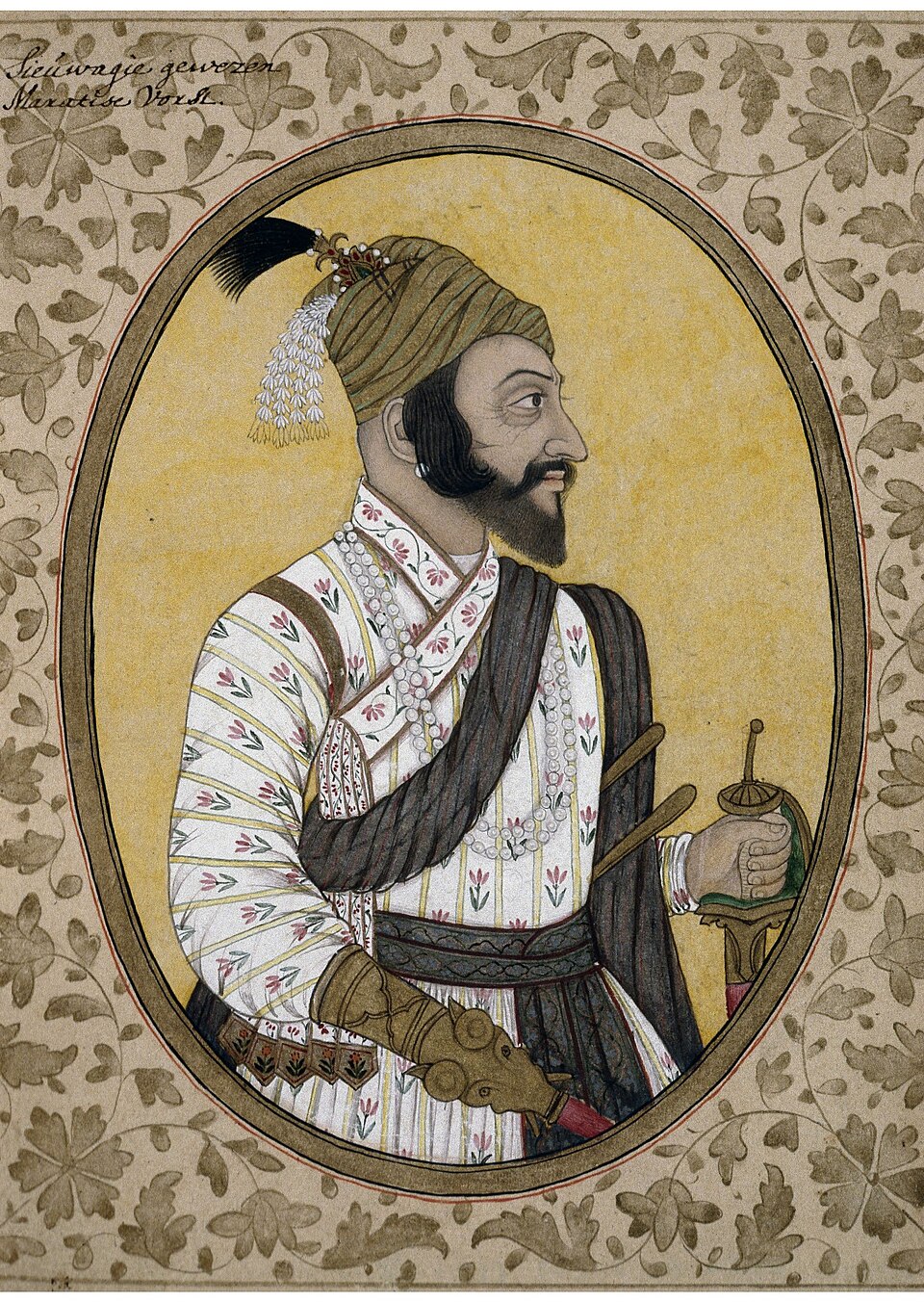
The Boy from Shivneri Fort
Shivaji was born on 19 February 1630 at Shivneri Fort near Junnar, in what is now Pune district, Maharashtra. His father Shahaji Bhosale was a general in the service of the Bijapur Sultanate. His mother Jijabai was the daughter of a powerful noble family, deeply religious, and fiercely committed to the idea that her son should build something of his own rather than serve a sultan for life.
Shivaji grew up mostly in the care of his mother and his teacher Dadaji Kondadev at Shivneri and later at Pune. His father was often away on military campaigns for Bijapur, and later for the Adil Shahis. Jijabai raised her son on stories from the Ramayana and the Mahabharata. She told him about Rama, about Krishna, about the great warrior kings of the past. From her, Shivaji absorbed the idea that a Hindu king could rule again.
The First Forts
By the time Shivaji was sixteen, he had captured Torna Fort from the Adil Shahi Sultanate. Torna became the first fort of the future Maratha Empire. Over the next twenty years, Shivaji would capture, build, or renovate over three hundred forts across the western Deccan.
His military method was unusual for its time. He did not fight large pitched battles in the open plains. Instead, he used the hills of the Sahyadri range as his fortress. His army moved quickly, in small groups, striking at Mughal and Bijapuri outposts and disappearing back into the mountains before reinforcements could arrive. Historians call this style guerrilla warfare, or in Marathi, ganimi kava. Shivaji did not invent it. But he perfected it against enemies who could not respond in kind.
The Killing of Afzal Khan
In 1659, the Bijapur Sultanate sent one of its most fearsome generals, Afzal Khan, to crush Shivaji once and for all. Afzal Khan was a huge man, an experienced killer, and confident that Shivaji would come to him. He set up camp at Pratapgad Fort in the hills.
Shivaji agreed to meet him for negotiations. Both men were to come unarmed. But Shivaji suspected a trap, and he was right. He wore chainmail under his clothes and hid a set of tiger claws called bagh nakh in his fist. When Afzal Khan pulled him into a bear hug and struck him with a hidden dagger, the chainmail saved Shivaji’s life. In the same movement, Shivaji ripped open Afzal Khan’s stomach with the tiger claws.
Shivaji then gave the signal to his hidden Maratha army waiting below Pratapgad. In the battle that followed, the Bijapuri army was routed. That day at Pratapgad changed the balance of power in the Deccan. Shivaji had proved he could defeat a full sultanate army.
The Escape From Agra
In 1666, Aurangzeb, the Mughal emperor, invited Shivaji to his court at Agra under the pretence of peace. When Shivaji arrived, Aurangzeb humiliated him by placing him among lower ranked nobles. Shivaji protested loudly in open court and was placed under house arrest.
What Shivaji did next is one of the most famous episodes in Indian history. Pretending to be ill, he asked permission to send baskets of sweets and fruits to holy men outside the palace as offerings. Over several weeks, the guards grew used to the baskets passing in and out. One day, Shivaji and his young son Sambhaji hid themselves inside two of the baskets and were carried out of the Mughal fort. They escaped Agra in disguise and travelled hundreds of miles back to Maharashtra on foot and by cart.
Aurangzeb, when he discovered the escape, said it was the greatest failure of his life. He never captured Shivaji again.
The Coronation at Raigad
On 6 June 1674, Shivaji was crowned Chhatrapati at Raigad Fort. Chhatrapati means “lord of the umbrella”, a title that traditionally marked a sovereign king. The coronation was a huge event. It signalled to India, and to the Mughal Empire in particular, that a Hindu king had risen who did not answer to any sultan.
Shivaji built his kingdom on principles that were remarkably modern for the seventeenth century. He appointed a council of eight ministers called the Ashta Pradhan. He built a strong navy, unusual for an Indian ruler, and used it to defend the western coast against European traders. He collected taxes fairly, protected farmers from exploitation, and gave equal treatment to Hindus and Muslims in his administration. Muslim officers served in his army. Christian missions were allowed to function.
The Death of a King
Shivaji died on 3 April 1680 at Raigad Fort. He was fifty years old. Some accounts say he died of an illness. Others suggest poisoning by court rivals. Either way, the Maratha Empire he left behind was still small compared to the Mughal Empire he had defied. But he had planted an idea that could not be uprooted.
His son Sambhaji continued the fight against Aurangzeb, was captured and killed in 1689. His grandson Shahu and his descendants built the empire that Shivaji had founded into the largest Indian power of the eighteenth century. At its peak, the Maratha Empire stretched from Attock in modern day Pakistan to Thanjavur in the deep south.
Why Shivaji Still Matters
Shivaji is not just a historical figure in Maharashtra. He is present in daily life. His portrait hangs in police stations, in schools, in taxis, in political party offices. Every February, in villages across the state, the anniversary of his birth is celebrated with processions and feasts.
What people admire about him is not just the military brilliance. It is the political imagination. In an age of sultanates and emperors, Shivaji built a state that respected its farmers, protected women, gave rights to all religions, and did not bow to any foreign power. His court corresponded in Marathi, not Persian. His weights and measures were standardised. His courts followed a written code.
Three hundred and fifty years later, he remains the model of what Indian leadership can look like when it puts the ordinary person first.
Frequently Asked Questions
When was Chhatrapati Shivaji Maharaj born?
Shivaji Maharaj was born on 19 February 1630 at Shivneri Fort near Pune, Maharashtra. His birthday is celebrated as Shiv Jayanti in Maharashtra every year.
Why is Shivaji Maharaj considered the founder of the Maratha Empire?
Shivaji built the Maratha Empire from a collection of hill forts in the western Deccan. He was formally crowned Chhatrapati at Raigad Fort in 1674, marking the start of independent Maratha rule. Under his descendants, the empire grew to cover most of India.
What was Shivaji’s military strategy?
Shivaji perfected ganimi kava, or guerrilla warfare, using the mountainous Sahyadri terrain to his advantage. He used fast moving small forces, surprise attacks, and a strong network of forts to defeat much larger Mughal and Bijapuri armies.
How did Shivaji escape from Agra in 1666?
Held under house arrest by Aurangzeb, Shivaji pretended to be ill and began sending baskets of sweets and fruits as offerings to holy men outside the palace. After some weeks, he and his son Sambhaji hid themselves inside two of the baskets and were carried out. They escaped Agra in disguise.
What was Shivaji’s relationship with religion?
Shivaji was a devout Hindu, but his administration was famously tolerant. Muslim officers served in his army and administration. He respected mosques and Sufi shrines during his campaigns. Christian missions were allowed to function. Non Hindu citizens paid the same taxes as Hindus.
Sources and Further Reading
- Ranade, M.G., Rise of the Maratha Power, Punalekar
- Sarkar, Jadunath, Shivaji and His Times, Orient Longman
- Gordon, Stewart, The Marathas 1600 to 1818, Cambridge University Press
- Sabhasad, Krishnaji Anant, Sabhasad Bakhar, a contemporary account