Indian Folk Art and Paintings: Traditional Art Forms of India
Indian folk art and paintings represent the raw, vibrant soul of rural India living canvases where mythology, nature, and daily life intertwine through natural pigments, rice paste, and cow dung walls.
Unlike refined classical arts, these democratic traditions emerge from tribal hamlets, village courtyards, and nomadic communities, each stroke carrying centuries of oral histories, rituals, and agrarian wisdom.
From Bihar’s intricate Madhubani wedding murals to Maharashtra’s minimalist Warli rice rituals, these art forms use only what’s locally available mud, leaves, charcoal, geru (red clay), and seasonal flowers. Practiced by women during festivals and life transitions, they transform ephemeral walls into visual epics that UNESCO now safeguards as intangible heritage.
More than decoration, Indian folk art and paintings function as community memory banks encoding medicinal plants, auspicious symbols, and caste genealogies. This comprehensive guide explores twelve major traditions, their techniques, symbolism, and remarkable journey from mud huts to global galleries while remaining rooted in living rituals.
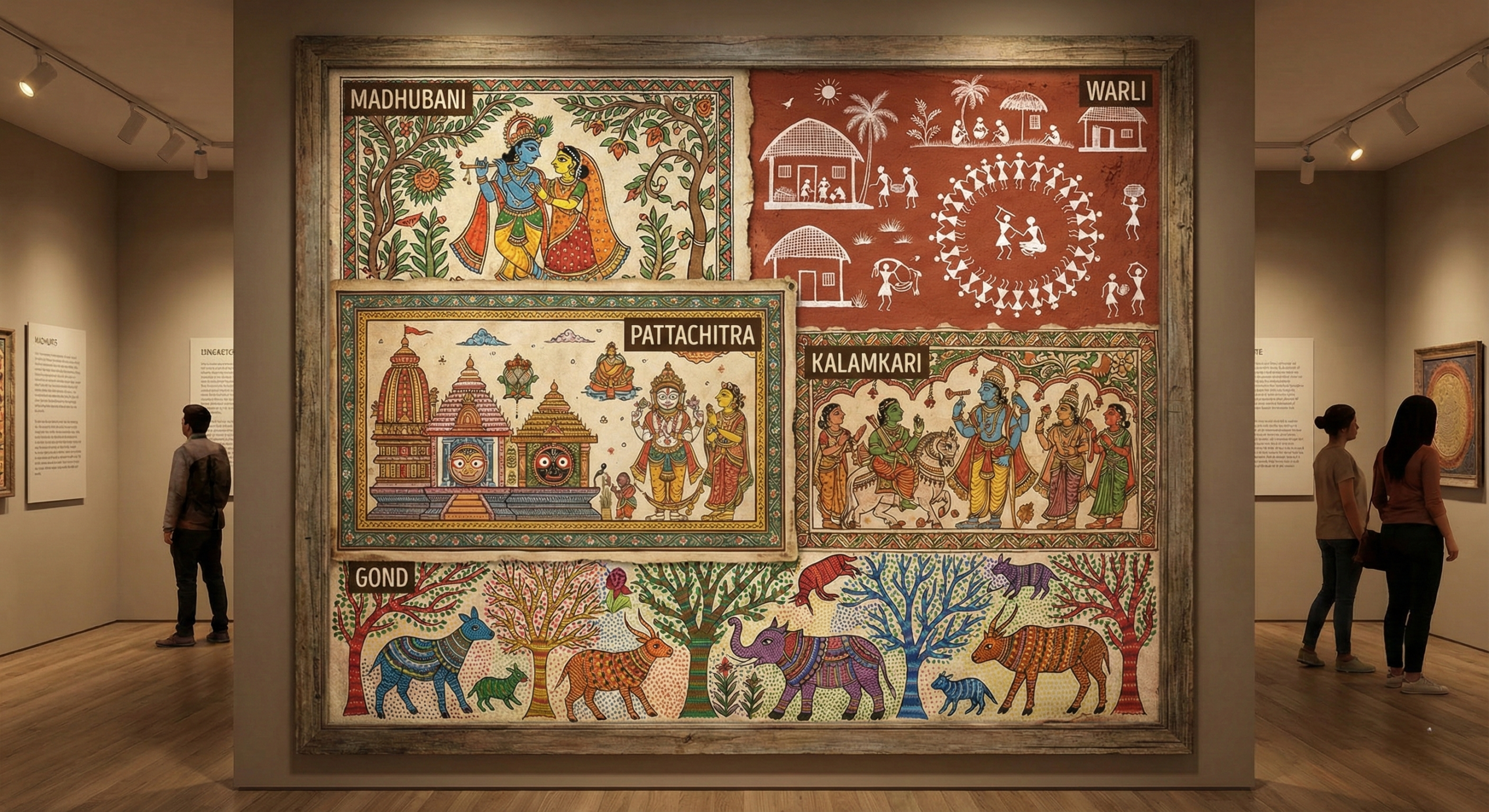
Indian Folk Art and Paintings: Complete Overview
| Art Form | Region/State | Medium & Surface | Core Motifs |
|---|---|---|---|
| Madhubani | Bihar | Rice paste, natural dyes, mud walls/paper | Tara-chakra, fish, parrots, geometric borders |
| Warli | Maharashtra | Rice paste on red mud, basic triangle-human | Human stick figures, nature cycles, harvest |
| Pattachitra | Odisha | Cotton cloth, vegetable dyes, mythology | Jagannath, Radha-Krishna, palm leaf |
| Kalamkari | Andhra Pradesh | Handblock printed cotton, fermented iron mordant | Deities, flora-fauna, epic narratives |
| Gond | Madhya Pradesh | Acrylic on canvas, tribal dot patterns | Trees as deities, animals, nature spirits |
| Phad | Rajasthan | Cloth scrolls, mineral colors, bardic epics | Pabuji, Devnarayan folk heroes |
| Pithora | Gujarat/MP | Mud walls, white rice paste, tribal ceremonies | Babaj (horse), cosmic creation myths |
| Aipan | Uttarakhand | Rice flour, geru base, rice paste, floor art | Swastika, lotus, geometric rice rituals |
| Lippan Kaam | Kutch, Gujarat | Mud, dung, mirror work, wall relief | Geometric patterns, mirror inlays |
| Tanjore Painting | Tamil Nadu | Wood board, gold leaf, gesso relief, deities | Divine figures, semi-classical |
| Rogan Art | Gujarat | Castor oil paint, cloth, freehand floral | Peacocks, trees, intricate curvilinear |
| Cheriyal Scroll | Telangana | Cloth scrolls, terracotta figures, folktales | Lepakshi mythology, village stories |
Ancient Origins: Ritual Roots of Folk Art
Indian folk art and paintings predate written history, emerging from Neolithic rock shelters (Bhimbetka, 10,000 BCE) where ochre handprints invoked fertility. Vedic rituals mandated alpana (floor drawings) for prosperity; every life event birth, marriage, harvest demanded wall murals by village women using fingers as brushes.
Mediums from Nature’s Palette
Traditional palettes derive exclusively from locale: Bihar’s Madhubani uses charcoal (black), haldi (yellow), bilberry (blue); Warli’s rice paste on geru (red ochre) mud; Kalamkari’s fermented iron-rust mordants fix vegetable dyes. No synthetic colors until 1970s government handicraft boards intervened.
Festival-specific: Diwali aipan (rice flour), wedding Madhubani (double lines for eternity), monsoon Pithora (post-rain ceremonies). These weren’t “art” but sacred geometry ensuring cosmic harmony each motif a prayer activating environmental intelligence.
Madhubani: Bihar’s Mythic Wall Canvases
Five Painting Styles, One Tradition
Madhubani painting (Mithila region) classifies into Bharni (color-filled), Katchni (line drawing), Tanrik (cobweb geometrics), Godna (tribal tattoos), and Gobar (cow dung base). Women paint entire house interiors for weddings using twig brushes, fingers, nib-pens with rice glue and natural dyes.
Iconic motifs tara-chakra (interlocked stars), interlocking fish skeletons (prosperity), parrots (messengers), peepal leaves (immortality) fill every inch without empty space. Post-1960s famine, Sita Devi pioneered paper commercialization, transforming bridal walls into global museum pieces.
Signature Elements:
- Double lines never cross (auspicious continuity)
- 108-angle geometric borders encode cosmology
- Sita-Rama wedding panels (20+ interconnected scenes)
- Natural colors: rice powder (white), cow dung (brown)
Warli: Maharashtra’s Minimalist Universe
Triangles Tell Life Stories
Warli art (8th-century adivasi tradition) reduces universe to three shapes: circle (sun/moon), triangle (mountain/house), square (sacred enclosure). Rice paste on red mud walls depicts harvest cycles, weddings as tarpa dances, trances with saci goddess.
Jivya Soma Mashe’s 1970s canvas innovation brought Warli to urban galleries while preserving ritual core walls repainted annually for monsoons. Human figures (triangle + circle) link hands in processions, animals rendered identically symbolizing unity.
Core Symbolism:
- Square pit (holy enclosure) = sacred space
- Interlocking triangles = male-female union
- Granary motifs = food security prayers
Pattachitra & Kalamkari: Scroll Masters
Pattachitra (Odisha) paints cotton cloth with gum-resin primer, 120+ organic colors depicting Jagannath temple mythology. Palm-leaf engraving (Tala Pattachitra) perforates stories for light transmission. Kalamkari (Andhra) hand-blocks 100+ rust-fermented motifs onto cotton krishnadevaraya era technique.
- Pattachitra: 7-day deity consecration rituals
- Kalamkari: 23-step natural dye process
- Both preserve Sanskrit Purana narratives visually
Gond & Tribal Visions: Nature as Deity
Gond art (central tribal belt) paints trees as gods, dots as souls using semecarpus seeds. Venkat Shyam, Jangarh Singh Shyam modernized while retaining animist worldview. Pithora (Bhil) murals invoke creator horse during life crises ritual trance painting.
Animist Signatures:
- Dots = breath/energy patterns
- Trees = ancestral lineages
- Animals = clan totems
Rajasthan’s Epic Scrolls: Phad TraditionPhad scrolls (15m x 1.5m) narrate folk hero Pabuji’s camel raids via bhopa priest recitals. Mineral paints ensure 300-year durability. Rogan art (Nirona village) paints castor oil on cloth heat-set designs last generations without fading.
Regional Floor & Wall Arts
Aipan (Kumaon) rice-floor mandalas invoke Lakshmi; Lippan Kaam (Mud-plaster mirrors) cool Kutchi homes; Cheriyal scrolls narrate Telangana folktales. These ephemeral arts activate spaces seasonally, dissolving post-ritual as their power transfers.
Cultural Significance & Modern Revival
Phad scrolls (15m x 1.5m) narrate folk hero Pabuji’s camel raids via bhopa priest recitals. Mineral paints ensure 300-year durability. Rogan art (Nirona village) paints castor oil on cloth heat-set designs last generations without fading.
Aipan (Kumaon) rice-floor mandalas invoke Lakshmi; Lippan Kaam (Mud-plaster mirrors) cool Kutchi homes; Cheriyal scrolls narrate Telangana folktales. These ephemeral arts activate spaces seasonally, dissolving post-ritual as their power transfers.
Indian folk art and paintings preserve 5000+ year old visual grammars predating Devanagari script. Women-centric traditions counter urban patriarchy; GI tags (Madhubani 2017) protect against mass-production. Contemporary artists fuse traditions Warli on denim, Gond acrylics while NGOs train 100,000+ artisans annually.
Global diaspora sustains markets (Japan loves Kalamkari kimonos); Bollywood sets feature Pattachitra. Unlike museum classical art, folk traditions remain alive 90% still serve rituals, ensuring organic evolution.
Learning & Practicing Folk Arts Today
Village homestays offer authentic immersion; online academies teach Madhubani basics. Annual fairs (Salar Jung, Dastkar) showcase 500+ artists. Sustainable tourism generates ₹5000 crore annually while preserving techniques against urbanization.
20 Frequently Asked Questions About Indian Folk Art
1. What are the major Indian folk art forms?
Madhubani, Warli, Pattachitra, Kalamkari, Gond, Phad, Pithora, Aipan, Lippan Kaam, Rogan, Tanjore, Cheriyal represent diverse regional traditions using natural materials.
2. What materials do folk artists use?
Rice paste, cow dung, geru clay, charcoal, vegetable dyes, haldi, leaves entirely natural, locally sourced materials specific to each region’s ecology.
3. Which folk art uses only three shapes?
Warli art uses circle, triangle, square to depict entire universe humans, animals, rituals, harvest cycles.
4. What is Madhubani painting famous for?
Intricately filled spaces without empty areas, double-line geometrics, mythological narratives, five distinct regional styles from Bihar.
5. How is Kalamkari fabric created?
23-step process: hand-block printing, fermented iron mordants, 100+ natural dyes, repeated washing to fix colors permanently.
6. What makes Gond art unique?
Tribal dot patterns treating trees/animals as deities, acrylic adaptations by Jangarh Singh Shyam bringing forest animism to canvas.
7. Why are folk arts mostly by women?
Ritual wall/floor paintings activate homes during life transitions births, marriages, festivals women’s sacred domestic domain.
8. What is Pattachitra scroll art?
Odisha’s cotton cloth paintings of Jagannath mythology, consecrated 7 days, using gum-resin primer and 120 organic colors.
9. Describe Phad scroll tradition?
Rajasthan’s 15m epic scrolls narrating folk heroes Pabuji/Devnarayan, recited by bhopa priests with mineral colors.
10. What is Aipan floor art?
Uttarakhand rice flour mandalas on geru base swastikas, lotuses for Diwali/Lakshmi invocation, repainted annually.
11. Why is Lippan Kaam special?
Kutchi mud-dung-mirror wall relief cools desert homes, geometric patterns with mirror inlays for light reflection.
12. What defines Rogan cloth painting?
Nirona’s castor oil paint on cloth heat-set freehand florals/peacocks lasting generations without synthetic fixatives.
13. How did folk art reach global markets?
1960s handicraft boards, paper commercialization (Madhubani), contemporary artists like Jivya Soma Mashe, GI tags.
14. Do folk arts still serve rituals?
90% continue ritual functions walls repainted annually, proving living traditions beyond commercial products.
15. What is Tanjore painting technique?
Wood base, gesso relief, gold leaf, jewel inlays creating embossed deities semi-classical Tamil tradition.
16. Name UNESCO protected folk arts?
Madhubani, Warli received intangible heritage status; GI tags protect Kalamkari, Pattachitra authenticity.
17. Can anyone learn folk painting?
Village workshops, online courses teach basics; authenticity requires ritual immersion and natural materials.
18. What colors do folk artists use?
Natural only: haldi (yellow), charcoal (black), geru (red), rice paste (white), leaves/flowers (green/blue).
19. How do folk arts preserve culture?
Visual memory banks encode oral histories, medicinal plants, caste genealogies, agrarian calendars pre-literacy.
20. Future of Indian folk art?
Urban fusion, sustainable tourism, artisan cooperatives balance preservation with ₹5000cr economic empowerment.
Conclusion: Canvas of the Common Soul
Indian folk art and paintings humble refined tastes proving deepest aesthetics emerge from mud fingers, not marble chisels. Each motif activates ancestral intelligence, each wall a portal to pre-literate wisdom. As climate change erodes village life, these traditions remind: true art doesn’t hang in galleries; it lives in rituals sustaining communities.
From Warli’s geometric universality to Madhubani’s cosmic density, folk arts encode India’s pluralist genius inviting global participation while fiercely guarding indigenous secrets. Paint your threshold; invoke prosperity; become the tradition.