A Temple Shaped Like a Chariot for the Sun
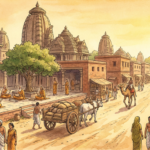
On the coast of Odisha, thirty five kilometres north of Puri, a massive stone chariot rises out of the sand. Its twenty four wheels are each ten feet across. Its seven horses strain forward at the reins. Its wheels, its horses, its walls are carved with a level of detail that is almost impossible to imagine being made by hand in the middle of the thirteenth century.
This is the Konark Sun Temple. It is a UNESCO World Heritage Site. It has stood on this stretch of the Bay of Bengal for almost eight hundred years. Even in ruin, even after centuries of weathering, invasion, and neglect, it is one of the most extraordinary buildings in India. This is the story of how it was made, what it was made for, and why the world still comes to see it.
The King Who Ordered the Chariot
The Sun Temple was built by King Narasimhadeva I of the Eastern Ganga dynasty, who ruled Odisha, then called Kalinga, between 1238 and 1264. Narasimhadeva was a strong military king who had defeated the Delhi Sultanate’s attempts to expand into eastern India. Building the temple was a statement of victory. It was also a statement of faith.
The temple was dedicated to Surya, the sun god, who had been worshipped in this part of India for centuries. Narasimhadeva envisioned the temple not as a normal building but as a chariot. Surya’s chariot, in Hindu mythology, is pulled by seven horses across the sky and moves on twelve pairs of wheels representing the twelve months. Narasimhadeva ordered his temple to be built in that exact shape.
The Twelve Years of Building
Construction began around 1246 and continued for approximately twelve years. According to Odia tradition, twelve hundred sculptors and artisans worked on the temple. They came from every corner of India. The master architect was a man named Bishu Maharana. The chief sculptor was called Sibei Samantaray. Legend says that Sibei’s own twelve year old son Dharmapada gave his life to complete the temple, jumping into the sea after solving a design problem that had defeated the older artisans.
Whether that story is true or not, the fact that Odia families still tell it eight hundred years later says something about how deeply the building lives in the memory of the state.
The Design of the Chariot
The Konark Temple was originally two hundred and twenty seven feet tall. The main tower, called the deul, has collapsed. What survives today is mainly the jagamohana, the audience hall, which is still around one hundred and thirty feet high, and the natya mandapa, the hall of dance.
Twenty four wheels line the base of the temple. Each wheel is a stone masterpiece. It has eight spokes. It has hubs and rims decorated with lotus and animal motifs. Together, the twenty four wheels represent the twenty four hours of the day. The spokes cast shadows that were used to tell the time. The temple was, among other things, a working sundial.
Seven horses, four on the south and three on the north, are carved rearing at the front of the chariot. Six of the horses have been damaged over time. One is still largely intact. They represent the seven days of the week. The chariot pulls the sun through the year.
The Carvings on the Walls
What draws visitors to Konark is not the size. It is the detail. Every stone of the outer walls is carved. There are court scenes. Musicians playing veenas and drums. Elephants. Warriors. Sailors on ships that give us some idea of what medieval Odia trade with Southeast Asia looked like. Deer, lions, and mythological creatures. Mothers with children. Old men. Ascetics. Kings on horses.
Among the carvings are hundreds of erotic sculptures similar to those at Khajuraho. They are often what tourists remember first. In their original context they were part of a wider tradition that saw sexuality as one of the four goals of a well lived life, along with dharma, artha, and moksha. Many scholars believe they also had a tantric significance, connecting the temple to a specific mystical tradition of Odisha.
How the Temple Fell
The exact story of Konark’s ruin is contested. What is certain is that by the sixteenth century, the temple was in serious decay. Some accounts blame invasions by the Bengal Sultanate and later by Mughal armies who removed the temple’s central idol and looted its treasures. Other accounts blame simple structural failure. The temple was built on sand. Its main tower may have collapsed under its own weight.
By the seventeenth century, priests had already stopped performing daily worship. The temple was slowly buried by sand and by the encroaching sea. When the British first surveyed it in the early nineteenth century, they found much of the main tower already gone. To prevent further collapse, they filled the jagamohana with sand and stone rubble and sealed it. The interior of the audience hall has been closed ever since. Nobody has entered it in over a hundred years.
What You Can See Today
Konark today is a working ruin. The Archaeological Survey of India maintains the site. Visitors walk through the courtyards, around the wheels, and up to the jagamohana. The sun still rises out of the Bay of Bengal and lights the temple every morning. Sunrise at Konark is one of the great sights of eastern India.
The Sun Temple was declared a UNESCO World Heritage Site in 1984. Every December, the Odisha government hosts the Konark Dance Festival, when the country’s best Odissi and Bharatanatyam dancers perform against the temple as their backdrop.
The temple museum next to the site holds hundreds of sculptures rescued from the ruins, along with photographs and diagrams that let visitors imagine what the whole complex looked like at its peak.
How to Visit Konark
Konark is on the Odisha coast, about thirty five kilometres from Puri and sixty five kilometres from the state capital, Bhubaneswar. The nearest airport is Bhubaneswar. The nearest railway station is Puri. From either, taxis and buses reach the temple in about an hour.
The best time to visit is between October and February, when the weather is cool and clear. Sunrise viewing usually starts around 5:30 in the morning. The temple opens for visitors from 6:00 am to 8:00 pm. Ticket prices are modest for Indian visitors and higher for international visitors. A small extra fee lets visitors enter the main enclosure at sunrise.
Why Konark Still Astonishes
What is remarkable about Konark is not just what remains. It is what its makers imagined. They took the mythology of the sun’s chariot and built it, in stone, life size, on a sandy beach. They gave it wheels that told the time. They gave it horses that ran into the wind coming off the Bay of Bengal. They carved every surface of it with the details of an entire civilisation.
Even in ruin, Konark tells us that the people who built it were capable of imagining something huge, and then, patiently, over twelve years, actually making it. In a world where we are often told that greatness is only possible with modern tools and modern methods, Konark quietly reminds us that greatness has always been possible where there is vision and skill and the patience to work stone by stone.
Frequently Asked Questions
Who built the Konark Sun Temple?
The Konark Sun Temple was built by King Narasimhadeva I of the Eastern Ganga dynasty. Construction started around 1246 and continued for about twelve years. Twelve hundred artisans, led by master architect Bishu Maharana, worked on the temple.
Why is the Konark Temple shaped like a chariot?
The temple was designed to represent the chariot of Surya, the sun god. In Hindu mythology, Surya is drawn across the sky by seven horses and rides a chariot with twelve pairs of wheels. Narasimhadeva ordered his temple built in this exact shape as a stone tribute to the sun.
Is the Konark Sun Temple a UNESCO World Heritage Site?
Yes. Konark was declared a UNESCO World Heritage Site in 1984. It is one of the most important surviving examples of thirteenth century Odia temple architecture.
Can you enter the main hall of the Konark Temple?
No. The main audience hall, the jagamohana, was sealed with sand and rubble by British engineers in the early twentieth century to prevent it from collapsing. Nobody has entered it in over a hundred years. Visitors can only walk around the outside of the sealed hall.
What is the best time to visit Konark?
The best months to visit Konark are between October and February, when the weather is cool and pleasant. Sunrise is the most beautiful time to see the temple, when the first light hits the eastern facade and the carvings come alive.
Sources and Further Reading
- Archaeological Survey of India, official Konark site guide
- Behera, K.S., Konarka, The Heritage of Mankind, Aryan Books International
- Fergusson, James, History of Indian and Eastern Architecture, John Murray
- UNESCO World Heritage Centre, Konark Sun Temple nomination file, 1984