[india_weather]
Chola Dynasty History: Powerful South Indian Empire
In 1025, a fleet sent by Rajendra Chola I sailed across the Bay of Bengal and attacked the ports of Srivijaya, the kingdom that controlled the Strait of Malacca. Very few Indian rulers, before or since, sent an armed fleet that far from home. That raid is the most famous episode in Chola Dynasty history, but the Cholas also built the Brihadeeswarar Temple at Thanjavur, cast the great South Indian bronzes, and ruled much of the south from the middle of the ninth century to 1279.
Who founded the Chola dynasty?
The Cholas are one of the three old Tamil ruling families, along with the Cheras and the Pandyas, and they already appear in Ashoka’s inscriptions and in Sangam poetry. The best known early Chola king is Karikala, to whom tradition credits the Kallanai (Grand Anicut), a dam on the Kaveri. After the Sangam period, however, the early Cholas faded into the background for several centuries.
The imperial Cholas begin with Vijayalaya, who captured Thanjavur from the Muttaraiyars, local chiefs who served the Pallavas, around 848-850. He made it his capital and built a temple there to the goddess Nishumbhasudini (Durga). Thanjavur stayed the heart of the kingdom for the next two centuries.
Chola Dynasty history: the main rulers in order
Aditya I (c. 871-907) defeated the Pallava king Aparajita and took over the Pallava lands of Tondaimandalam, and also conquered the Kongu country around present-day Coimbatore. His son Parantaka I (907-955) took Madurai from the Pandyas, but in 949 he was defeated by the Rashtrakuta king Krishna III at Takkolam, and the kingdom shrank for a generation.
Rajaraja I (985-1014)
Rajaraja I rebuilt Chola power and turned it into an empire. He defeated the Cheras in a naval battle at Kandalur Salai on the Kerala coast, conquered the Pandyas, and invaded Sri Lanka, sacking the old capital of Anuradhapura and annexing the north of the island. His inscriptions also claim the conquest of the Maldives, described as the “twelve thousand ancient islands”. He fought the Western Chalukyas of Kalyani in the Deccan for much of his reign.
Rajaraja also organised the state. He had land surveyed for revenue and recorded his achievements in long inscriptions that open with a set historical introduction, the meykirti. His greatest monument is the Brihadeeswarar (Rajarajeshwaram) temple at Thanjavur, completed around 1010.
Rajendra I (1014-1044)
His son Rajendra I took the empire to its widest reach. He completed the conquest of Sri Lanka, captured the Sinhala king Mahinda V, and campaigned against the Western Chalukyas. Around 1019-1023 his army marched north through Kalinga to the Ganga, defeating the Pala king Mahipala of Bengal. To mark it, Rajendra took the title Gangaikondachola (“the Chola who took the Ganga”), had Ganga water carried back to the south, and built a new capital, Gangaikonda Cholapuram.
The later Cholas
Rajendra’s sons kept up the wars with the Western Chalukyas; Rajadhiraja I was killed fighting them at the Battle of Koppam in 1054. In 1070 Kulottunga I, a prince of the Eastern Chalukya line of Vengi with a Chola mother, took the throne, and his long reign (1070-1120) was relatively stable, although Sri Lanka was lost around the same time. Kings such as Rajaraja II and Kulottunga III continued to build great temples into the twelfth and early thirteenth centuries.
The Chola navy and Rajendra Chola’s overseas campaigns
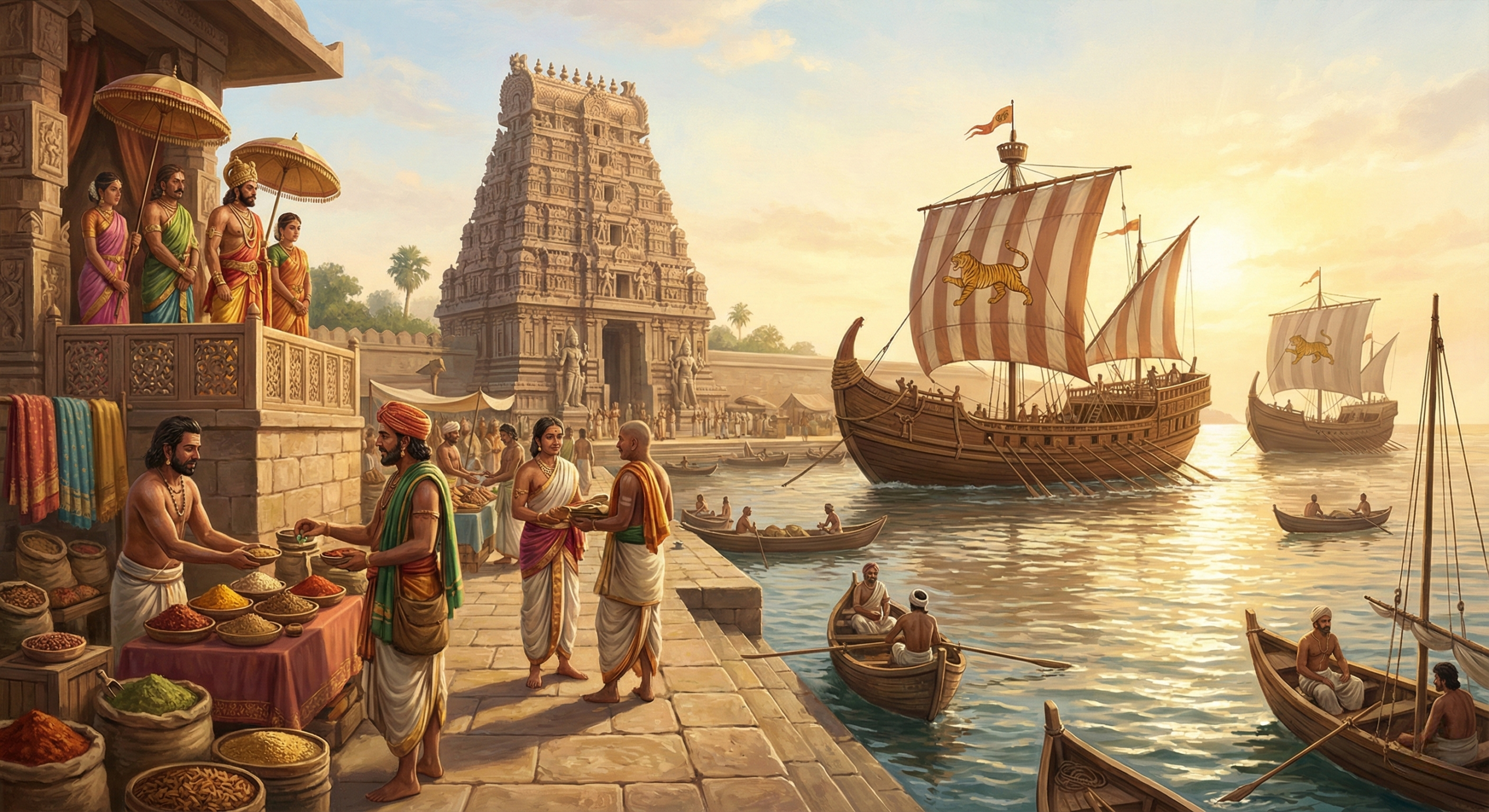
The Chola navy is the reason many people search for this dynasty, and it deserves a careful account. The Cholas did not have a standing navy in the modern sense, and no reliable figure exists for the number of ships. What the evidence shows is that Chola kings could gather fleets large enough to carry armies across open sea, probably using the merchant ships and sailors of the Coromandel ports such as Nagapattinam, and that they did so repeatedly.
The first big campaigns were closer to home. Rajaraja I’s victory at Kandalur Salai was won on the western coast, and his invasion of Sri Lanka and claim over the Maldives both needed ships. Rajendra I used the same capacity to complete the Sri Lankan conquest.
The great expedition came in about 1025. Rajendra’s inscriptions list the places his fleet attacked in the Srivijaya kingdom, which controlled the Strait of Malacca and the sea route between India and China. They include Kadaram (Kedah, on the Malay peninsula), the Srivijaya capital, Malaiyur, Ilamuri-desam in northern Sumatra, and Nakkavaram, the Nicobar Islands. The inscriptions say the Srivijaya king Sangrama Vijayottungavarman was captured.
Why did the Cholas attack? Historians still debate it. The most widely accepted explanation is trade: Srivijaya taxed shipping through the straits, and Tamil merchants trading with Song China wanted a free passage. Others see it as a show of power by a king who had already reached the Ganga. Either way, it was a raid, not a conquest. The Cholas did not set up a lasting government in Southeast Asia, although they kept diplomatic and trade contacts, and Chola embassies are recorded at the Chinese court.
Behind the navy stood Tamil merchant guilds such as the Ainnurruvar and the Manigramam, whose inscriptions are found from Sri Lanka to Sumatra. For a later South Indian state that also drew its wealth from ports and overseas trade, see our history of the Vijayanagara Empire.
How the Cholas governed: villages and assemblies
The empire was divided into mandalams (provinces), which were split into valanadus and nadus, and then into villages. Land revenue was the state’s main income, and Rajaraja’s land survey made assessment more systematic.
Chola villages had their own assemblies. The ur was the assembly of an ordinary village, and the sabha (or mahasabha) the assembly of a brahmadeya, a village granted to Brahmins. Two inscriptions from Uttaramerur, dated to the reign of Parantaka I (919 and 921), describe how the sabha chose its committees by lot, the kudavolai system, in which names were written on palm leaves and drawn from a pot. Candidates had to own land and a house, be between 35 and 70 years old, and know the Vedas. Historians often cite these rules when discussing local self-government in medieval India, although the assemblies represented landholders, not the whole village.
Chola temples and bronzes
The Brihadeeswarar temple at Thanjavur, built by Rajaraja I, is the high point of Chola architecture. Its granite vimana rises about 66 metres, and the stone at the top is often said to weigh around 80 tonnes. Rajendra’s temple at Gangaikonda Cholapuram followed the same model, and the Airavatesvara temple at Darasuram, built under Rajaraja II, is smaller but richly carved. Together the three are listed by UNESCO as the Great Living Chola Temples.
The Chola period is also when South Indian bronze casting reached its best. Using the lost-wax method, artists made the processional images of Shiva as Nataraja, Parvati and the Shaiva saints that are still carried out of temples at festivals today.
Tamil literature under the Cholas
The hymns of the Shaiva saints, the Nayanmars, were collected into the Tirumurai, traditionally by Nambiyandar Nambi around the time of Rajaraja I. Sekkizhar’s Periyapuranam, the lives of the 63 Nayanmars, was written at the court of Kulottunga II, and Kamban composed his Tamil Ramayana in the Chola period.
How the Chola dynasty declined
By the thirteenth century the Cholas were squeezed between the Hoysalas to the north-west and a revived Pandya kingdom to the south, while their own feudatories grew stronger. The Pandyas under kings such as Jatavarman Sundara Pandya took over most of the Chola lands, and the last known Chola king, Rajendra III, disappears from the records around 1279.
If you want to see what the Cholas left, the three Great Living Chola Temples can be covered in a long day from Kumbakonam: Darasuram is just outside the town, Thanjavur is about forty kilometres away, and Gangaikonda Cholapuram is to the north.
Read Next
- Brihadeeswarar Temple Thanjavur: The Great Chola Masterpiece
- Vijayanagara Empire History: Rise, Rulers and Cultural Legacy
- Gupta Empire History: Golden Age of Ancient India Explained
Frequently Asked Questions
What was the emblem of the Chola dynasty?
The tiger. It appears on Chola coins and seals, and the Chola flag is described as bearing a tiger.
Did the Cholas rule Indonesia or Malaysia?
No. Rajendra I’s fleet raided Srivijaya ports in Sumatra and the Malay peninsula around 1025, but the Cholas did not set up lasting rule there.
Is Ponniyin Selvan real history?
Kalki Krishnamurthy’s novel Ponniyin Selvan is historical fiction. Its central figure, Arulmozhivarman, is the future Rajaraja I, and many characters are real, but the plot is largely invented.