[india_weather]

Vijayanagara Empire History: Rise, Rulers and Cultural Legacy
Around 1520, a Portuguese visitor named Domingo Paes walked through the capital of Krishnadevaraya and came away comparing it with Rome. That city, which we now call Hampi, was the heart of the Vijayanagara Empire (1336-1646 CE), the largest South Indian state of the late medieval period. Vijayanagara Empire history covers three centuries, four dynasties and most of the peninsula, from Karnataka and Andhra to Tamil Nadu and Kerala.
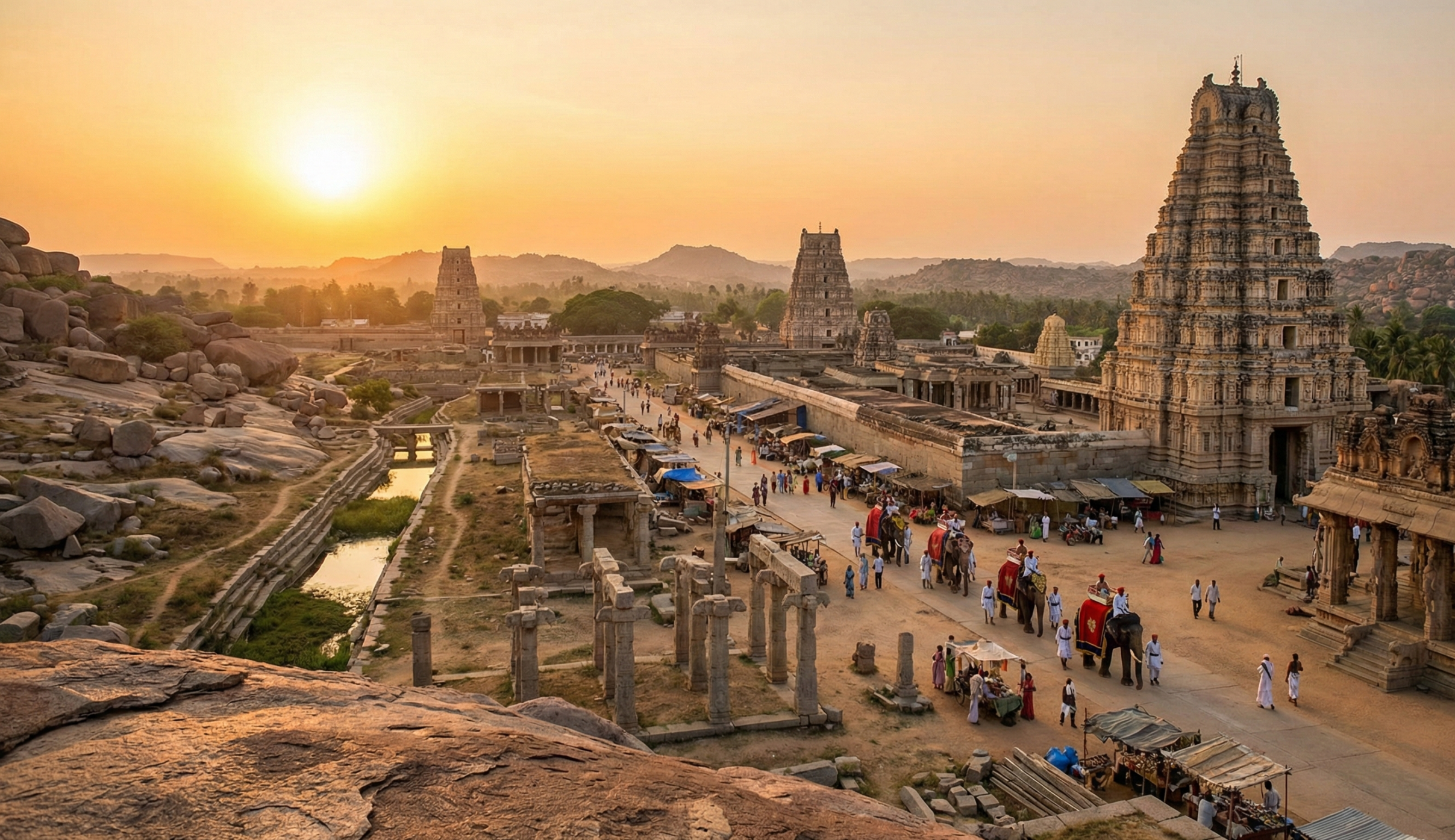
The empire was founded by two brothers, Harihara I and Bukka Raya I, with the sage Vidyaranya as their guide. It reached its height under Krishnadevaraya (1509-1529), and its capital was sacked after the Battle of Talikota in 1565. The ruins at Hampi are now a UNESCO World Heritage Site, and they are the best place to see what this state built.
Vijayanagara Empire history at a glance
| Aspect | Details |
|---|---|
| Time period | 1336-1646 CE (310 years) |
| Founders | Harihara I and Bukka Raya I (Sangama dynasty) |
| Capital | Vijayanagara (modern Hampi, Karnataka); later Penukonda and Chandragiri |
| Greatest ruler | Krishnadevaraya (1509-1529) |
| Dynasties | Sangama, Saluva, Tuluva, Aravidu |
| Key battles | Talatadri (1370), Raichur (1520), Talikota (1565) |
| Best-known temples | Virupaksha, Vitthala, Hazara Rama |
| Literature | Golden age of Telugu at Krishnadevaraya’s court |
Why was the Vijayanagara Empire founded in 1336?
By the early fourteenth century, armies of the Delhi Sultanate under Alauddin Khalji and then Muhammad bin Tughlaq had raided deep into the south. The Yadavas of Devagiri, the Kakatiyas of Warangal and the Hoysalas were defeated one after another, temples were plundered, and no single southern power was left to hold the Deccan.
Into this gap stepped Harihara I and Bukka Raya I, two of five sons of a man named Sangama. The traditional account says they had served a southern king, were taken to Delhi and made to convert to Islam, then were sent back to govern the region, returned to their old faith under the influence of Vidyaranya, and declared independence. Historians still argue over parts of this story, including whether the brothers began as Hoysala or Kakatiya servants. What is clear is that in 1336 they founded a new kingdom on the southern bank of the Tungabhadra, where rocky hills and the river made a natural fortress.
Harihara took control of northern Karnataka while Bukka pushed into the Telugu country. Bukka’s son Kumara Kampana marched south and ended the short-lived Madurai Sultanate in the 1370s. By about 1377 the kingdom held most of the land between the Krishna and the Kaveri.
The four dynasties of Vijayanagara
Sangama dynasty (1336-1485)
The Sangamas built the state. Devaraya I (1406-1422) is remembered for irrigation tanks and dams, and for wars with the Bahmani Sultanate and the Gajapatis of Odisha. Devaraya II recruited Muslim archers and bought Turkish and Arab horses, because he saw that the Bahmani cavalry outclassed his own. Some accounts link him to building at Sringeri, the monastery associated with Vidyaranya, though the Vidyashankara temple there is usually dated earlier.
Saluva dynasty (1485-1505)
As the later Sangama kings weakened, the general Saluva Narasimha seized the throne in 1485 to hold off the Gajapatis and the Bahmanis. His line did not last long.
Tuluva dynasty (1505-1570)
The Tuluvas gave Vijayanagara its best years, mainly through Krishnadevaraya. After him came Achyuta Deva Raya and then Sadashiva Raya, a weak king whose minister Aliya Rama Raya held real power and led the army at Talikota.
Aravidu dynasty (1570-1646)
After the disaster of 1565, the Aravidu family ruled a smaller state, first from Penukonda and then from Chandragiri. Venkatapati Raya II was its ablest king. Over time, the governors known as nayakas in Madurai, Thanjavur, Gingee and Ikkeri became independent rulers in all but name.
Krishnadevaraya: the empire’s greatest ruler
Krishnadevaraya came to the throne in 1509 and spent much of his reign at war. His best-known victory came in 1520, when he took Raichur in the disputed Raichur Doab from the Adil Shahi ruler of Bijapur. Portuguese accounts say Portuguese musketeers fought alongside his army, which still depended heavily on war elephants and massed infantry.
On the eastern front, he took the fortresses of Udayagiri and Kondavidu from the Gajapati king Prataparudra and pushed as far as Simhachalam. The war ended with a treaty, and Prataparudra’s daughter married Krishnadevaraya. With the Portuguese, who had taken Goa in 1510, he kept a working relationship, because they controlled the sea trade in horses that his cavalry needed.
He was also a poet. His Telugu work Amuktamalyada, on the Tamil saint Andal, includes passages on statecraft and on the life of farmers. His court hosted the Ashtadiggajas, the eight poets said to hold up the literary world like the eight elephants of the directions. Allasani Peddana, author of Manucharitram, was the chief among them, and Nandi Thimmana was another. Tenali Ramakrishna, famous today for his witty stories, is traditionally counted in the group.
How the empire was run: the nayaka system
The king ruled with a council of ministers, the chief of whom was the mahapradhana. The empire was divided into provinces called rajyas, often placed under princes or trusted nobles, and these were split into smaller districts down to villages.
Much of the land was given out as amaram to military chiefs called amaranayakas, or simply nayakas. In return they collected revenue, kept a fixed number of soldiers ready for the king and sent part of the income to the capital. This arrangement, sometimes called the nayankara system, let a single court govern a huge area. It also created powerful local families who could break away once the centre weakened, which is exactly what happened after 1565.
Land revenue is often given as one-sixth of the produce, though rates varied with the quality of land and crops. Taxes were collected partly in gold coins called varahas, known to the Europeans as pagodas.
Economy, trade and the horse trade
The economy rested on farming in the river valleys. Anicuts (stone dams), tanks and canals watered rice, sugarcane and cotton across the river valleys. Krishnadevaraya is described as personally inspecting irrigation works.
On the west coast, ports such as Bhatkal, Honavar and Mangalore sent cotton cloth, spices and gems to the Persian Gulf, the Red Sea and Southeast Asia. The most important import was horses, first from Arab and Persian traders and later through the Portuguese. Vijayanagara’s gold coins circulated well beyond its borders.
The army and the major battles
Foreign visitors wrote of a very large army. Portuguese accounts give figures as high as 800,000 infantry, 24,000 cavalry and about 1,000 elephants, raised mostly through the nayakas’ contingents. Numbers like these are hard to check and probably include every armed man the empire could call up. Turkish and Muslim archers and some Portuguese gunners served alongside the regular troops.
The battles students are most often asked about are Talatadri (1370) against the Madurai Sultanate, Raichur (1520) against Bijapur, and Talikota (1565) against the combined Deccan Sultanates.
Battle of Talikota (1565) and the fall of Hampi
The Bahmani Sultanate had split into five states: Bijapur, Golconda, Ahmadnagar, Bidar and Berar. Rama Raya had spent years playing them against each other. In 1565 most of them combined against him, with Ali Adil Shah I of Bijapur among the leaders, and met the Vijayanagara army near the villages of Rakshasa and Tangadi, close to Talikota.
Rama Raya was captured and killed. Several accounts say two Muslim commanders in his army changed sides during the battle, which turned the fight into a rout, though historians treat this detail with some care. The victors then sacked the capital for months. Temples were damaged, palaces burned and the city never recovered as a capital.
The empire itself survived. The Aravidus ruled from Penukonda from about 1570 and later from Chandragiri, until pressure from the Deccan Sultanates and the breakaway of the nayaka states brought it to an end by 1646. The fall of Vijayanagara reshaped power across medieval India, much like the changes described in our post on Delhi Sultanate History: Dynasties, Rulers and Administration.
Hampi: what to look at in the Vijayanagara capital
Archaeologists usually divide the site into a Royal Centre (palaces, audience halls and the citadel), a Sacred Centre along the river with the main temples, and an urban core with bazaars between them. The site is often said to cover about 26 sq km. The walls, aqueducts and stepped tanks show how carefully the builders managed water in a dry, rocky place.
Vijayanagara builders took the southern temple style of the Chola Dynasty: Masters of the Indian Ocean and made it bigger and busier. Typical features are tall gateway towers (gopurams), kalyana mandapas for the god’s marriage festival, and halls full of carved pillars with rearing horses and lion-like yalis. Look for these at the main sites:
- Virupaksha Temple: still a working temple, dedicated to the state deity Virupaksha (a form of Shiva). Its core is much older than the empire and it kept growing for centuries.
- Vitthala Temple: famous for its stone chariot and its pillars that ring when tapped. Local guides will tell you the chariot’s stone wheels once turned.
- Hazara Rama Temple: the royal family’s temple inside the Royal Centre, with walls carved with long panels of the Ramayana.
- Secular buildings: the Lotus Mahal, the Elephant Stables and the Queen’s Bath, which mix temple carving with arches and domes from the Deccan Sultanates.
- Mahanavami platform: a large stepped granite platform, often given as about 60 by 40 metres, from which the king watched the festival.
Religion and court festivals
The kings worshipped Virupaksha as their family deity, but they also gave large grants to the Venkateshwara temple at Tirupati. Srivaishnavism, the tradition of Ramanuja, grew strong under the Tuluvas. Jain and Lingayat communities also lived and built in the empire.
The biggest public event was Mahanavami, the nine-day festival we now know as Dasara. Foreign visitors describe parades of soldiers and elephants, dancers, wrestling and the counting of tribute from the nayakas, all watched by the king from the great platform. The festival was a display of power to nobles and foreign envoys alike, and the Mysore Dasara today keeps something of that royal style.
After the empire broke up, the nayaka kingdoms of Madurai, Thanjavur, Gingee and Keladi (Ikkeri) carried on its temple building, its patronage of Telugu and its irrigation works. Later, the Maratha rulers of Thanjavur continued many of these traditions into the nineteenth century.
Read Next
- Delhi Sultanate History: Dynasties, Rulers and Administration
- Chola Dynasty History: Powerful South Indian Empire
- Badami Caves: The Early Chalukya Rock Temples of Karnataka
Frequently Asked Questions
Which foreign travellers wrote about Vijayanagara?
The best-known accounts are by the Italian Niccolo de’ Conti, the Persian envoy Abdur Razzaq, and the Portuguese Domingo Paes and Fernao Nuniz. Paes and Nuniz wrote in the sixteenth century and are the main sources for Krishnadevaraya’s reign.
What coins did Vijayanagara use?
The main gold coin was the varaha, called the pagoda by Europeans. Smaller silver coins (tar) and copper coins (kasu) were used for everyday trade.
Who was Vidyaranya?
Vidyaranya was a scholar and head of the Sringeri monastery in Karnataka. Tradition credits him with guiding Harihara and Bukka when they founded the kingdom in 1336.
Which dynasties claimed to continue Vijayanagara rule?
The nayakas of Madurai, Thanjavur, Gingee and Ikkeri ruled as its successors, and the Wodeyars of Mysore also drew on Vijayanagara traditions, including the Dasara celebrations.
How long should you spend at Hampi?
Two full days lets you cover the Sacred Centre one day and the Royal Centre the next. Start at the Vitthala Temple early in the morning, before the heat and the tour buses.