[india_weather]
Christmas in India: Bada Din Traditions From Kerala, Goa, and the North East
In the last week of December, the queue outside a good bakery in any Indian city tells you what season it is. Plum cake sells out, malls put up plastic trees, and schools hold Santa parties for children who have never been inside a church. Christmas in India is the most important day of the year for the country’s roughly 28 million Christians, and over the past few decades it has also become a shared holiday across much of urban India.
Here is how the day is celebrated in different parts of the country, where the customs came from, and what people eat.
How old is Christianity in India?
Older than in much of Europe, if you follow tradition. St Thomas the Apostle is said to have landed on the Kerala coast in 52 CE and preached along the Malabar coast until his death near present-day Chennai in 72 CE. The Syrian Christians of Kerala, often called St Thomas Christians, trace their community to those early converts.
A second, much larger wave came with European traders and rulers. Portuguese, Dutch, French and British missions spread Christianity between the sixteenth and nineteenth centuries. Today Christianity is India’s third-largest religion after Hinduism and Islam. The biggest Christian populations are in Kerala, Goa, Tamil Nadu, Andhra Pradesh and the north-eastern states of Nagaland, Mizoram, Meghalaya and Manipur.
What Christmas in India looks like on 25 December
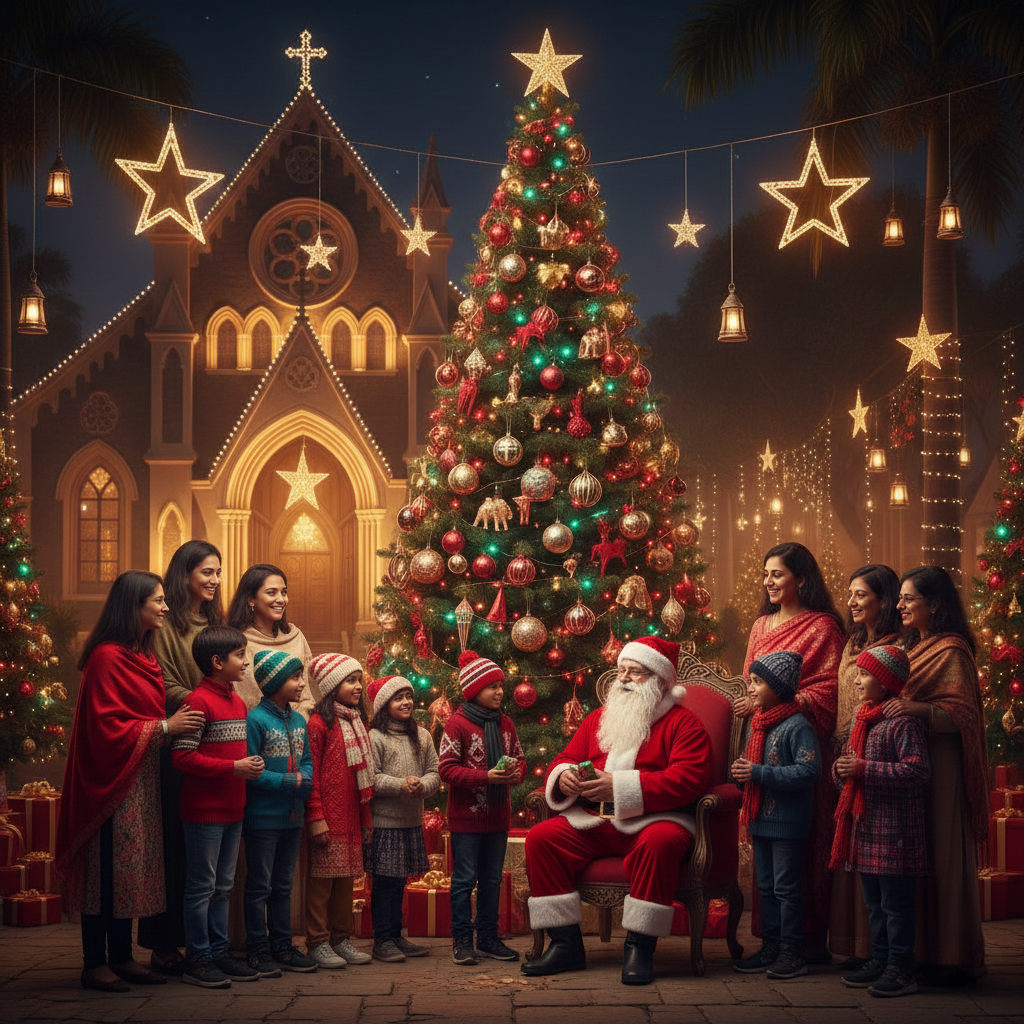
25 December is a gazetted national holiday, so schools, government offices, banks and most private companies are closed. For Christian families the day usually begins in church. Many attend midnight Mass on Christmas Eve, and churches are decorated with paper stars, poinsettias and strings of lights. A crib, the nativity scene of Jesus born in a stable, is set up in the church and in many homes.
After Mass comes the family lunch, and this is where regional differences show most. A Kerala table might have duck roast with appam. A Goan one will almost certainly have pork sorpotel and vindaloo. Anglo-Indian families across the country often serve roast chicken with mashed potatoes and rice. And every one of them ends with Christmas cake.
Christmas in Kerala
From the start of December, Christian homes in Kerala hang a paper star lantern (often called a nakshatra vilakku) outside the front door, and Christian neighbourhoods string lights across the streets. Carol groups go from house to house through the first three weeks of the month, singing Malayalam carols and collecting donations for the parish.
The main event is midnight Mass on Christmas Eve. Churches are full, and families come in new clothes, often white. When the bells ring at the end, people greet everyone around them with “Christmas aashamsakal” (Christmas greetings) before heading home to eat.
Christmas in Goa
Goa has the most public Christmas celebrations in India, shaped by more than four centuries of Portuguese rule. Houses and streets are lit for about two weeks, and markets in Panjim and Margao sell decorations, sweets and seasonal food. Midnight Mass at the Basilica of Bom Jesus and the Se Cathedral in Old Goa draws very large crowds.
The food is what most visitors remember. Kuswar is the general name for the platter of sweets and savouries that families make and share with neighbours. It usually includes:
- Kulkuls: small curled sweets made from flour, coconut and sugar.
- Nevris: half-moon pastries filled with coconut and jaggery.
- Dodol: a dark, sticky sweet of rice flour, coconut milk and palm jaggery.
- Bebinca: a layered coconut cake, often the centrepiece of the dessert table.
Christmas-night beach parties, now copied across urban India, are closely associated with Goa. If you plan to be there in the last week of December, book your stay well ahead, since it is one of the busiest weeks of the tourist year.
Christmas in the North East
Christianity is the majority religion in Nagaland (88%), Mizoram (87%) and Meghalaya (75%), and has a large following in Manipur and Arunachal Pradesh. In these states Christmas is the biggest festival of the year, celebrated on the scale that Diwali is elsewhere in India.
In Nagaland and Mizoram the celebrations run all the way from Christmas Eve to New Year’s Day. Villages and church congregations hold community feasts, choirs sing through the evening, and carols are mixed with traditional dances. Pork usually takes pride of place at these feasts.
Indian plum cake and the bakeries that made it famous
One thing unites Christmas across every region: plum cake. The Indian version is denser and darker than most Western fruitcakes, made with dried fruit soaked in rum or brandy for weeks beforehand. Every family has its own recipe, every neighbourhood bakery its own version, and cakes go out to neighbours as gifts throughout December.
Three bakeries have particularly long histories. Mambally’s Royal Biscuit Factory in Thalassery, Kerala, founded in 1880, is generally credited with baking India’s first Christmas cake in 1883. Wenger’s in Delhi’s Connaught Place has been baking Christmas cakes since 1926. Nahoum and Sons in Kolkata’s New Market, founded in 1902, is the last of the city’s well-known Jewish confectioners, and its December queues are part of Kolkata’s Christmas.
Christmas trees, Santa and newer customs
The Christmas tree came to India with British and other European settlers in the nineteenth century. It is now standard in Christian homes and increasingly common in others. Where there are no pine trees, people use artificial trees, and in some homes banana or mango branches are decorated instead.
Santa Claus has been fully adopted. He is Christmas Baba in Hindi and Christmas Thatha in Tamil. Children write him letters, schools arrange Santa visits, and malls hire Santas for the season.
Why is Christmas called Bada Din?
In Hindi and Urdu, Christmas is called Bada Din, “the big day”. The name came into common use in North India during the colonial period, when 25 December was a major holiday for the British and offices closed for everyone. Another explanation you will often hear links the name to the days starting to grow longer after the winter solstice, though the colonial-holiday reading is more widely given.
Either way, the name says something about the festival in India. Most people who say “Bada Din” are not Christian, yet they know exactly which day it means.
One practical tip if you want a cake from one of the old bakeries: go or order in the first half of December. By the week of Christmas the queues at places like Nahoum’s and Wenger’s are long, and the best-known cakes can run out.
Read Next
- Diwali: Festival of Lights, Legends, Rituals, and Modern Celebrations
- Lohri and Makar Sankranti: The Harvest Festivals That Still Shape Life in India
- Urban Lifestyle in India: Life in Delhi, Mumbai, Bengaluru, and Other Metros
Frequently Asked Questions
How many Christians live in India?
According to the 2011 Census, around 28 million Indians identify as Christian, about 2.3 percent of the population.
Which Indian states celebrate Christmas the most?
Kerala and Goa have the best-known celebrations, while in Christian-majority Nagaland, Mizoram and Meghalaya Christmas is the biggest festival of the year.
Where is the best place to spend Christmas in India?
For public celebrations and food, Goa. For church traditions and carols, Kerala. For a festival that takes over whole towns for a week, Nagaland or Mizoram.
Sources and Further Reading
- Census of India 2011, religion data (Office of the Registrar General and Census Commissioner, Government of India)
- Robert Eric Frykenberg, Christianity in India: From Beginnings to the Present (Oxford University Press)
- George Menachery (ed.), The St. Thomas Christian Encyclopaedia of India