[india_weather]
Lessons From India’s Oldest: Civilizations for Today’s Cultural Identity Debates
In the Brihadaranyaka Upanishad, a woman philosopher named Gargi Vachaknavi questions the sage Yajnavalkya in front of King Janaka’s court until he warns her not to ask any further. That scene was composed close to three thousand years ago, and it is a useful place to start when thinking about India’s ancient civilizations and cultural identity. Arguments about who we are, what counts as tradition and how the past should be read did not begin with television debates or social media. They are part of the Indian record itself.
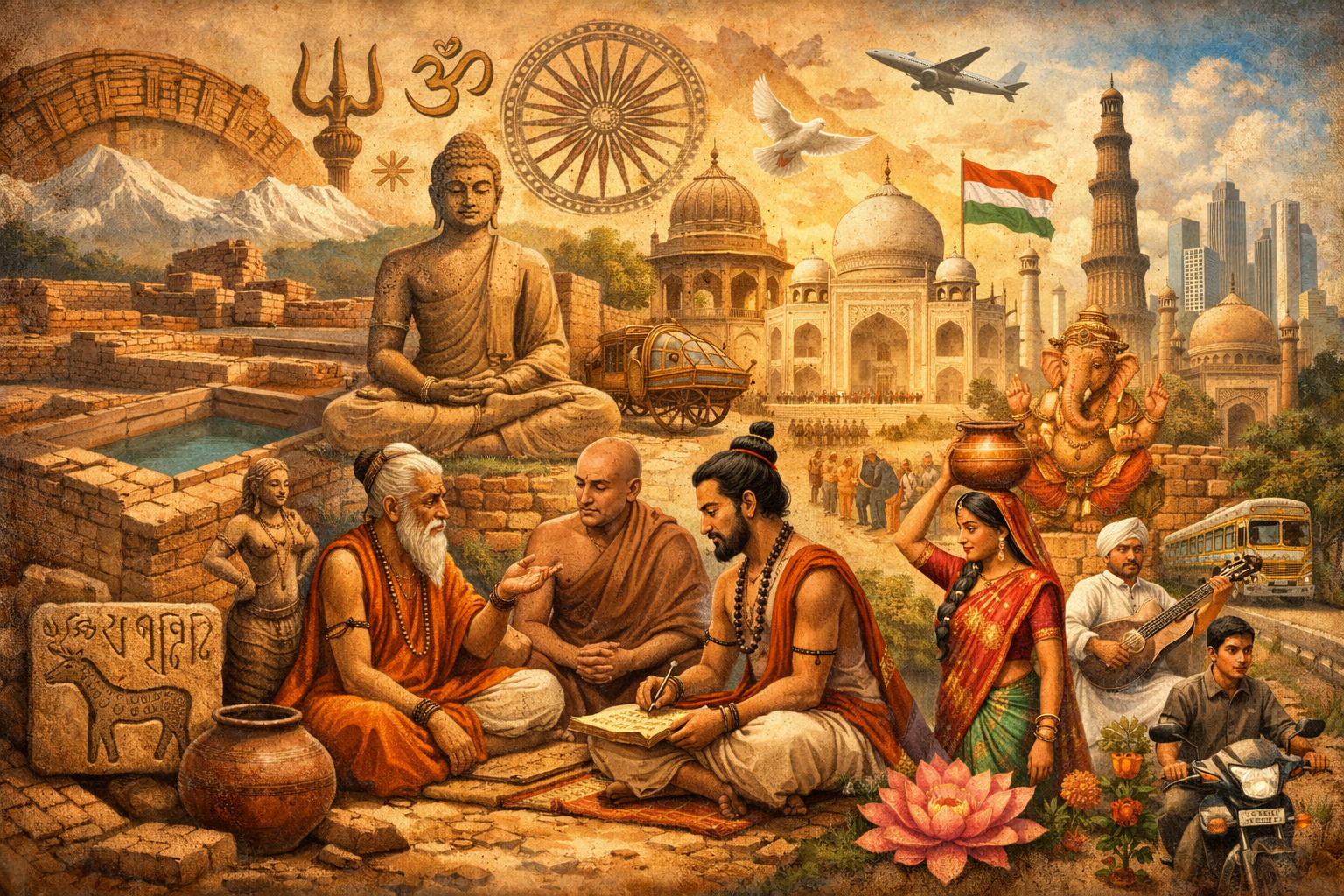
This essay does not take a side in any present-day argument. It looks at what the evidence from the Indus cities, the Vedic and Upanishadic texts, Ashoka’s edicts and the many languages of early India actually shows, and asks what that might mean for the way we discuss identity now. The past does not settle modern questions, but it can make them less heated.
What the Indus cities tell us about shared civic life
The Indus Valley Civilization flourished from roughly 2600 to 1900 BCE in cities such as Mohenjo-daro, Harappa, Dholavira and Kalibangan. These cities used bricks of a standard ratio of 1:2:4, covered drains along their streets, and a common system of weights based on cubes of chert.
What the archaeologists have not found is just as interesting. There is no building at Mohenjo-daro that can be identified with confidence as a royal palace, and no grand tomb of a ruler of the kind found in Egypt. The Great Bath and the raised citadel suggest some public authority, and the seals carry animals and figures that may be religious, but we cannot read the script, so we do not know how these people described themselves.
Many historians take this as a sign that Harappan society held together through shared systems such as drainage, weights and trade as much as through a ruler’s image. That is a cautious reading, not a proven one. Still, it is worth asking whether a common civic life (clean water, fair measures, roads that connect) can bind people as strongly as shared symbols do.
Trade, contact and cultural confidence
Harappan seals and beads have been found in Mesopotamia, and Mesopotamian texts mention trade with a land called Meluhha, which most scholars identify with the Indus region. Lapis lazuli from Afghanistan reached Indus workshops. Shortughai, a Harappan trading settlement, sat in northern Afghanistan itself.
We cannot know what Harappans felt about foreigners, so it would be wrong to claim they welcomed every outside influence. What the evidence does show is a civilisation that traded over long distances for centuries while keeping its own script, weights and town plans. Contact and a distinct identity existed side by side.
How Vedic and Upanishadic thought grew through questioning
The Vedic texts were composed over many centuries, and they are not a single voice. The Rigveda is mostly hymns to deities like Agni and Indra, but its Nasadiya Sukta (Hymn of Creation) ends by wondering whether even the highest god knows how the world began, “or perhaps he does not know”. Later Brahmana texts focus on the exact rules of sacrifice, while the Upanishads turn inward to questions about the self and the absolute.
This shift happened gradually, through teachers and students arguing over what the older texts meant. The Katha Upanishad, for example, is built around a boy, Nachiketa, putting hard questions to Yama, the god of death. The tradition kept the older layers even as it moved on from them, which is one reason Indian religious thought contains so many schools that still claim the same roots.
Debate as a tradition in its own right
Indian philosophy later formalised argument itself. The Nyaya school wrote detailed rules on valid reasoning and the kinds of error in debate. Writers of many schools would first state the opponent’s view (purvapaksha) in full before answering it, a habit that forced them to understand the other side.
Buddhist and Jain thinkers took part in the same arguments. The Jain idea of anekantavada holds that reality has many sides and no single viewpoint captures all of it, and it is often explained with the story of the blind men and the elephant. Disagreement in this tradition was a normal part of looking for truth, not a sign of disloyalty to one’s community.
Pluralism, and its limits
Buddhism and Jainism arose in the sixth and fifth centuries BCE alongside Vedic traditions, and all three borrowed from and argued with each other. Later, Bhakti saints wrote in regional languages such as Tamil, Kannada, Marathi and Hindi, and their poems reshaped worship across the subcontinent. Ideas like karma and rebirth moved freely across these boundaries.
It would be dishonest to call this history peaceful at all times. There were rivalries between sects, quarrels over royal patronage, and a social order built on caste that excluded many people. Ancient India was often far from harmonious. What it did manage, over long periods, was to keep several traditions alive at once rather than settle on only one.
Religion and royal authority: the case of Ashoka
Ancient Indian kings did make religious claims. Many performed Vedic sacrifices like the ashvamedha, and some took titles linking them with the gods. But the most famous royal statement on religion from early India points another way. In his Twelfth Rock Edict, Ashoka asks people to honour other sects and warns that whoever praises his own sect while disparaging others “injures his own sect”.
Ashoka was a committed Buddhist, yet he gave cave shelters in the Barabar hills to the Ajivikas, a rival order. His edicts appealed to good conduct, care for animals and respect for parents and teachers, values that people of different faiths could accept. Whether later rulers followed this example is a separate and debated question.
Stories that changed as they travelled
The Ramayana is the clearest example of a story with many tellings. Valmiki’s Sanskrit epic was retold in Tamil by Kamban in the twelfth century and in Awadhi by Tulsidas in the sixteenth, and there are Jain, Buddhist and Southeast Asian versions as well. Each one changes details, emphasis and even characters to suit its audience.
For most of Indian history, this variety was simply how stories lived. People in different regions, castes and faiths grew up with their own version and rarely felt that the existence of another version threatened theirs.
Many languages, one civilisation
Early India was multilingual from the start. Sanskrit was used for ritual and learned writing, Prakrits and Pali for everyday speech and Buddhist teaching, and Tamil had its own classical literature in the Sangam poems. Ashoka’s edicts appear in Prakrit in Brahmi and Kharosthi scripts, and at Kandahar in Greek and Aramaic.
A king who wanted to be understood across his empire wrote in the languages his people actually used. Shared ideas travelled across these languages without needing a single common tongue.
What India’s ancient civilizations and cultural identity debates have in common
Ancient India offers no ready-made answers to modern questions, and treating it as a golden age is as misleading as dismissing it. Its people faced conflict, inequality and violent change. Picking one period or one text and calling it the whole of Indian identity leaves out most of what actually happened.
What the record does show is a habit of holding many traditions together and arguing about them openly. Gargi asked her questions in a royal court, Nyaya logicians wrote rules for fair argument, and Ashoka put tolerance in stone. If you want to read the oldest of those sources for yourself, a translation of Ashoka’s Rock Edict XII or the Gargi dialogue in the Brihadaranyaka Upanishad is short enough to finish in one sitting.
Read Next