[india_weather]
Traditional Indian Clothing: A Complete Guide to Sarees, Kurtas, and Regional Wear
A Maharashtrian nauvari saree is nine yards long and passes between the legs like a dhoti. A Bengali saree has no front pleats at all. Both are traditional Indian clothing, and both are “the saree”, which tells you how hard it is to make a neat list of what Indians wear. This guide covers the main garments for women and men, the regional costumes you will see at festivals, and the weaving centres behind the cloth.
Nobody has counted every garment, and no count would stay accurate for long. Each state has its everyday dress, each community its festival wear and bridal outfit, and each generation changes what it inherited. So treat the sections below as a map of the big categories, not a complete catalogue.
The saree and its many drapes
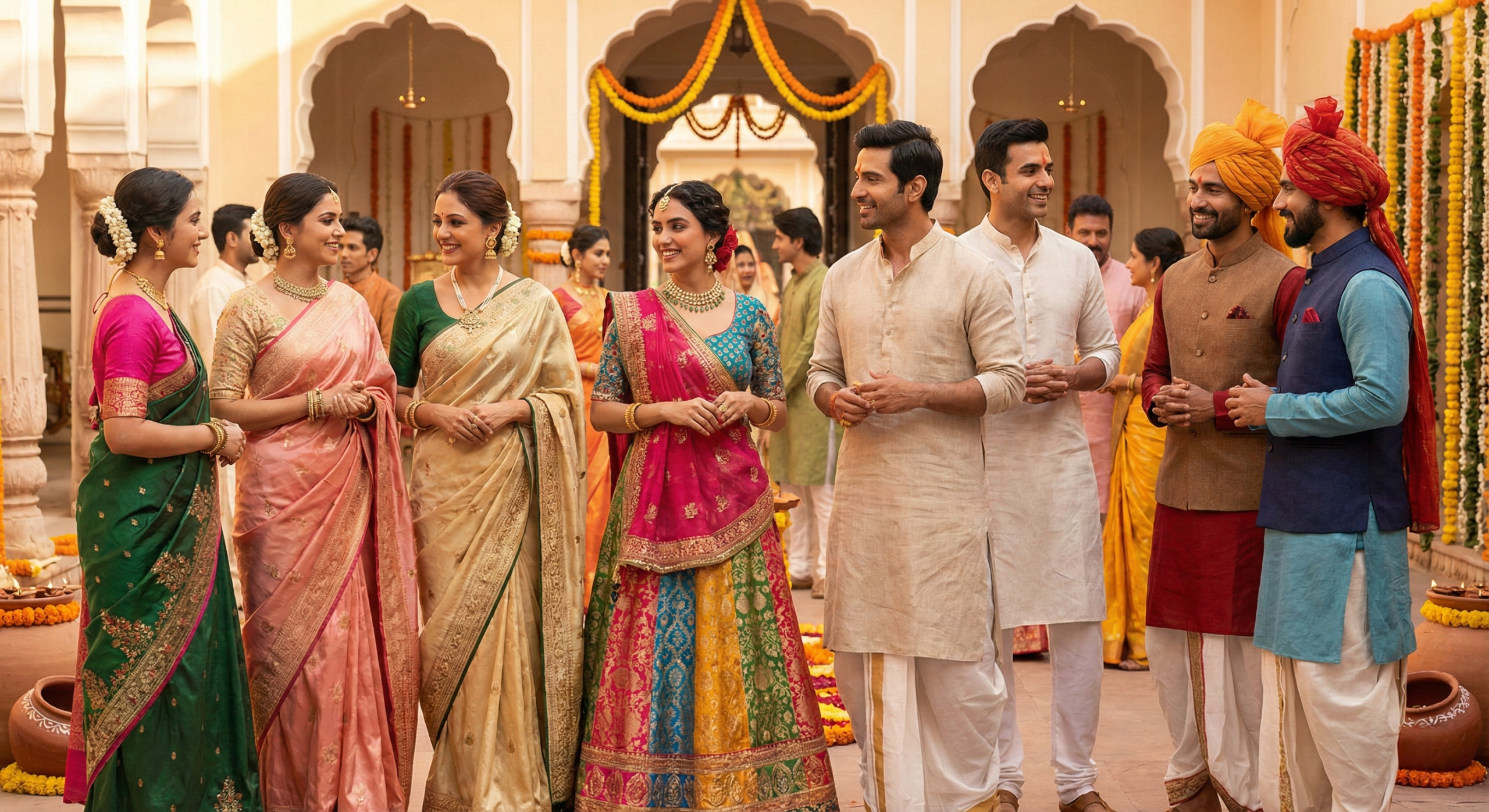
The saree is a single length of unstitched cloth, usually five to nine yards long. There are no buttons or zips. You wrap it around the waist, tuck it in, pleat the front and throw the free end, the pallu, over the left shoulder.
That method is the nivi drape, which comes from Andhra Pradesh and is now the default across most of the country. There are well over a hundred other drapes. The Maharashtrian nauvari uses nine yards and is tied the way the soldiers of Shivaji’s army tied their dhotis, with the cloth passing between the legs. The Bengali drape skips the front pleats and brings the pallu over both shoulders. In the Coorgi drape, the pleats sit at the back instead of the front.
The cloth matters as much as the drape. Kanjeevaram silk comes from Tamil Nadu, Banarasi silk from Varanasi, Chanderi from Madhya Pradesh, Paithani from Maharashtra, Bomkai from Odisha, Jamdani from Bengal, Muga silk from Assam and Patola from Gujarat. Each has its own weaving technique and its own motifs, and many families still expect at least one of them in a bride’s trousseau.
Salwar kameez: the everyday outfit of the north
For millions of women, especially in North India, the salwar kameez is daily wear. The kameez is a tunic that reaches about the knees. The salwar is a pair of loose trousers gathered at the waist and narrowing at the ankle, and a long scarf, the dupatta, goes over the shoulders or across the chest.
The outfit has Central Asian roots. It is usually said to have come with the Mughal armies in the sixteenth century and settled first in Punjab, though loose trousers and tunics were worn in the north-west earlier too. Today women of every religion wear it from Kashmir to Kanyakumari, in many cuts:
- Punjabi salwar: heavily gathered and roomy.
- Patiala salwar: falls in deep, loose folds.
- Churidar: a tight, legging-like version worn under a longer kurta.
- Anarkali: a floor-length, flared kurta for special occasions.
Lehenga choli and the modern Indian bride
The lehenga choli has three parts: the lehenga (a long, full, flared skirt), the choli (a fitted blouse that ends above the waist) and the dupatta, draped over the shoulders or head. It started in Rajasthan and Gujarat, where many women still wear versions of it every day.
The Gujarati chaniya choli, the one you see spinning at Navratri garba nights, is lighter and covered in mirror work. The Rajasthani ghagra choli is heavier and more elaborately embroidered. Over the last thirty years or so the lehenga has become the standard bridal outfit in much of India, replacing the saree in that role for many families.
What do Indian men wear traditionally?
Dhoti and kurta
The men’s counterpart to the saree is the dhoti, an unstitched cloth of about five yards wrapped around the waist and legs. In the south it is called veshti in Tamil and mundu in Malayalam, and it usually hangs straight to the ankles, often folded up to the knee for work or walking. In Bengal it is tied with pleats at the front. In Maharashtra and parts of the north it passes between the legs and is tucked in at the back, which gives it a trouser-like shape.
Worn with a kurta, a long shirt that reaches the knees, the dhoti is formal traditional dress for Hindu men across most of India. Priests wear plain white, grooms wear silk. Gandhi wore khadi, and that hand-spun cotton became one of the strongest political images of twentieth-century India.
Sherwani, achkan and bandhgala
Most grooms today choose a sherwani over a dhoti kurta. It is a long, fitted coat that reaches the knees, buttoned down the front and worn over churidar trousers. It came into fashion in the late Mughal and Nawabi courts as the formal dress of Muslim nobles, and grooms of every community now wear it.
The achkan is a close cousin, a little shorter and less flared. The bandhgala, made popular by the rulers of Jodhpur, has a stiff, standing collar and is now a common choice for formal evenings.
Regional costumes worth knowing
Beyond these pan-Indian garments, every region has its own dress. A few you are likely to see:
Kerala. Women wear the mundu neriyathu, a two-piece set of white or cream cotton with a gold border, at temples and during Onam. Men wear the mundu on its own.
Assam. The mekhela chador is a two-piece drape, often woven in pat or muga silk, both of which Assam is known for. Look for it during Bihu.
Kashmir. Men and women wear the pheran, a long, loose woollen robe made for hard winters. Many people carry a kangri, a small clay fire pot in a wicker case, underneath it.
The north-east. In Nagaland, Mizoram and Manipur, hand-woven wraparound skirts such as the mekhela, the puan and the lungi are traditional wear. Each community has its own stripes, patterns and dye colours, and the design often tells you which community the weaver belongs to.
Turbans and headwear
For Sikh men, the turban is a religious requirement. In Rajasthan, men wear a colourful safa or pagdi whose style varies by community and region, and in some communities a particular fold marks a particular caste or village. In the south, the mundasu is a smaller turban for formal occasions.
Turbans also carry meaning in ceremony. Punjabi grooms wear an embroidered sehra over theirs at the wedding. Across North India, two men who exchange turbans (pagdi badal) are declaring a lifelong friendship.
Textiles and weaving centres
Every garment above depends on a textile tradition, and India’s is among the oldest in the world. Cotton was grown and spun in the Indian subcontinent by at least 3000 BCE, at Harappan sites. Silk weaving developed in Assam, Bengal and Karnataka. Hand block printing on cotton, associated with the villages of Bagru and Sanganer in Rajasthan, is still done by hand.
Many weaving centres, including Varanasi, Kanchipuram, Chanderi, Maheshwar and Sambalpur, have Geographical Indication (GI) tags for their textiles. A GI tag works like the protection given to Champagne in France or Parmesan in Italy: the name can only be used for products made in that place by the traditional method.
Is traditional Indian clothing still worn every day?
In cities, mostly not. Over the last thirty years western clothes have become everyday wear for most urban Indians, and traditional garments have moved to weddings, festivals and temple visits. In villages and small towns, sarees, salwar kameez, dhotis and lungis are still daily dress for many people.
The handloom sector is still large. The Ministry of Textiles’ third Handloom Census (2009-10) counted over four million handloom weavers and allied workers, and the fourth (2019-20) about 3.5 million, still more than any other country. Weavers face competition from powerlooms and falling incomes, but the craft is very much alive.
If you want to see the difference between handloom and powerloom for yourself, turn a saree over. Handwoven cloth usually shows small irregularities on the reverse, and the border and body of a good Kanjeevaram are woven separately and then interlocked, a join you can feel with your fingers.
Read Next
- Indian Wedding: A Complete Guide to Traditions, Rituals, and Regional Customs
- Indian Folk Art: A Guide to Madhubani, Warli, Pattachitra, Kalamkari and Gond Traditions
- Rural Lifestyle in India: Village Life, Farming, and Community Structure
Frequently Asked Questions
What is the difference between a lehenga and a saree?
A saree is one length of unstitched cloth draped around the body. A lehenga is a stitched, flared skirt worn with a fitted choli and a dupatta, and it is now the more common bridal choice in much of India.
What is the difference between a mundu and a dhoti?
Both are unstitched cloths wrapped around the waist. The mundu is the Kerala version, usually white or cream with a gold border, and is worn hanging straight; the dhoti is tied in many different ways across the rest of India, often with pleats or a tuck between the legs.
What is the most common way to drape a saree?
The nivi drape from Andhra Pradesh, with pleats at the front and the pallu over the left shoulder. It is the style most people learn first.
Which Indian textiles have GI tags?
Many do, including Kanchipuram silk, Banarasi saris, Chanderi, Maheshwari and Sambalpuri textiles. The tag means only cloth from that region, made in the traditional way, can carry the name.
Sources and Further Reading
- Ministry of Textiles, Government of India, Handloom Census reports
- Rta Kapur Chishti, Saris: Tradition and Beyond, Roli Books
- Ritu Kumar, Costumes and Textiles of Royal India, Antique Collectors’ Club
- Crafts Council of India