The Nine Nights That Belong to the Goddess
Every autumn, sometime in September or October, India turns loud, bright, and full of movement. Streets fill up with pandals. Markets stay open until midnight. Women in Gujarat spin in circles of a thousand dandiya sticks. Bengalis begin the long walk from one pandal to the next. Tamil homes set up the golu of dolls. In every corner of the country, in nine different ways, the same thing is happening. This is Navratri, the nine nights of the Goddess.
Navratri 2026 will be celebrated from 12 October to 20 October. The last day, Vijayadashami, is 20 October. This is the story of what these nine nights mean, what they celebrate, and why India still keeps them so close to its heart.
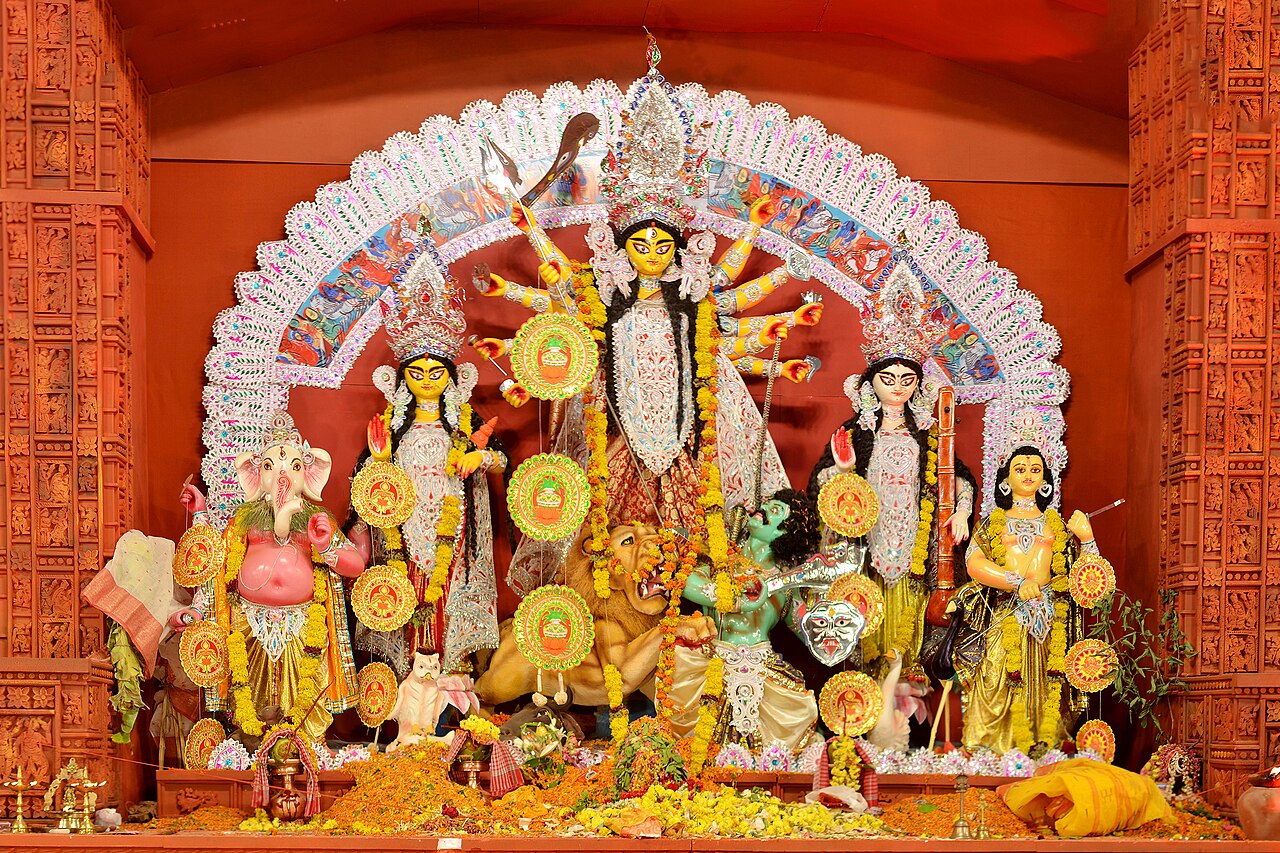
What Navratri Actually Celebrates
Navratri means “nine nights”. The festival honours Durga, the mother goddess who defeated the buffalo demon Mahishasura after a battle that lasted nine nights and ended on the tenth day. Each of the nine nights is dedicated to a different form of Durga, together known as the Navadurga.
Beyond the mythology, Navratri marks a turning of the season. It arrives just after the monsoon has ended and the air is beginning to cool. In an older India that lived closer to the land, it was also the moment when the harvest was ripening in the fields. Nine nights of the Goddess became nine nights of thanks, of asking for strength, and of celebrating the return of light after the wet months.
The Nine Forms of Durga
Each day of Navratri is dedicated to one form of the Goddess. The order is fixed, and every form has her own story, colour, and offering.
- Day 1 — Shailaputri, the daughter of the mountain, mounted on Nandi the bull
- Day 2 — Brahmacharini, the ascetic, honoured for her penance
- Day 3 — Chandraghanta, who wears the crescent moon on her forehead
- Day 4 — Kushmanda, the creator of the universe with her smile
- Day 5 — Skandamata, mother of the warrior god Kartikeya
- Day 6 — Katyayani, born to sage Katyayana to slay Mahishasura
- Day 7 — Kalaratri, the fierce, dark night that destroys ignorance
- Day 8 — Mahagauri, the pure white form, worshipped for peace
- Day 9 — Siddhidatri, the giver of spiritual power
How Navratri Is Celebrated Across India
What makes Navratri unusual among Indian festivals is how completely it changes from state to state.
In Gujarat, the festival is one long dance. Every evening, communities gather in large open grounds for garba and dandiya raas. Women wear chaniya cholis in bright colours. Men wear kediyus and dhotis. The dance goes on until well past midnight for all nine nights.
In West Bengal, Navratri is Durga Puja, the biggest festival of the year. Pandals go up across Kolkata weeks in advance, each one competing for the title of the most beautiful. Families dress in new clothes, eat bhog together at the pandals, and spend the last three days visiting one pandal after another.
In Tamil Nadu, Karnataka, and Andhra Pradesh, Navratri is Golu. Families arrange steps of dolls and figurines that tell stories from the Puranas. Women visit each other’s homes, exchange coconut, betel leaves, and small gifts, and sing bhajans together.
In North India, Navratri is a time of fasting. Many families eat only sattvic food. On the evenings of the eighth and ninth days, families invite young girls into their homes and worship them as forms of Durga in a ritual called Kanya Puja.
The Nine Colours of Navratri 2026
- Day 1 (12 Oct) — Yellow
- Day 2 (13 Oct) — Green
- Day 3 (14 Oct) — Grey
- Day 4 (15 Oct) — Orange
- Day 5 (16 Oct) — White
- Day 6 (17 Oct) — Red
- Day 7 (18 Oct) — Royal Blue
- Day 8 (19 Oct) — Pink
- Day 9 (20 Oct) — Purple
What People Eat During Navratri
Many devotees fast for all nine days. The fast is not always about eating nothing. It is about eating differently. Grains like wheat and rice are avoided. Onion and garlic are not used. Instead, the kitchen fills up with foods that are permitted during a vrat.
Kuttu ki puri made from buckwheat flour, sabudana khichdi cooked with peanuts and green chillies, singhare ke atte ka halwa, and rock salt (sendha namak) instead of regular table salt. Fruits, milk, curd, and dry fruits are all allowed. On the ninth day, the fast is broken with a full meal of poori, halwa, and chana, offered to the young girls of Kanya Puja and then shared by the family.
What Navratri Means Today
In a country where women’s safety and voice are still hard fought subjects, there is something quietly powerful about nine nights every year that belong entirely to the Goddess. Girls of five, six, seven years old are worshipped as her form. Women are the centre of every ritual, from the aarti to the garba to the final immersion. For nine nights, the divine is not male.
Navratri is also a reminder of what a festival can be when it is not simply about eating and gifting. It is about staying awake, staying present, and staying joyful for nine nights in a row.
Related Reading
- Basant Panchami: The Festival of Knowledge, Spring, and Goddess Saraswati
- Lohri and Makar Sankranti: The Harvest Festivals of India
Frequently Asked Questions
When is Navratri in 2026?
Navratri 2026 begins on Monday, 12 October and ends on Tuesday, 20 October. The tenth day, Vijayadashami or Dussehra, falls on 20 October 2026.
What is the difference between Navratri and Durga Puja?
They are the same festival. Navratri is the pan Indian name for the nine nights. Durga Puja is what the last four days of Navratri are called in Bengal, Odisha, and parts of Assam.
Why is Navratri celebrated for nine days?
The nine days represent the nine nights that Durga battled the buffalo demon Mahishasura. Each night is dedicated to one form of the Goddess.
Can everyone eat during Navratri?
Fasting is a personal choice. Many families fast for all nine days on sattvic food, while others fast on the first, eighth, and ninth days only.
What is Kanya Puja?
On the eighth or ninth day of Navratri, families invite young girls between the ages of two and ten into their homes, wash their feet, offer them a meal of puri, halwa, and chana, and give them small gifts. The girls are honoured as living forms of the Goddess.
Sources and Further Reading
- Ministry of Culture, Government of India, Festivals of India archive
- Sahapedia, The Many Traditions of Navratri
- Devdutt Pattanaik, Devi: The Mother Goddess, Vakils Feffer and Simons